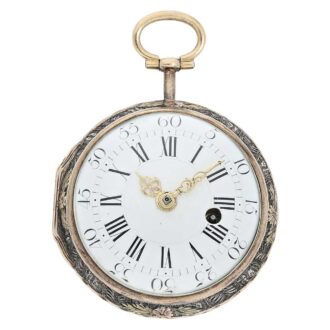
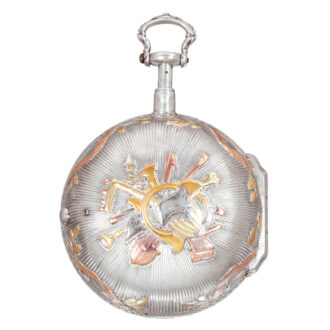
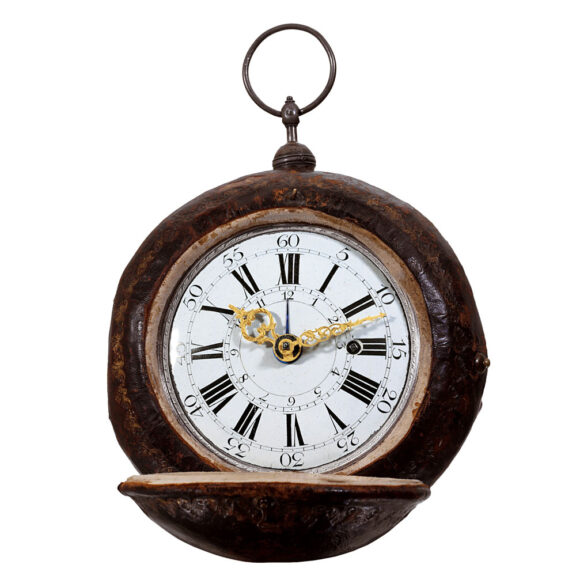
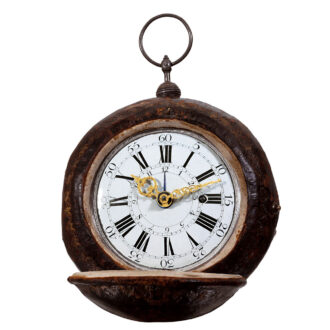
French silver striking and repeating coach clock Circa 1750
- Kenmerk
- FA0146
- Diameter
- 112 mm
- Estimate
- € 11.000 - 17.000
- Price sold
- € 12.700
Silver striking and repeating coach clock with alarm
–
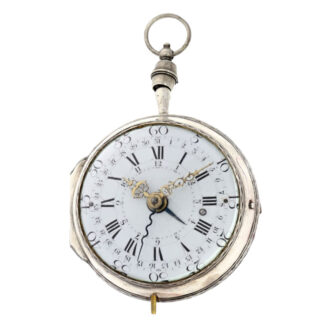
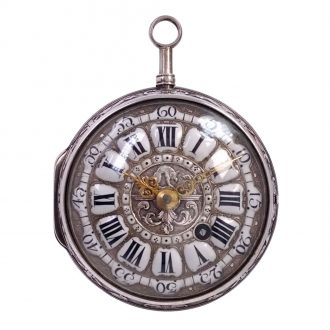
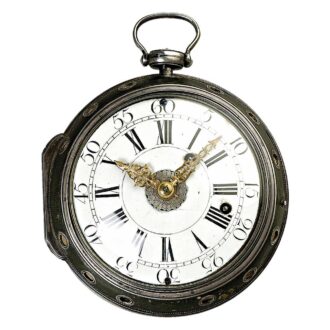
Very fine and rare French Louis XV silver and shagreen petite sonnerie striking and repeating coach watch with alarm and the original gold tooled leather-covered travelling case, circa 1750. Full plate movement, turned pillars, fusee with chain, spring barrels for the striking and alarm trains, polished steel hammers, verge escapement, three-arm brass balance, blued steel balance spring, pierced and chased foliate continental type balance cock, silvered calibrated regulator disc, striking on a bell.
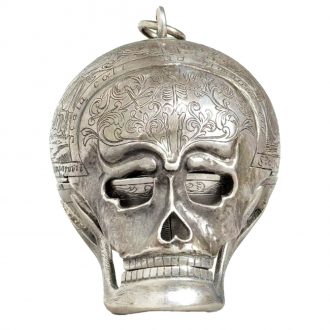
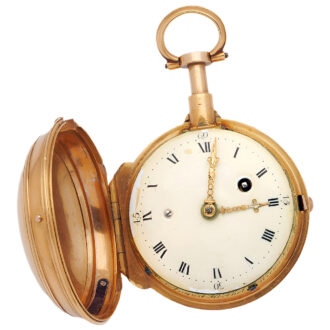
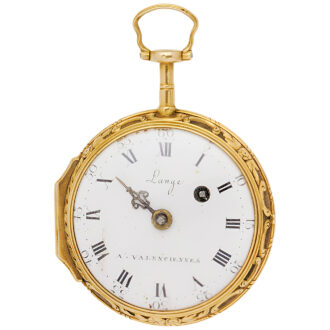
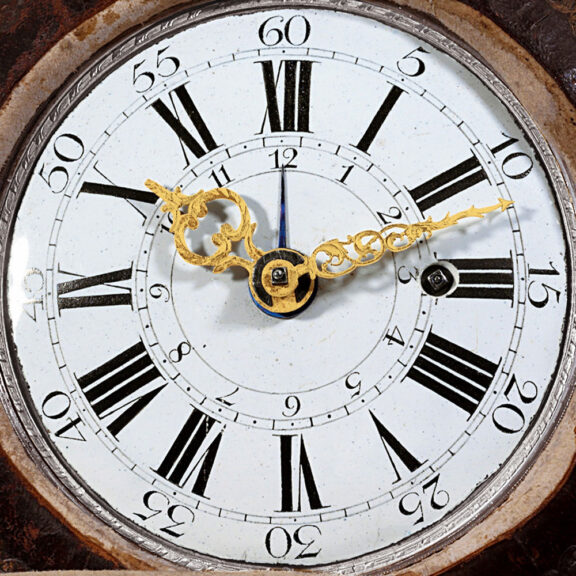
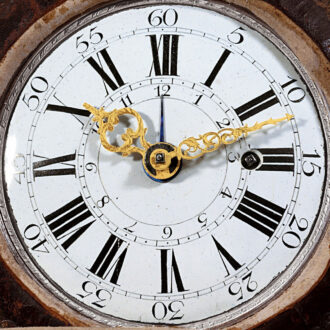
The inner case is pierced, chased and engraved with rococo flowers, scrolls and geometric patterns, a strike/stop button in the bezel, gimballed pendant. A shagreen-covered outer case with moulded bezel, decorated with pin-work, circular sound holes and a pull cord operating the pivoted sprung lever for pressing the strike/stop button on the inner case bezel. The travelling case is covered with leather, chamois lined with gold tooling, a hinged cover for viewing the dial while travelling. White enamel dial with radial Roman hours, an outer minute track with Arabic five-minute numerals, an inner Arabic alarm chapter with half-hour and quarter-hour markers and a key arbour for setting the alarm hand, gilt Louis XV hands. Movement signed.
–
Diameter: 112 mm
–
Signed: Julien Le Roy à Paris
–
It is very unusual to find a coach watch in its original travelling case, which was hinged to be opened to view the time during the journey. Julien Le Roy (1686-1759) is one of the clockmakers who contributed most to the progress and the reputation of French watch- and clockmaking. Born in Tours on August 6, 1686, he came to Paris in 1699 and was received a master in 1713. He married Jeanne Lafons and established himself in the Rue du Harlay. First member, then director of the Société des Arts, he improved almost all branches of clockmaking and many important inventions in the realm of time measurement are owed to him. In 1717, Le Roy presented an equation clock to the Royal Academy of Sciences, which showed the right time, the place of the sun and its decline. Appointed Clockmaker to the King in 1739, he had his private quarters in the Louvre.
–
His inventions concerned, among other things, turret clocks, equation clocks and pull-repeat mechanisms, which, previously hidden under the dial, were arranged on the backplate to make them more accessible and ensure easier adjustment and maintenance. He developed a double anchor escapement with dimensions suitable for making the vibrations isochronic by making the arms the same length as the wheel’s radius. However, his most important discoveries concerned watch mechanisms. The adjustable potency for the verge escape wheel considerably improved the escapement’s functioning. The steel end-piece (coqueret) allowed oil to be retained in the balance pivots to diminish frictional force, which other watchmakers quickly adopted. The inventor of dumb repeating watches, in 1740, created a new arrangement that allowed the area allotted to the repeating work to be enlarged. This invention, called ‘à bâte levée’, was also adopted by his fellow clockmakers. In 1755 he invented a small anchor escapement used as a regulator for the repeating train. He contributed to the Encyclopédie by writing several articles on clockmaking with his son Jean-Baptiste, the Academician. This watch shows many of Friedberg’s watches for other European makers.
–
Friedberg watchmakers specialized in the production of repeating and striking watches. From the beginning of the 18th century, they made watches and coach watches with a quarter, half-quarter, and even minute repeating mechanisms and sold them all over Europe. The cases, often of very high quality, were produced in Augsburg, and the movements were made in the style of the country for which they were destined. Some of them were signed by their makers, some bear signatures of eminent French and English makers (perhaps at their request, when they were retailing them), and still, others bear the signature of their makers, written backwards, together with the names of cities in which they were intended to be sold. Until the recent discovery of many ebauches, Blancs and completed movements that had never been cased and their study by serious specialists such as Sebastian Whitestone, these watches were wrongly attributed to unrecorded makers from different European countries.
Signed: Julien Le Roy à Paris
Share this page: