Fine, unique Swiss miniature watch with brooch Circa 1890
- Kenmerk
- SB0238
- Diameter
- 23 mm
- Estimate
- € 40.000 - 60.000
- Price sold
- € 49.600
Gold, enamel and diamond set hunting cased watch with brooch by Patek Philippe
–
–
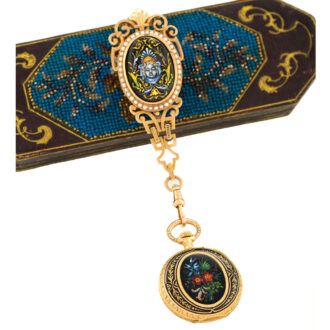
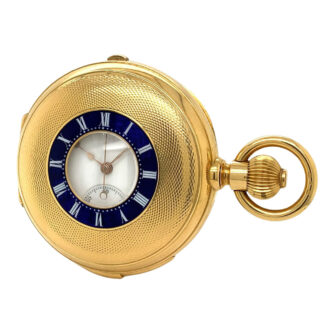
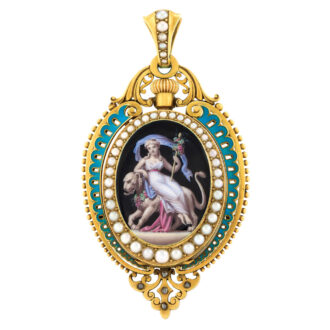
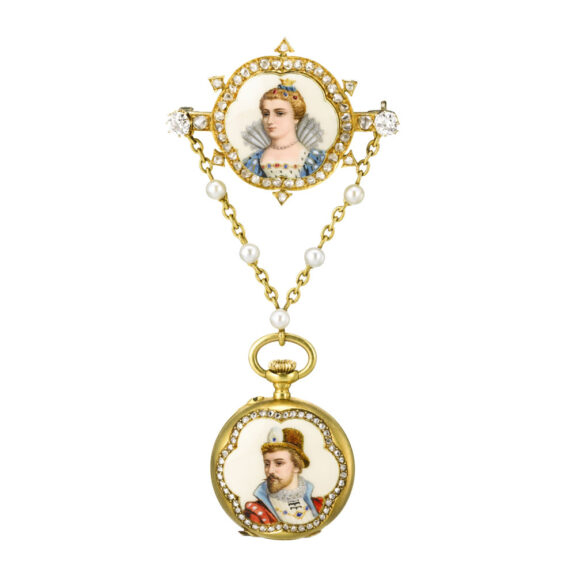
A very fine and probably unique miniature gold, enamel and diamond set hunting cased watch with brooch, circa 1890. 8”’ Manual winding jeweled cylinder movement. 18 Carat gold cuvette engraved ‘M.T. Milne Philadelphia 1892’. White enamel dial and Roman numerals. 18 Carat gold case, front cover with polychrome enamel depicting Henry I, Duke of Guise framed with rose cut diamonds. 18 Carat gold and diamond set brooch with polychrome enamel possibly depicting Duke of Guise’s mistress Margaret of France. Case, dial and movement signed. With an Extract from the Archives confirming production in 1890 and sale on June 23rd, 1892.
–
–
Diameter: 22.5 mm
–
–
Signed: Patek, Philippe & Co.
–
The enamel painting found on this miniature fob watch is of a particularly high quality for the era and undertaken by a master of the craft. Signed Theodore Z. Zasche to the sitters’ hat. The artist was a third generation enameller of exceptional quality with his work exhibited in the Geneva Museum of Art. Enameled portraits featuring Henry’s father, Francois de Guise can be found in the Louvre Gallery, Paris and of his brother Charles de Guise in the Victoria & Albert Museum, London. An almost identical fob watch made by Patek Philippe in 1890 with a portrait of King Henry II, also a miniature hunting case, No.203369, was sold in 2008. The portraits were unquestionably painted by the same artist as part of a special, select, collection of 8-10 unique examples featuring French nobility of the 16th century created by Patek Philippe circa 1890. Henry I, Duke of Guise, Prince of Joinville, Count of Eu, was born the eldest son of Francis, Duke of Guise on December 31, 1550. Henry succeeded his father as the Duke of Guise in 1563 after his father’s assassination and later became notable for his controversial love affair with Margaret of France (1553-1615) in 1570 and in 1576 founding the French Catholic League. Reputed to be a charismatic leader and adored by the Catholic people of France for his opposition to the Huguenots, he was also noted to be generous and humane. With his popularity came strong ambition to rule the throne and by cunning means he was able to reach the position of Lieutenant General of France shortly before being assassinated on December 23, 1588 by the King of France’s personal bodyguards. Margaret of France (1553 –1615) was Queen of France and of Navarre during the late sixteenth century. Margaret was famous for her beauty and sense of style (she was one of the most fashionable women of her time, influencing most of Europe’s Royal Courts with her clothing). She was also a gifted poet and writer. Margaret took many lovers both during her marriage and after her annulment. One of them was Henry I, Duke of Guise. Her life has inspired a variety of stories over the centuries, beginning with Shakespeare’s early comedy Love’s Labour’s Lost written during her lifetime, to Alexandre Dumas, 1845 novel La Reine Margot, to a 1994 movie La Reine Margot.
–
The enamel painting found on this miniature fob watch is of a particularly high quality for the era and undertaken by a master of the craft. Signed Theodore Z. Zasche to the sitters’ hat. The artist was a third generation enameller of exceptional quality with his work exhibited in the Geneva Museum of Art. Enameled portraits featuring Henry’s father, Francois de Guise can be found in the Louvre Gallery, Paris and of his brother Charles de Guise in the Victoria & Albert Museum, London. An almost identical fob watch made by Patek Philippe in 1890 with a portrait of King Henry II, also a miniature hunting case, No.203369, was sold in 2008. The portraits were unquestionably painted by the same artist as part of a special, select, collection of 8-10 unique examples featuring French nobility of the 16th century created by Patek Philippe circa 1890. Henry I, Duke of Guise, Prince of Joinville, Count of Eu, was born the eldest son of Francis, Duke of Guise on December 31, 1550. Henry succeeded his father as the Duke of Guise in 1563 after his father’s assassination and later became notable for his controversial love affair with Margaret of France (1553-1615) in 1570 and in 1576 founding the French Catholic League. Reputed to be a charismatic leader and adored by the Catholic people of France for his opposition to the Huguenots, he was also noted to be generous and humane. With his popularity came strong ambition to rule the throne and by cunning means he was able to reach the position of Lieutenant General of France shortly before being assassinated on December 23, 1588 by the King of France’s personal bodyguards. Margaret of France (1553 –1615) was Queen of France and of Navarre during the late sixteenth century. Margaret was famous for her beauty and sense of style (she was one of the most fashionable women of her time, influencing most of Europe’s Royal Courts with her clothing). She was also a gifted poet and writer. Margaret took many lovers both during her marriage and after her annulment. One of them was Henry I, Duke of Guise. Her life has inspired a variety of stories over the centuries, beginning with Shakespeare’s early comedy Love’s Labour’s Lost written during her lifetime, to Alexandre Dumas, 1845 novel La Reine Margot, to a 1994 movie La Reine Margot.
Signed: Patek, Philippe & Co.
Share this page: