Rare English deck chronometer watch in mahogany box Circa 1785
- Kenmerk
- AD1682
- Diameter
- -
- Estimate
- € 15.000 - 22.500
- Price sold
- € 16.800
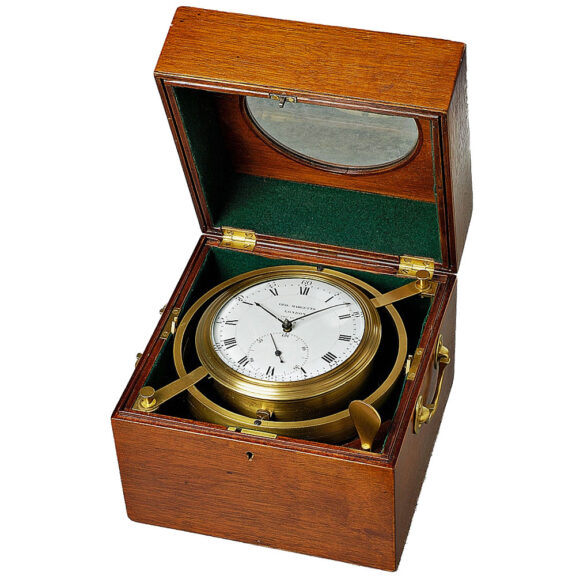
Brass ship’s chronometer by George Margetts
–
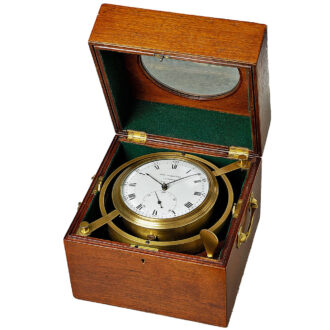
A remarkable, very rare and early English ship’s chronometer, circa 1785.
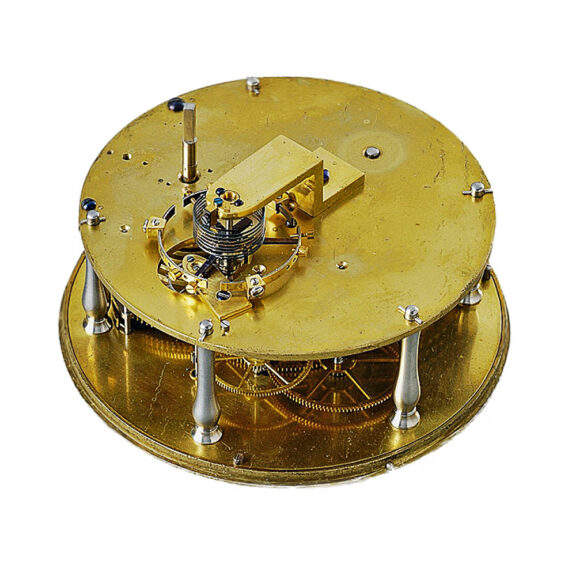
The case is a mahogany box with brass inlays and hinged handles. The enamel signed dial has Roman radial hours, outer minutes track with Arabic five minutes numerals, subsidiary dial for the seconds, and spade hands. And the movement is a brass movement with chain/fusee with maintaining power, spring detent escapement according to Thomas Earnshaw, three-arm bimetallic chronometer balance with three weights and six screws, and free-sprung blued helical balance spring with terminal curves.
–
Signed: George Margetts, London, Invt. et Fecit
–
George Margetts (1748-1804)
George Margetts was born on June 17, 1748, in Woodstock in Oxfordshire. On October 11, 1779, he was freed from the Clockmakers’ Company and able to have his own business at 21 King Street in Cheapside.
He later moved to no. 3 Cheapside around the turn of the century. He specialised in fine astronomical watches. However, he seemed to have run into financial problems at some point because, in 1788, the Morning Chronicle reported his bankruptcy.
In 1789 Margetts presented a design for a detached pendulum to the Board of Londitude, but he did not receive the support he hoped for. Nevertheless, he continued his research on longitude and soon presented a longitude table to the Board. His petition for the pendulum still exists and gives us some insight into Margetts work. He fitted the gridiron pendulum in a way intended to provide the astronomer with the possibility to adjust the expansion or contraction of the pendulum; this was meant to counteract the effects of heat, cold, moisture or atmospheric pressure.
The tables Margetts presented to the Board of Longitude in August 1789 were published in the same year and came with “a logarithmic rotula invented by the author for making decimal and sexagesimal proportions…..which will greatly facilitate the various calculations necessary to be made in every branch of Mathematics and Astronomy and navigation”. However, although Margetts seemed to have been a very active maker, he did not prosper; in 1789, he also lost money in the Indian trade. On October 7, 1799, Margetts was elected to the livery of the Clockmakers’Company. He died on December 27, 1804.
Signed: George Margetts, London
Share this page: