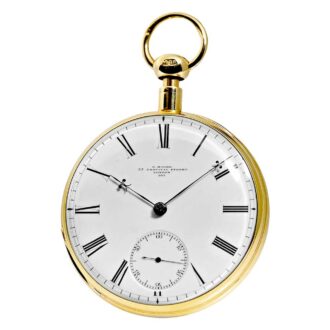
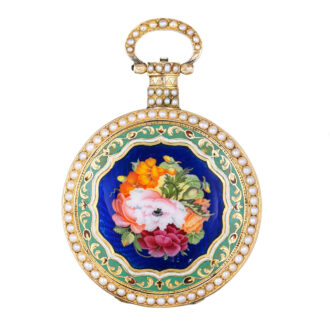
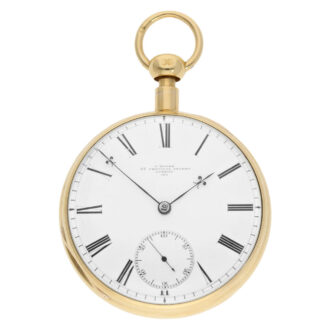
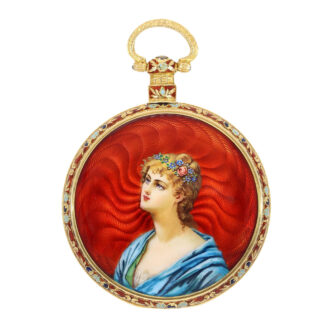
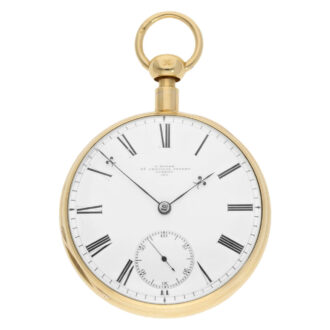
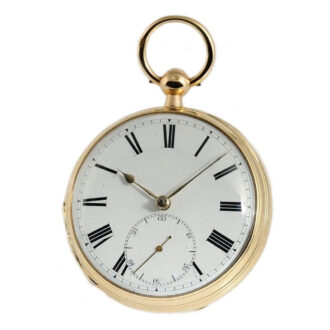
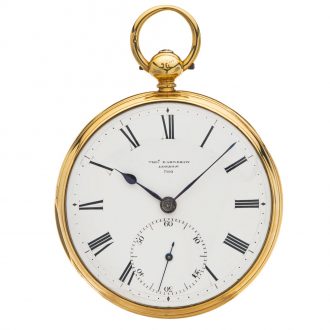
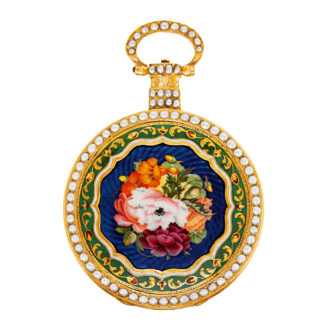
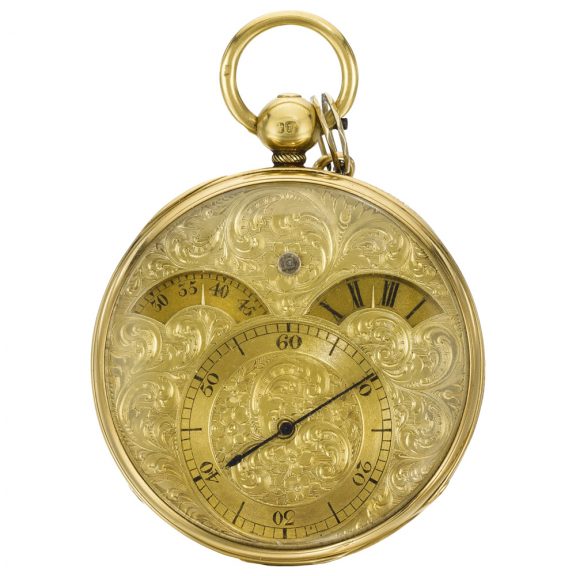
English split-seconds chronograph watch with chain Circa 1840
- Kenmerk
- AS1673
- Diameter
- 52 mm
- Estimate
- € 11.000 - 20.000
- Price sold
- € 10.250
Gold watch with wandering dial by Thomas Prest
–
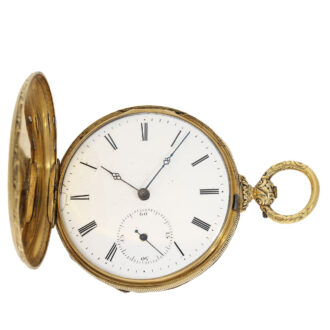
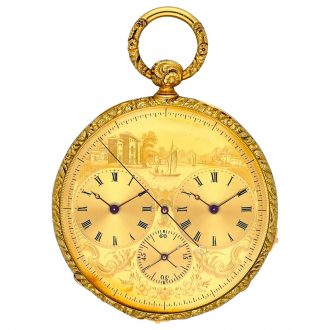
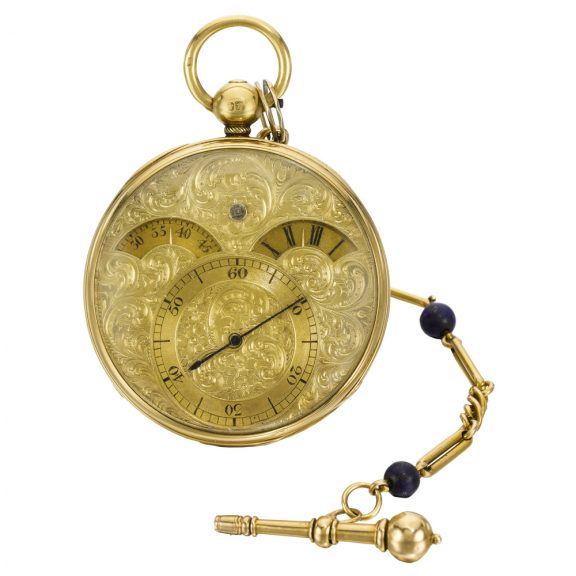
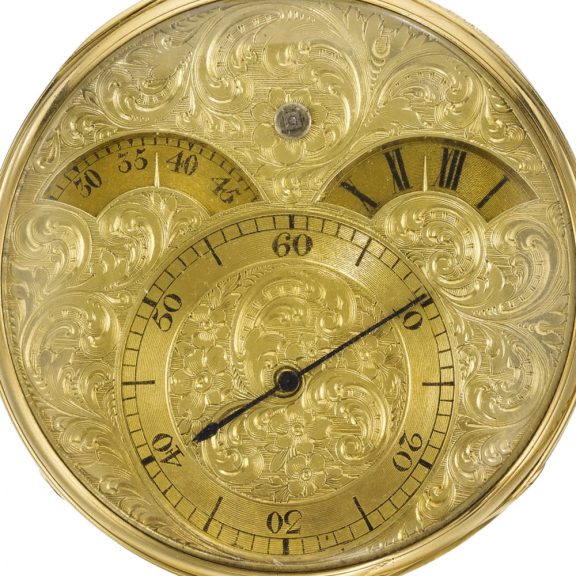
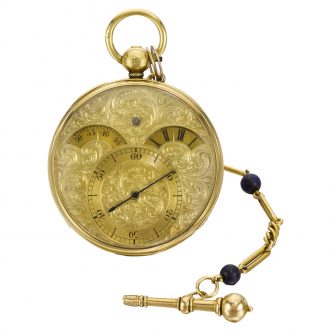
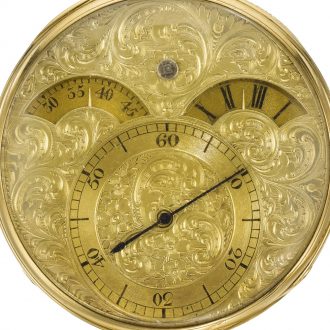
An exceptional and very rare English gold open faced split-second chronograph watch with apertures for hours and minutes, circa 1840. Accompanied by a gold and lapis lazuli chain and key. This timepiece features a gilded full plate key-wound movement with a bimetallic compensation balance, diamond endstone, and a visible chronograph mechanism under the dial. The movement also includes a recessed barrel pivoted around the fourth wheel seconds pivot and a spiral spring surmounted by a second hand. It is signed and numbered by Tho. Prest London. The watch has a gilt dial with engraved scroll and foliage decoration, along with two fan-shaped apertures for the wandering Arabic minutes and Roman hours. It also includes a large subsidiary seconds dial with two blued steel-splitting hands.
–
The engine-turned case has a pusher through the crown to split the second hands, and a movement stop slide beneath the bezel. It is hallmarked London 1840, with a plain polished gold cuvette. The case back and cuvette bear the case maker’s mark HH incuse (possibly Henry Hardy). It comes with a short gold chain, with links separated by lapis lazuli roundels terminating in a key in the form of a T-bar.
–
Diameter: 51.5 mm
–
Signed: Thomas Prest, London
–
The movement is functioning, with the split function in working order. There is a slight discoloration beneath the signature on the plate and some light oxidation on the blued elements. The case shows some wear, with light surface scratches throughout. The engine turning exhibits some rubbing on the band and case back, which is expected due to the age and use of the watch. There are marks on the inside case back and cuvette, but they are clear and well-defined. The hallmarks also show some rubbing. The engraving on the dial is very crisp and defined. The engine turning on the seconds ring has some marks, but overall the condition is very good.
–
Thomas Prest was apprenticed to John Roger Arnold in January 1784 and later became his foreman. Around 1820, he started his own business. Prest is best known for patent no. 4501, granted on October 20, 1820, for an early form of keyless winding system. According to an article in Antiquarian Horology (No. 5, Vol. 24, Spring 1999, p. 447) by Paul Tuck, Prest was also one of the first to devise a form of split-seconds chronograph mechanism. Only a few of these are known to exist, with no. 527 being considered the finest example. There is speculation that Prest may have worked for Breguet early in his career due to the refinement of his work. The watch he created demonstrates his skill and creativity, particularly with its unique split-second mechanism. When the pusher in the pendant is depressed, the seconds hands within the large subsidiary dial split, with one stopping while the other continues to run. Releasing the pusher causes the static second hand to fly back and join the running hand. The watch can measure a difference of 25 seconds before a mechanism prevents the spring from being overwound.
Signed: Thomas Prest, London
Share this page: