Rare Swiss 18 Carat gold observatory pocket chronometer Circa 1913
- Kenmerk
- AA0360
- Diameter
- 50 mm
- Estimate
- € 9.000 - 15.000
- Price sold
- -
Gold pocket chronometer watch by Patek Philippe
–
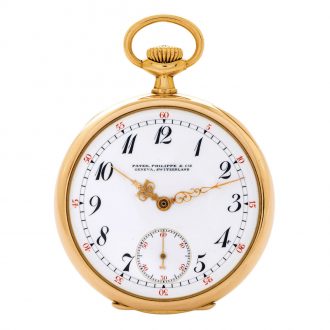
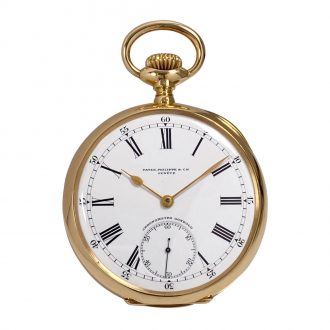
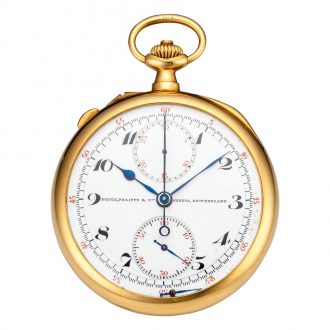
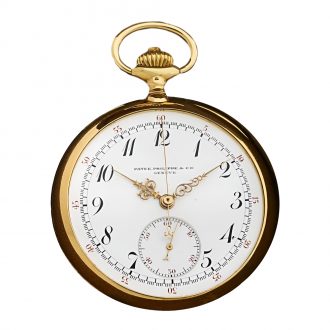
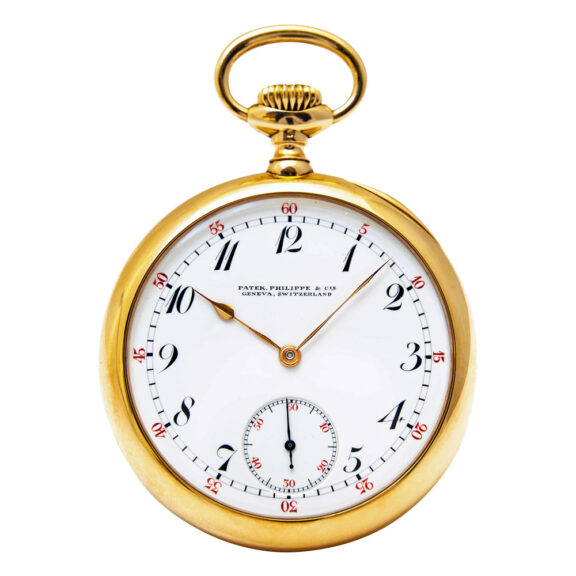
A very fine and rare Swiss keyless winding pocket watch chronometer, a so called observatory chronometer, circa 1913.
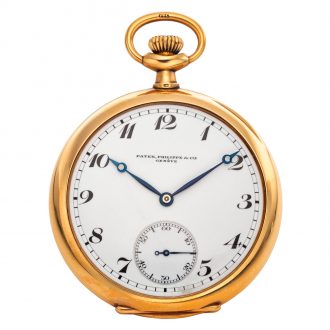
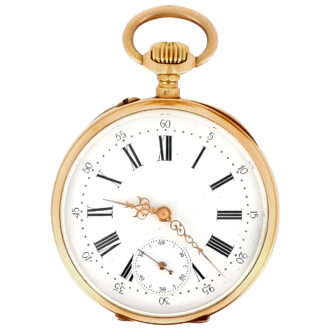
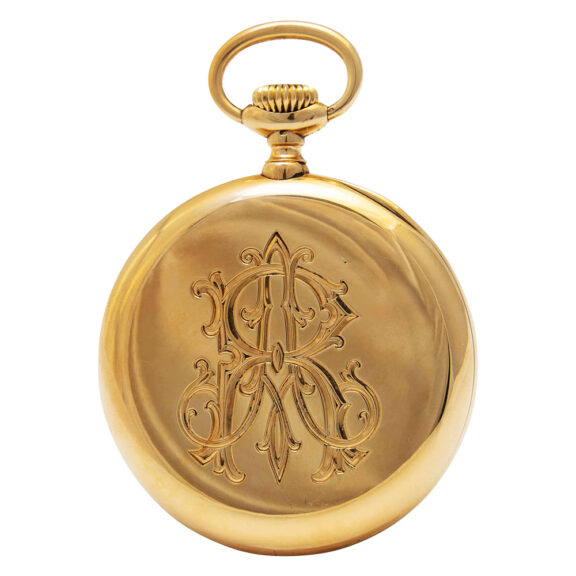
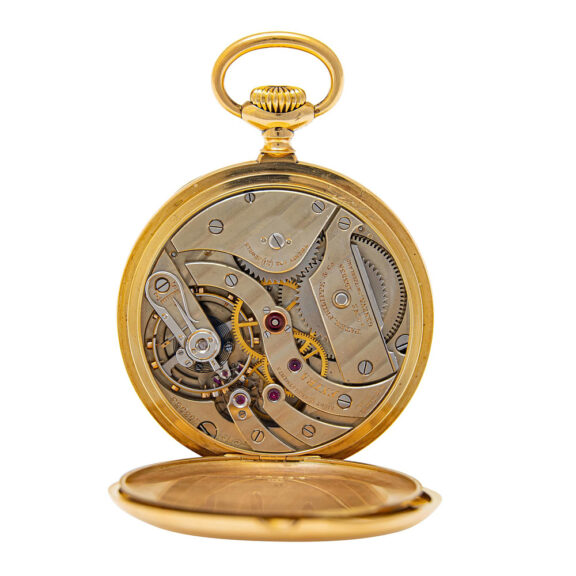
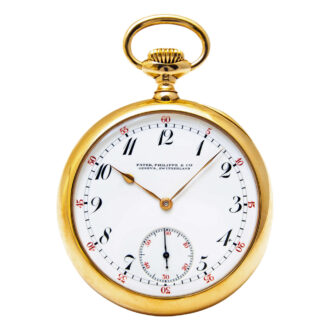
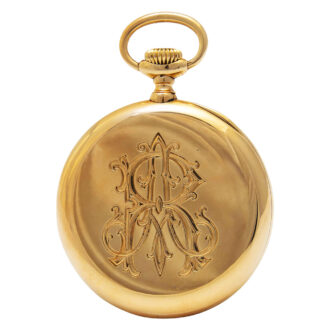
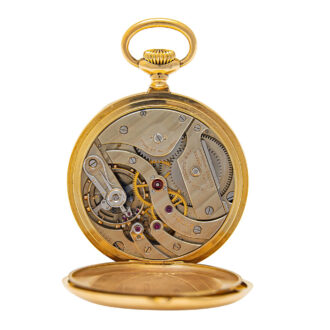
Polished 18 Carat yellow gold round-shaped case. Case back engraved in taille douce (fine cut) with the cypher A R. Cuvette (dome) engraved with the name of the original owner Armand Rolloy. Enamel dial with Breguet style radial hours, outer minutes track with red five minutes numerals, subsidiary dial for the seconds, and gold pear hands. Extra quality movement, brass Invar Guillaume balance with gold and platinum poising screws, blued steel hairspring with a terminal curve, diamond end stone, index regulator with swan neck spring, and micrometric screw, adjusted by Charles Batifolier (1867-1924). Dial, case and movement signed.
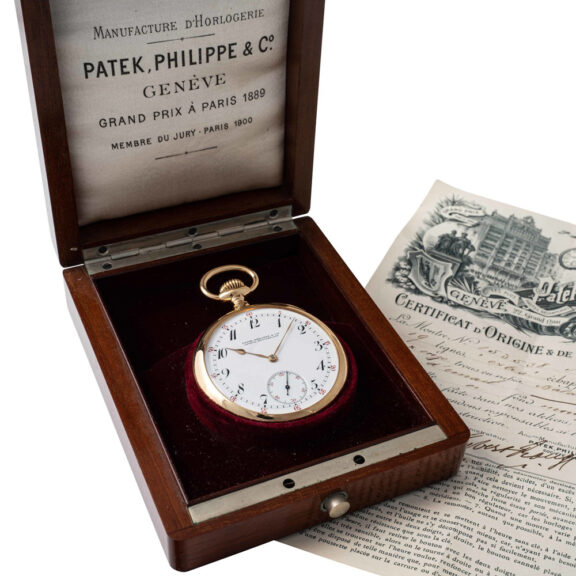
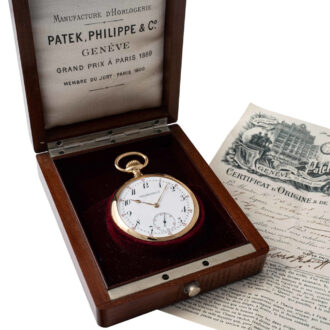
Accompanied by the original fitted box, a copy of the Bulletin de Marche of the Astronomical Observatory of Geneva (dated November 9, 1993), the Extract from the Archives, and a certificate of origin that mentioned this watch was sold on November 7, 1913.
–
Diameter: 50 mm
–
Signed: Patek Philippe & Cie, Geneva Switzerland
–
The movement is based on the French invention patent No. 142 376, delivered on April 16, 1881, to Jean-Adrien Philippe (1815-1894), Geneva, for a régulateur de precision (precision regulating device for fast/slow using an eccentric snail). It is also based on the Swiss invention patent No. 2 680, delivered on September 27 1890, to Patek, Philippe & Cie, Geneva, for a Remontoir avec mise à l’heure perfectionné (the definitive version of the keyless winding and setting device), and, on the US design patent No. 20 483, delivered on January 13, 1891, to Adrien Philippe, Geneva, for a “Watch bridges for Watch-Movements”.
–
Patek Philippe and the Observatory
When destined for Observatory Timing Contests, the movements of Patek Philippe watches, like those of other makers, were double engraved with the movement serial Numbers.
The inscription “Extra” on the bridge of the movement refers to the high finishing of all the parts of the movement. This movement, of the highest quality for a watch without horological complications, is fitted with a precision Guillaume balance, with gold and platinum poising screws, and has been tested in eight positions. It has a diamond endstone and a patented micrometric regulator.
Observatory
At the timing contest organised in 1911-1912 at the Astronomical Observatory of Geneva, this Chronometer was awarded a First Class Bulletin, with a mention of Second prize.
It was ranked 11 out of 102, with 787 points on a possible total of 1000 (classified with more than 600 marks).
The first obtained 866 points, and the last classified 600 points.
Patek Philippe and Chronometry
The first-rate watch trials at the Geneva Observatory were carried out as early as 1790 and 1792, but until 1873, they were sporadic affairs and of no significance. Towards the second half of the 19th century, it was realised that adopting its own internationally recognised testing standard could positively influence the Canton of Geneva watch industry. And so, in 1873, the first annual Chronometer competition at the Geneva Observatory was organised.
According to Huber & Banbery (1993, p. 85), the archives reveal Patek Philippe & and 230.14 marks, respectively.
Between 1897 and 1899, for four years, Patek Philippe refused to participate in the timing contest.
Between 1900 and 1939, the firm took 764 prizes for results achieved at the Geneva Observatory, of which 187 were first places. This represented over half of the total number of distinctions awarded.
Signed: Patek Philippe & Cie, Geneva Switzerland
Share this page: