Repeating chronograph for the Indian market Circa 1890
- Kenmerk
- SB0539
- Diameter
- 54 mm
- Estimate
- € 35.000 - 70.000
- Price sold
- € 71.000
Rare, fine minute repeating full hunter chronograph with the portrait of a maharajah
–
–
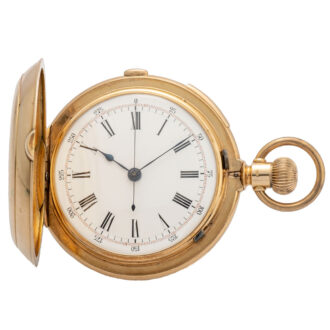
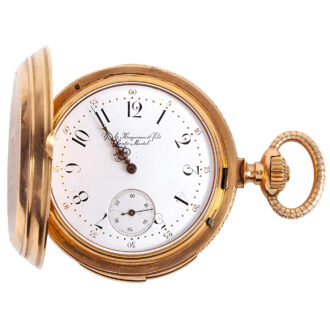
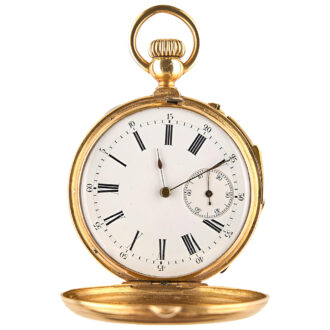
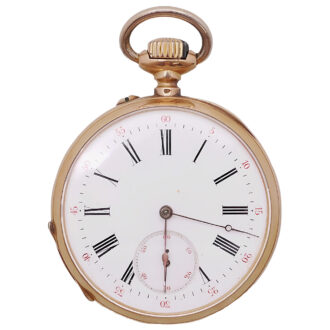
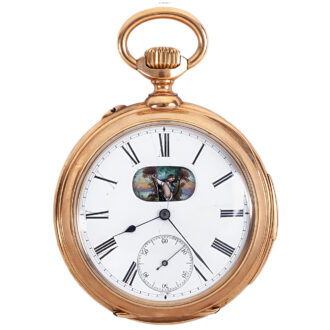
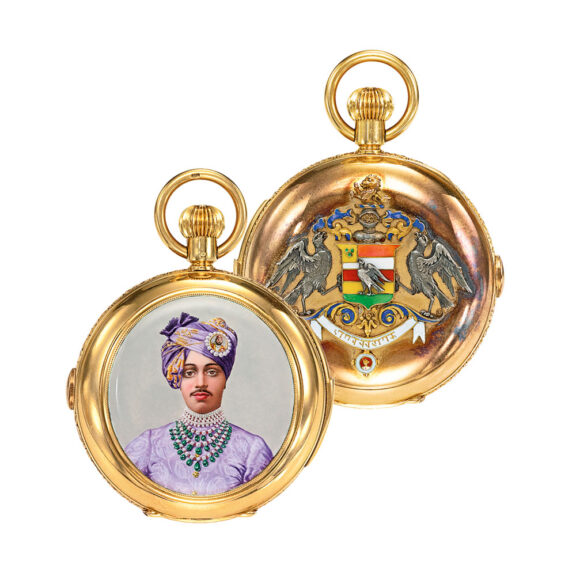
A rare and fine Swiss 18 carat gold and enamel hunting cased minute repeater chronograph watch with the portrait of a maharajah made for the Indian market in the manner of J. Graff, circa 1890. Gilt lever movement, bimetallic compensation balance, slide repeat, two hammers repeating on gongs, the back plate with polished steel chronograph work, glazed and gold cuvettes, the gold cuvette engraved specially made for H.H. The Maharaja Sirdar Singhyi Saheb Bahadur of Jodhpur. White enamel dial, Roman numerals, subsidiary dials indicating constant seconds at 6 o’clock and 30 minute register at 12 o’clock. The front cover finely painted with a portrait of the Maharajah resplendent in lilac dress completed by a multi strand emerald, ruby and pearl necklace, his matching turban pinned with a miniature portrait of an image of another Maharajah, the reverse applied with vari color gold and enamel armorial centered by a state flag of Jodhpur.
–
Diameter: 54 mm
–
Signed: No name
–
The portrait on the present watch is that of Maharajah Sardar Singh (1880-1911) who became ruler of Jodhpur at the age of fifteen. Sardar Singh visited Europe in 1901 and is known for his involvement in extending the railway from Jodhpur to Hyderabad.It is interesting to note that the portrait featured in the brooch pinned to Maharajah Sardar Singh’s turban is likely that of Jaswant Singh II of Jodhpur (1873–1896) whom he succeeded as Maharajah of Jodhpur in 1896.
–
Watches made for the Indian market, known as ‘Maharaja watches’, frequently made use of photographs sent from Indian dignitaries so that artists in Geneva could render the portraits in enamel. Of the half dozen most esteemed artists specializing in this work, John Graff (1836-1902), rose to the top of his field.
–
These subjects presented a particular challenge to enamellers, as the color schemes favored by the subjects’ dress were so vivid that work by less talented Western artists appeared gaudy. Graff’s portraits, however, are a testament to his understanding of color, and portray the dignitaries in their intended grandeur. Furthermore, the portraits were done using often blurry photographs sent from India as the basis, rather than seeing the subject first hand or working from a clear likeness.
–
For further discussion of ‘Maharaja watches’ and Swiss watch trade in India, see E. Jaquet, & A. Chapuis, Technique and History of the Swiss Watch, pp. 100 and 128-9, and illustrations on pl. 133.
Diameter: 54 mm
–
Signed: No name
–
The portrait on the present watch is that of Maharajah Sardar Singh (1880-1911) who became ruler of Jodhpur at the age of fifteen. Sardar Singh visited Europe in 1901 and is known for his involvement in extending the railway from Jodhpur to Hyderabad.It is interesting to note that the portrait featured in the brooch pinned to Maharajah Sardar Singh’s turban is likely that of Jaswant Singh II of Jodhpur (1873–1896) whom he succeeded as Maharajah of Jodhpur in 1896.
–
Watches made for the Indian market, known as ‘Maharaja watches’, frequently made use of photographs sent from Indian dignitaries so that artists in Geneva could render the portraits in enamel. Of the half dozen most esteemed artists specializing in this work, John Graff (1836-1902), rose to the top of his field.
–
These subjects presented a particular challenge to enamellers, as the color schemes favored by the subjects’ dress were so vivid that work by less talented Western artists appeared gaudy. Graff’s portraits, however, are a testament to his understanding of color, and portray the dignitaries in their intended grandeur. Furthermore, the portraits were done using often blurry photographs sent from India as the basis, rather than seeing the subject first hand or working from a clear likeness.
–
For further discussion of ‘Maharaja watches’ and Swiss watch trade in India, see E. Jaquet, & A. Chapuis, Technique and History of the Swiss Watch, pp. 100 and 128-9, and illustrations on pl. 133.
Share this page: