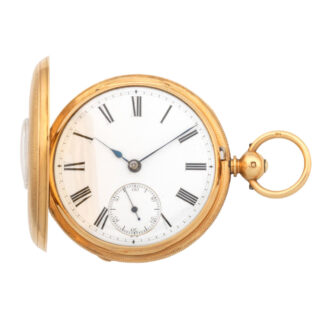
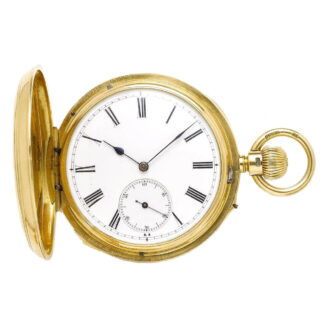
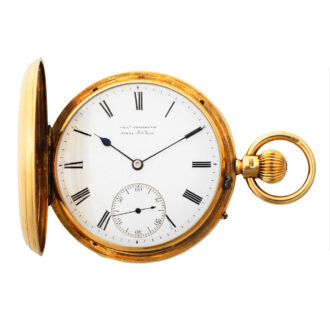
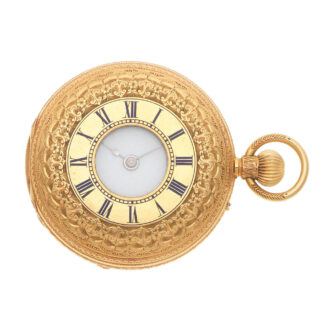
English very fine gold perpetual calendar watch Circa 1877
- Kenmerk
- SA9474
- Diameter
- 56 mm
- Estimate
- € 9.000 - 17.500
- Price sold
- -
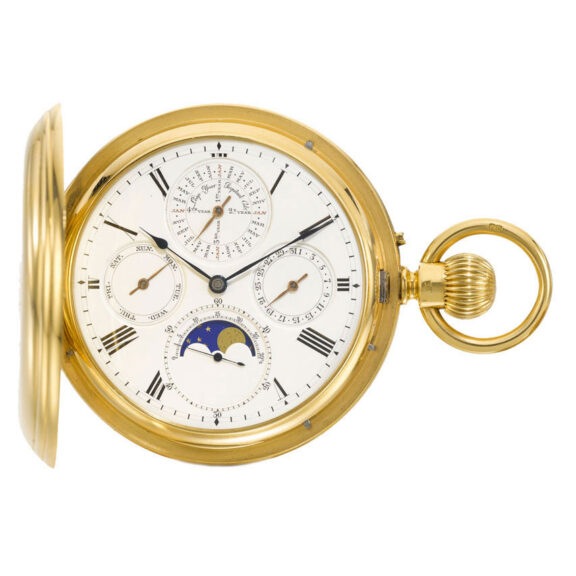
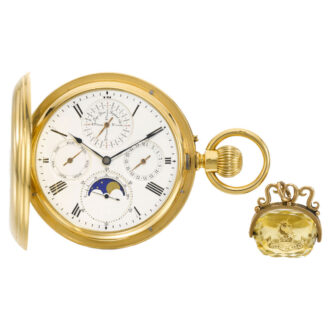
Gold hunting cased lever perpetual calendar watch with moon-phases
–
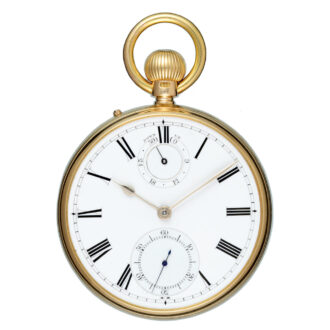
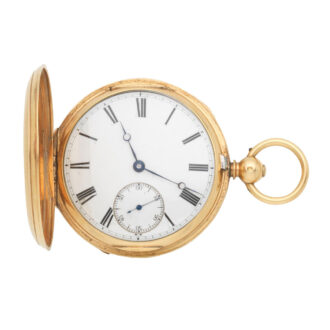
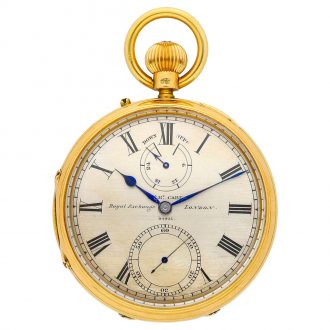
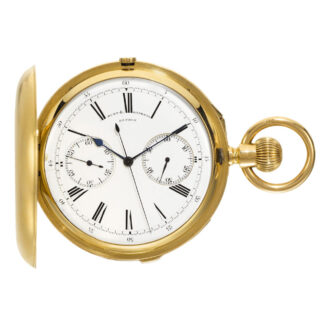
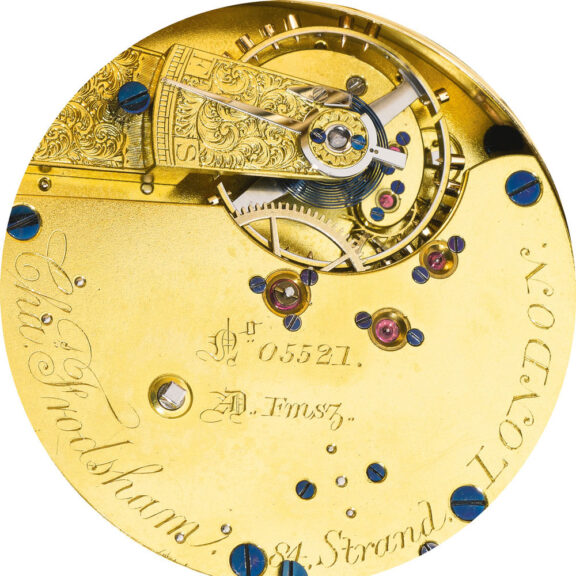
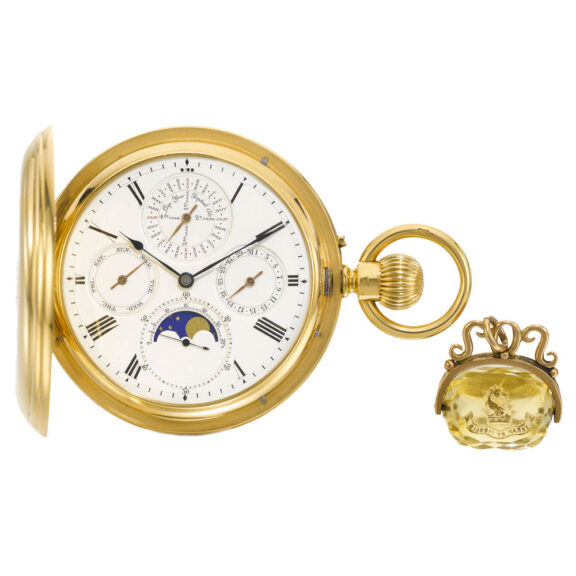
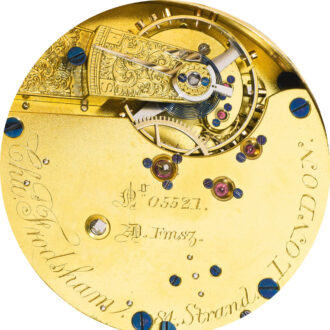
An English very fine and heavy gold hunting cased keyless lever perpetual calendar watch with moon phases, circa 1877, gilded frosted three quarter plate movement, ratchet tooth lever escapement, bi metallic compensation balance, diamond endstone, signed Chas. Frodsham, 84 Strand, London.
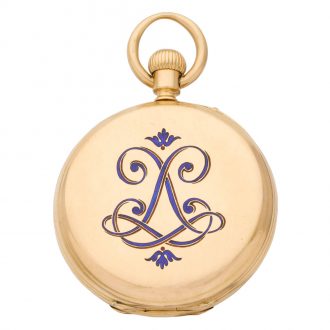
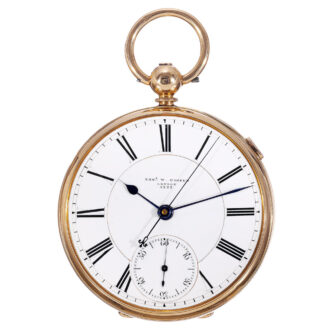
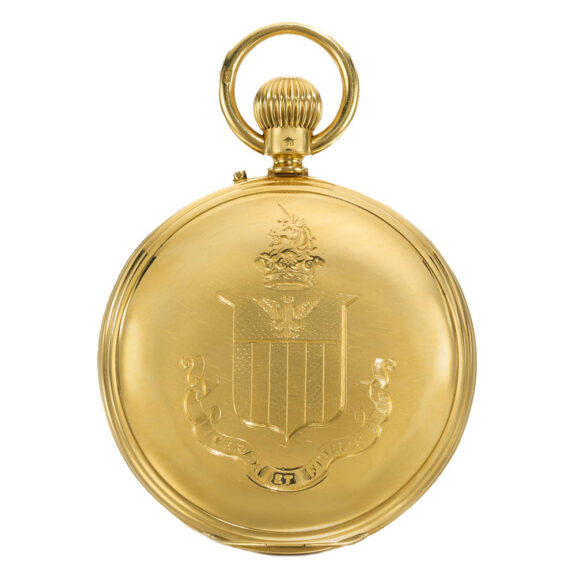
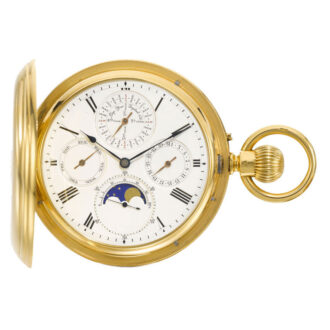
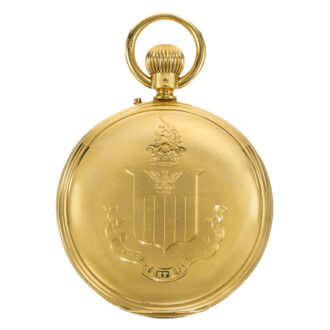
White enamel dial, Roman numerals, four subsidiary dials for months/leap year indication, date, day, and subsidiary seconds combined with aperture for moon phases, outer minute ring, blued steel spade hour, minute and seconds hands, gold hands for calendar indications. Gold case with polished covers and double stepped bezels, the front with the arms and crest of J. Court, Staveley, 4 adjusters beneath the inner bezel for calendar/moon adjustment, gold handset button with olivette to the band, polished gold cuvette engraved J. Court, Staveley, case and cuvette hallmarked for 18 carat gold, London 1877 and with maker’s mark AS for Alfred Stram. With a 9 carat gold mounted citrine seal engraved with the Court crest.
–
Diameter 56 mm
–
Signed: Chas. Frodsham 84 Strand London
–
Accompanied by a Charles Frodsham Certificate of Origin confirming that the movement of this watch was supplied by Garnish on 20th August 1877.
–
An extremely handsome perpetual calendar watch, this is an impressive, heavy and tactile watch. The design of the dial is wonderfully clear with each month of the 4-year perpetual calendar cycle individually calibrated and further substantial subsidiary dials for day, date, and subsidiary seconds with separate arc for moon age.
–
In 1843, Charles Frodsham bought the firm J.R. Arnold, renaming the business Arnold and Frodsham. This was a bold move as it set him up at 84 Strand. He retained the double name until 1858 when the firm Charles Frodsham, 84 Strand, was officially established. Through his many publications and timepieces, Frodsham dedicated himself to the exploration and improvement of timekeeping in its many forms, achieving acclaim for his work from chronometers to barometers. The Frodsham balance, which was designed for phenomenal accuracy, can be found in carriage clocks and some mantel clocks dating to as early as 1851. Frodsham became free of the Clockmakers’ Company in 1845 and Master of the Company in 1855. He served as Master of the Company for the second time in 1862, that same year he was elected Vice-President of the British Horological Institute, of which he was one of the original members. In 1855 he won the Gold Medal of Honour at the Paris Exhibition. In 1862 he was awarded the Medal of Honour for his service as a juror at the Great International Exhibition in South Kensington. He continued to achieve recognition at exhibitions from Russia to Paris. Charles Frodsham excelled at his art until his death in January 1871, at the age of 60. Upon Charles’s death, his son, Harrison Mill Frodsham, took charge of the firm and incorporated it in 1893 as Charles Frodsham and Co. Ltd. Harrison Mill Frodsham proved to be an able horologist and businessman and the firm continued to flourish as a maker of fine timepieces.
Signed: Chas. Frodsham 84 Strand London
Share this page: