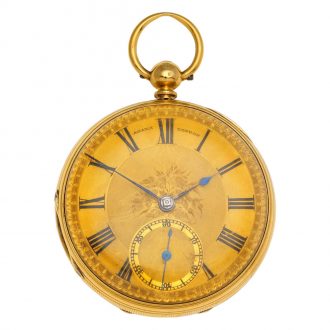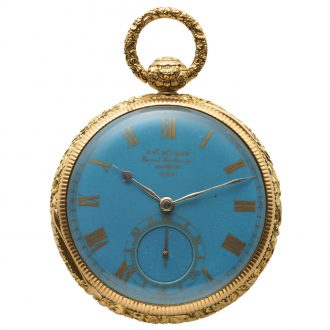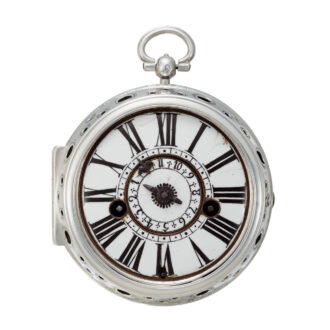
Magnificent English gold watch for the Chinese market Circa 1820
- Kenmerk
- TA4537
- Diameter
- 57 mm
- Estimate
- € 100.000 - 200.000
- Price sold
- € 222.500
Gold and enamel duplex pocket watch
–
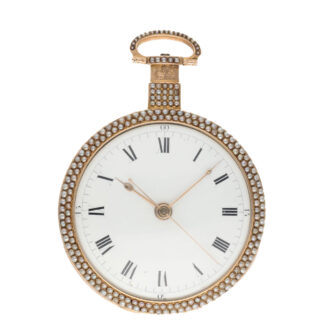
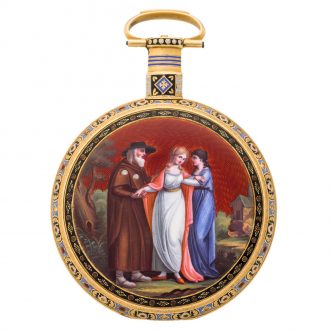
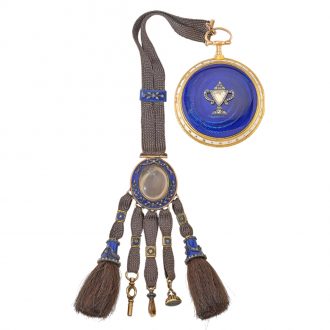
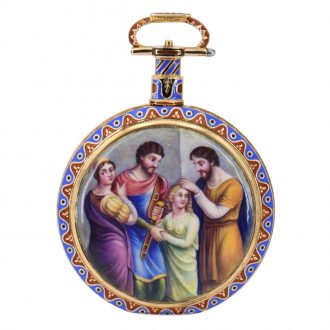
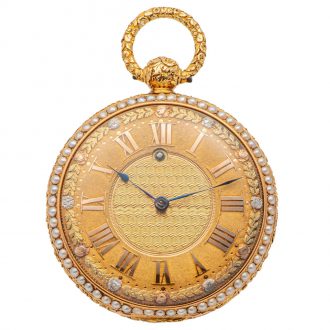
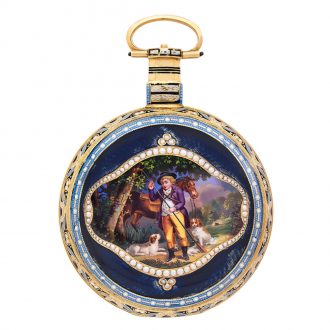
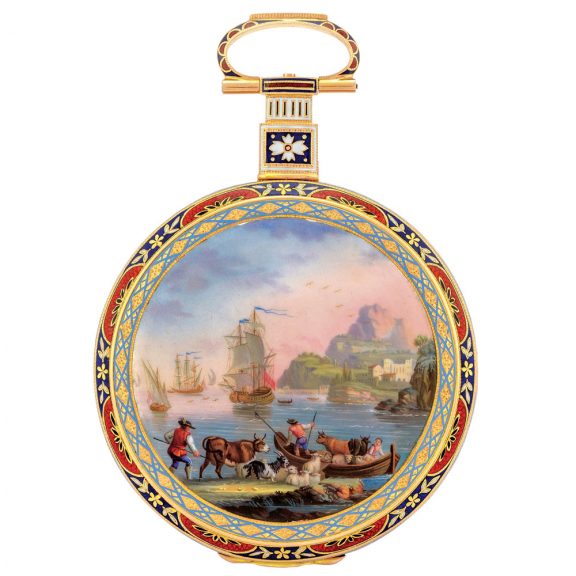
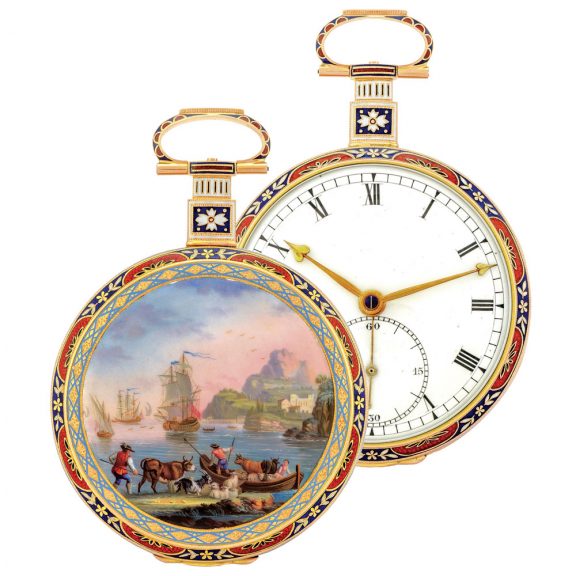
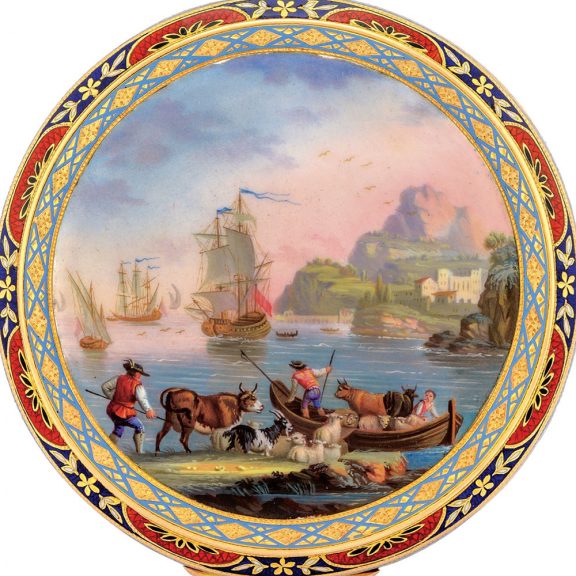
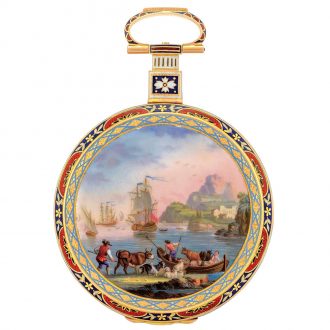
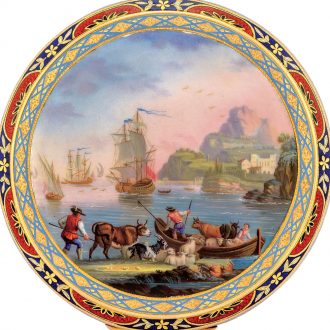
A magnificent English 18k gold pocket watch with champlevé and painted enamel, made for the Chinese market, circa 1820. The enamel is in the manner of Claude Vernet (1714–1789) and attributed to Jean-Louis Richter (1766–1841) of Geneva.
–
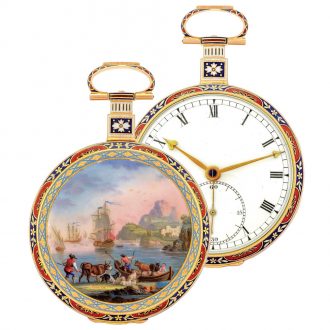
The Empire case has a hinged back cover with a very finely painted enamel scene: drovers with sheep and cattle in a boat. Behind them lies a calm harbour with ships, and mountains in the distance.
The bezel, border, band, pendant and bow have repeating patterns in red, blue and white champlevé enamel. The serpentine edges on the inside of the covers are decorated the same way. The hinged, sprung gold cuvette is attached to the movement ring and has a geometric pattern in blue and white champlevé enamel.
–
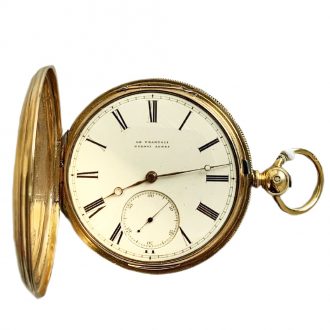
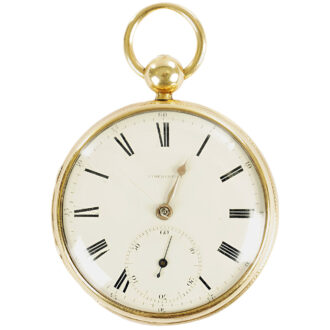
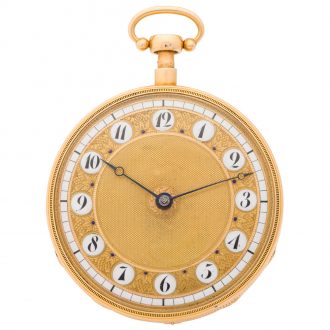
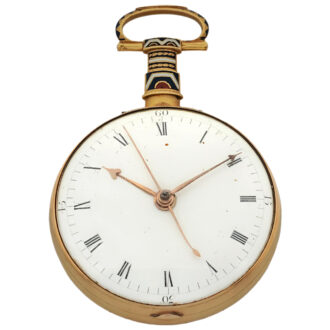
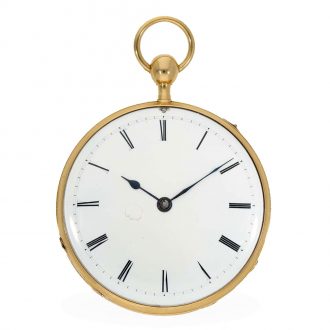
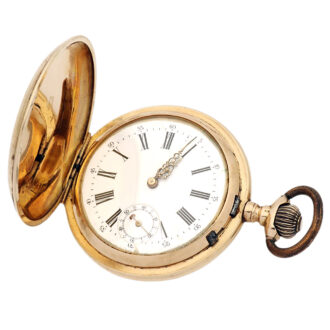
The white enamel dial has radial Roman numerals, an outer minute track, large small seconds and gold heart-shaped hands.
–
The frosted gilt movement is finely engraved with foliage. It has a standing barrel, a duplex escapement, a large polished steel five-arm balance with a flat rim, and an index regulator.
–
The movement is signed. The case has partial English hallmarks for 18k gold.
–
Diameter: 57 mm
–
Signed: Ilbery London
–
William Ilbery 1760–1839
worked in London from 1780, first in Goswell Street and then, towards the end of the 18th century, in Duncan Terrace. Following James Cox in London and Jaquet-Droz in Switzerland, he specialised in luxury watches for the Chinese market.
–
His early watches were very English in style, with a full-plate movement and an English single-wheel duplex escapement. His finest watches had a spring detent escapement instead. His later movements drew heavily on the Lépine calibre, with a free-standing barrel. This was also true of the Swiss-made watches that Jaquet-Droz signed with a London address, and of the work of the London maker William Anthony.
The finest Genevan enamellers decorated his cases. They included Jean-François-Victor Dupont, who usually signed his work, and Jean-Louis Richter, who rarely did. Ilbery also had richly engraved movements for the Asian market made in Switzerland, mainly in Fleurier. Makers such as Bovet and Juvet, also based in Fleurier in the Val de Travers, later followed his example. Ilbery can therefore be seen as one of the most typical makers of “Chinese” watches.
–
He seems to have had close links with the trade on the Continent. A watch signed “Ilbery Paris” is known, and Ilbery & Son are recorded in London and Fleurier as well as in Canton.
Signed: Ilbery London
Share this page: