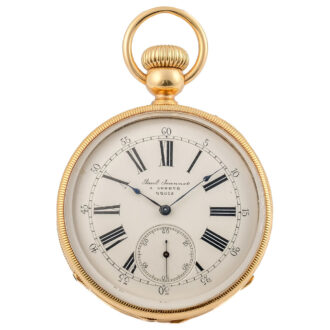
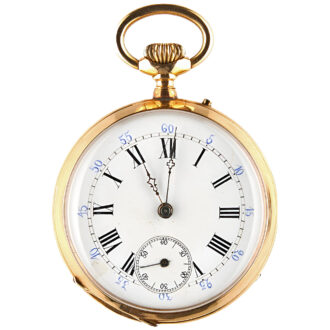
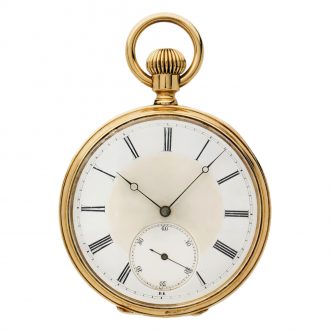
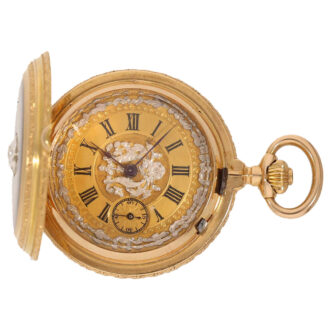
Swiss gold one minute tourbillon chronometer Circa 1880
- Kenmerk
- TA5198
- Diameter
- 57 mm
- Estimate
- € 25.000 - 50.000
- Price sold
- € 49.900
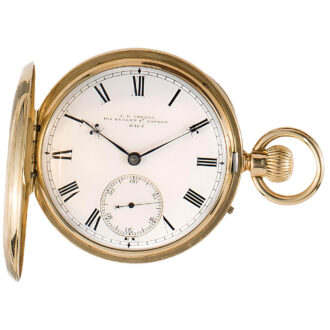
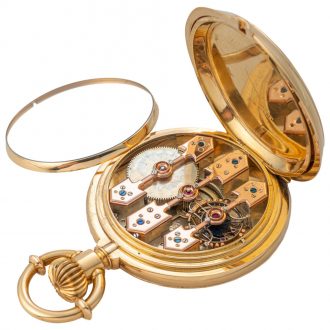
Gold full hunter with pivoted detent chronometer escapement
–
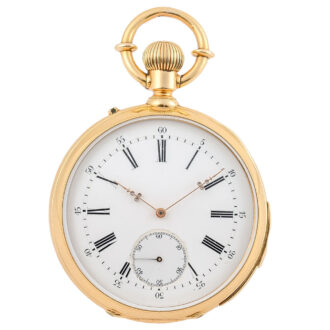
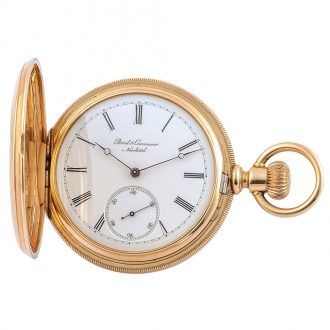
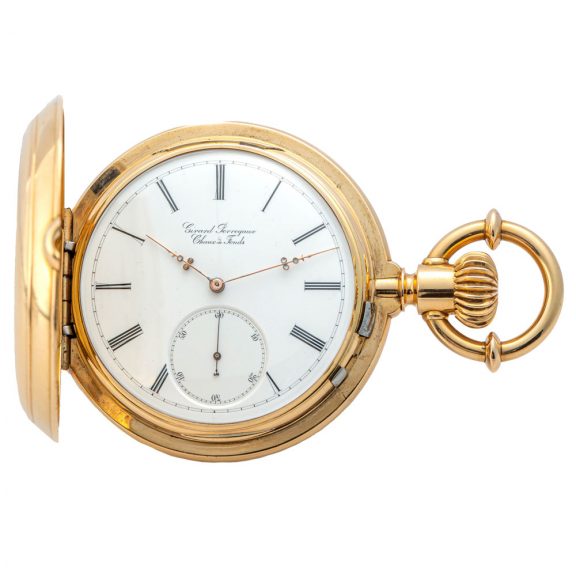
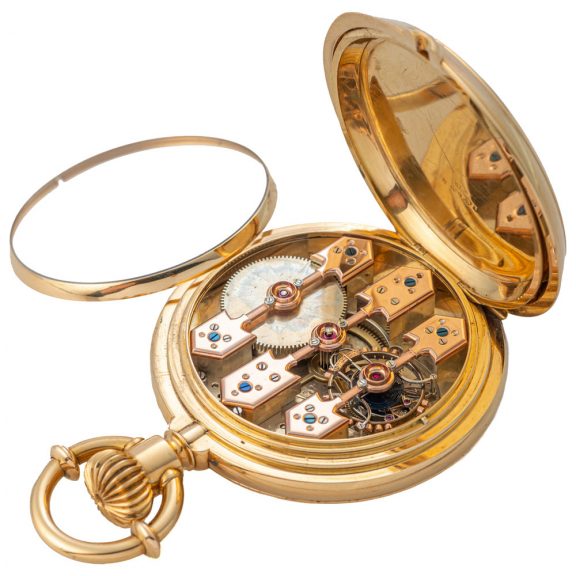
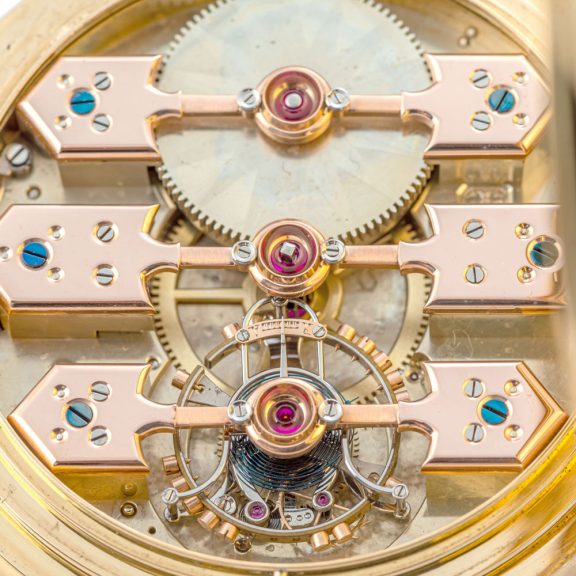
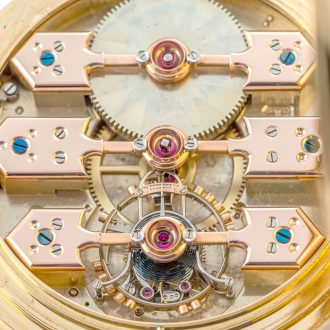
An extremely fine 18 carat gold hunting cased keyless pocket chronometer made by Girard-Perregaux in La Chaux-de-Fonds, circa 1880. A solid, plain case with a hinged gold cuvette. White enamel dial with Roman numerals, outer minute track, sunk subsidiary seconds at 6 o’clock and gold, rose cut diamond set Ulysse Breting type hands. First quality movement with three parallel golden bridges, 16 jewels, a gold wheel train, Perregaux caliber one minute tourbillon regulator with pivoted detent escapement, anibal brass Guillaume balance with gold temperature adjustment screws, blued steel balance spring with Phillips terminal curve and amplitude limiting device, and an index regulator. The three gold bridges, one minute tourbillon regulator and pivoted detent chronometer escapement by Ernest Guinand. Dial, case and movement are signed.
–
Diameter: 57 mm
–
Signed: Girard Perregaux Chaux de Fonds
–
A very similar chronometer tourbillon is in the collection of Girard-Perregaux and is described and illustrated by Reinhard Meis, in ‘Le Tourbillon, Editions de l’Amateur, Paris 1990, p.145. The patent for the three bridge tourbillon watches (No. 144919) was filed in the US patent office on 25th March 1884: “Be it known that I, Girard Perregaux … have invented and produced a new and original Design for a Watch-Movement, of which the following is a full, clear and exact description: the design for a bridge, consisting a bridge having a central annular portion, spread out ends and bar like portions between the said annular portions and ends” The design, which proved to be highly successful, has been used by Girard-Perregaux ever since. Today, their prestigious 13 wrist tourbillon uses the same design. At the Paris Universal Exhibition of 1889, Girard Perregaux received the highest of all awards, a Gold Medal for excellence, for his famed three-bridge Tourbillon. Its technical and aesthetic perfection and its impressive finish soon became an unquestioned reference. Due to their extreme complexity, only a handful of these timepieces were ever produced.
–
Ernest Guinand
Ernest Guinand (c. 1810-1879). Guinand was an important Master Horologist from Le Locle, who, along with Auguste Grether from Ponts-de-Martel (1817-1879), specialised in the production of tourbillon carriages. According to the records of the Neuchâtel Observatory, Guinand’s production of tourbillons began between 1865 and 1867. He designed three models of Tourbillon carriages, always based on an A-shaped frame. He worked for several important makers, including Girard-Perregaux and Montandon. Most of Guinand’s carriages were equipped with a pivoted detent escapement, one with a spring detent and some with a lever escapement. Most of his carriages were not signed and can only be identified by their characteristic A-shape. In 1864, Patek Philippe chose him to build their first tourbillon regulator.
Signed: Girard Perregaux Chaux de Fonds
Share this page: