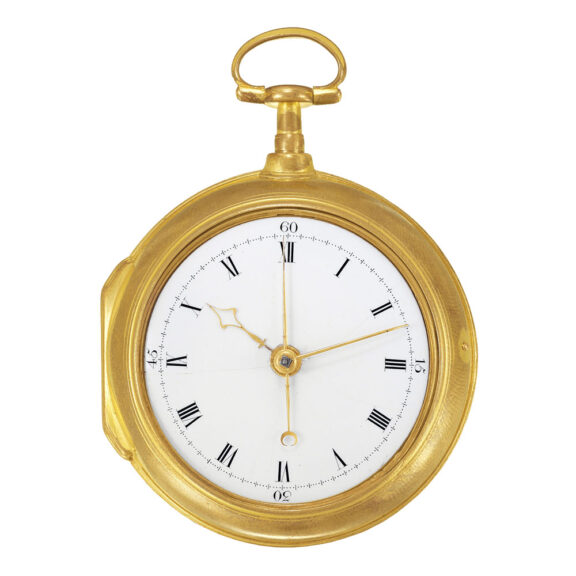
Important and historic English gilt metal pocket watch Circa 1774
- Kenmerk
- TA1568
- Diameter
- 54 mm
- Estimate
- € 40.000 - 70.000
- Price sold
- -
Gilt metal open faced lever watch
–
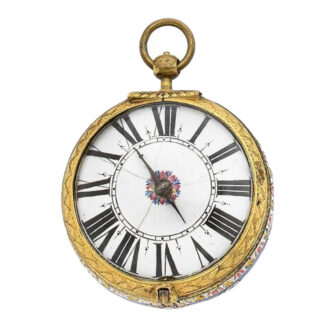
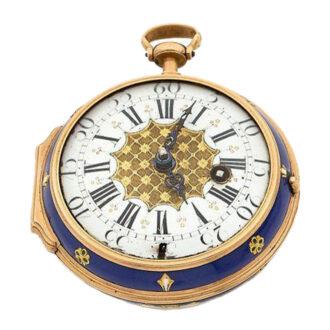
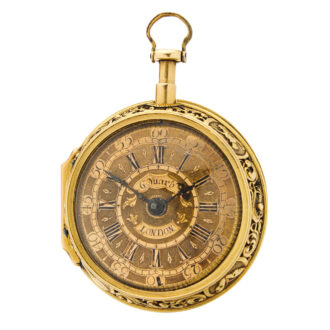
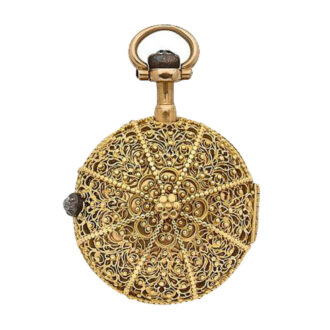
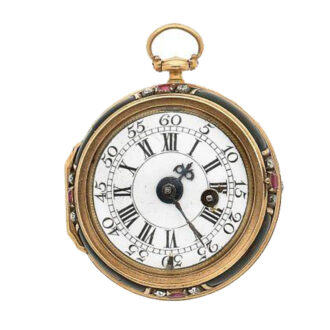
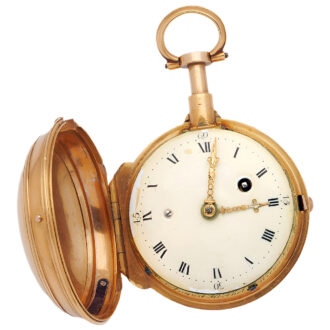
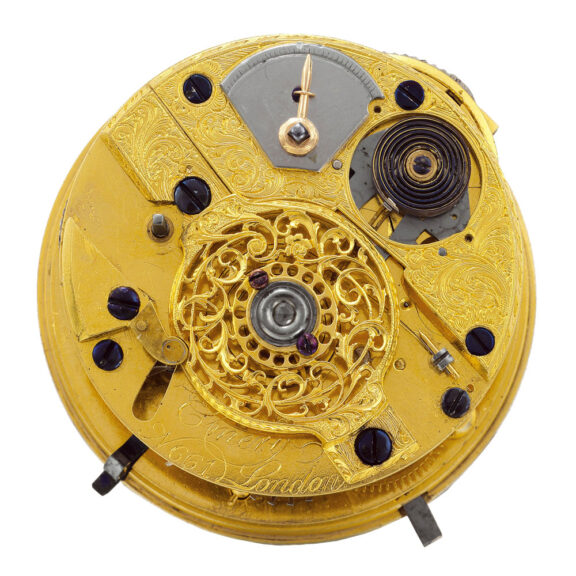
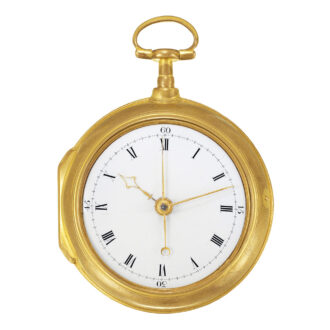
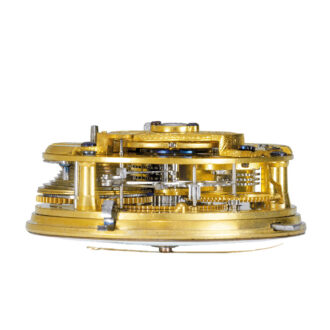
A very fine and unique English highly important and historic gilt metal pair cased pocket watch, circa 1774. The movement with an exceptionally early experimental lever escapement, very high-frequency balance, independent centre seconds with stop piece, Harrison type balance spring and temperature compensation curb. The present watch features a highly significant piece of the early history of the lever escapement, it was the first example of a lever escapement to be made by Josiah Emery and one of the earliest watches ever to be made with such an escapement. White enamel dial with radial Roman numerals, outer minutes divisions, Arabic 15 minute numerals, gold poker and open lozenge hour and minute hands and a gold poker seconds hand with a crescent tail.
–
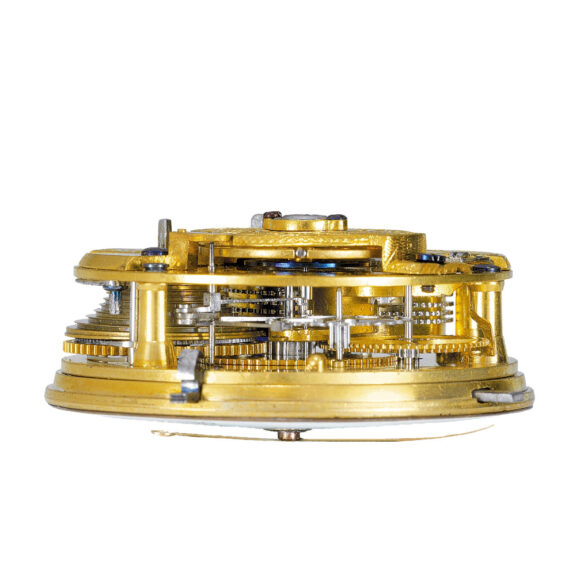
A gilt full plate movement, cylindrical pillars fixed by blued steel screws, fusee with chain, Harrison‘s maintaining power, centre seconds driven from a wheel mounted under the dial on an extension of the third wheel, blade for braking the second’s wheel, experimental lever escapement with polished steel escape wheel, one tooth jewelled, the lever with independently fixed long slender arms for the pallets and the fork, the fork made on two planes, two D section pieces on the staff for impulse and safety action, gilt-brass three arm balance with two small steel poising screws eccentrically mounted and inset into the rim, jewelled pivot holes, high frequency of 36,000 beats per hour, Harrison type blued steel balance spring with long straight tail, curb pins for temperature compensation, two footed pierced and chased foliate balance cock, diamond endstone, spiral Chelsea bun bimetallic temperature compensation curb mounted on a sliding steel frame with rack adjustment and silver segmental regulation scale, stop lever protruding from the edge of the dial plate. Movement signed.
–
Diameter: 54 mm
–
Signed: Josiah Emery London
–
Josiah Emery (1725-1797) was a Swiss watchmaker, born in the canton of Vaud, near Vevey. He settled in England and had a shop at 33 Cockspur Street, Charing Cross, London. Emery made very fine cylinder watches but became famous as the first watchmaker in the world after Thomas Mudge to produce a watch with a lever escapement (the present piece). He made about 36 lever watches between 1774/1775 and 1795. Three of Emery’s lever watches were imported into France and served as a model for Robert Robin for a series of precision watches that he produced at the end of the 18th century. One of these watches was shown to Louis Berthoud, who used the escapement several times and attempted to improve it, but finally abandoned it in favour of the pivoted detent escapement. He also used the pivoted detent escapement for precision watches. In 1782, Emery patented his double S balance, a fact which he advertised widely. Most of Emery’s double S balances are found in his lever watches, which he started making in 1782, the year of the patent. He produced less than 40 of them, of which fewer than 12 are known to have survived, making the double S balance even rarer. Emery did submit four chronometers to the Office of Longitude between 1792 and 1796, but obtained no success with them. He studied and corrected the error of the escapement of the chronometer made by Genevan clockmakers Demole & Magnin. His workmanship is always superlative, equal to the best of his contemporaries, including Arnold. Louis Berthoud said of Emery’s work that it was particularly good in its essential points and not showy. In 1781 his excellence was recognized by his peers, who elected him an Honorary Freeman of the Clockmakers’ Company, a distinction rarely given. He was succeeded by Recordon and Dupont in 1796.
Because it incorporates one of the earliest known experimental examples of lever escapement, this unique and quite recently discovered watch can be described as being amongst the most historically important English watches in the world. Josiah Emery’s numbering system was very consistent and the number 661 can be linked fairly accurately to the years 1774-1775. With the exception of the balance spring, the lever escapement was the greatest single improvement that has ever been applied to watches. In addition, this watch has an early automatic device for compensating changes in temperature and centre seconds that can be stopped independently of the rest of the movement. Thomas Mudge invented the lever escapement in 1754 but the first watch to incorporate this important innovation was not made until 1770. That watch was acquired by King George III for Queen Charlotte and was referred to as the Queen’s watch in correspondence between Mudge and his patron Count von Bruhl, Saxon Ambassador to Great Britain when it had been returned to Mudge’s Plymouth workshop for alterations and adjustment in the early 1770s. Mudge subsequently described his invention as the most perfect watch that can be worn in the pocket, that was ever made. The present watch is closely linked to the Queen’s watch by Count von Bruhl who approached Emery and tried to persuade him to make watches with Mudge’s lever escapement. Bruhl described the escapement to Emery in about 1774 but we know that Emery had not seen the Queen’s watch nor any model of it. Therefore, the present watch was almost certainly made as a direct result of his conversations with Bruhl. We know that Emery was experimenting around this time with a number of different ideas to make a precision timekeeper, his watch No. 615 (hallmarked 1772-3) made just a year or so before the present watch, No. 661, was heavily influenced by Harrison’s publication Principles, 1767, and was fitted with Kendall’s escapement which proved to be a poor design. By 1778, Emery had moved on to using Arnold’s pivoted detent escapement which had been shown to be highly successful from the mid-1770s. The making of the present watch, therefore, falls between these two periods and shows Emery’s experimenting with the strange new escapement described to him by Bruhl and interpreted by Emery directly from Bruhl’s description of the Queen’s watch. This watch was very likely to have been made almost entirely by Emery himself, largely to ensure its existence remained a secret until he had seen how it would perform. This said it is possible that other makers might have seen this watch and been influenced by it. For instance, the early lever watches made by John Leroux in the mid-1780s have an identical escape wheel, and as in the present watch, all the lift is on the teeth. This would explain the otherwise anomalous lever escapements made by Leroux at this time. The train of the present watch determines a balance frequency of 36,000 beats per hour, this is almost certainly a uniquely high frequency for an eighteenth-century watch.
The Stages of Development of Emery in common with the makers of most experimental machines, Josiah Emery maker did not immediately produce this watch in its final form, but rather improvements and developments resulting from experimentation with the various components were introduced and adjusted as time went by. Does this watch appear to have had two distinct previous states before reaching its present form?
–
First State in 1774-1775, Emery had the movement signed and numbered in case he might one day want to claim it as his product and maybe even sell it. Giving a serial number might also have been a means of staking his claim to the overall movement design. At this stage the movement is likely to have been ungilded and uncased, it almost certainly had no maintaining power and appears to have had a straight, Harrison-type bimetallic compensation curb acting on the tail of the balance spring. The curb would have been mounted on a pivoting slide plate, for meantime adjustments, centred on a hole in the potency plate that has since been removed and a piece of brass dovetailed into the backplate. In its first form, the balance spring would have been studded in a position about 90 degrees from its present position (a plugged hole of the correct size is there) presenting the extended curved tail in the correct orientation for the curb to act upon it. An arc of 20 dots on the backplate marks the span over which the curb would have operated. The balance and spring are where we see the further influence of John Harrison. The extraordinarily high frequency of the train is undoubtedly inspired by Harrison, who implied in Principles that the smaller the watch, the faster the train should be.
–
Second State approximately two or three years later, the maintaining power was fitted, such a high frequency balance associated with an experimental type of lever escapement meant that the watch was not self starting, although reasonably reliable once going. Without maintaining power, it would need a good twist to start it after every winding. The pillar closest to the fusee has been considerably cut away to make room for the new maintaining power detent and the fusee itself has been fitted with a peculiar, small maintaining power wheel hidden between the fusee and the great wheel necessitating the detent to be thinned to a sliver in order to fit into the groove. The compensation would have been changed at this time and also the area of the backplate containing the hole for the previous compensation slide cut out and plugged with the dovetail piece. The entire movement would have then been gilded. The new compensation is of Chelsea bun type and fitted into the original slide-plate but with the compensator filling the opening for it fully. The balance and spring were positioned in their present place at this stage to work with the new compensation.
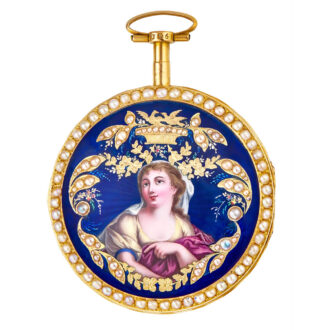
The final stage of the making of this watch occurred probably in the 1790s and perhaps after Emery’s death. At this stage, the changes were purely additions and not alterations. It is very likely that up until this point the movement had never had a dial or case. The present case, dial and hands date from this period and are therefore original. It is possible that the watch remained Emery’s property until his death and was among the effects that came to Recordon & Dupont in 1795 and they had the watch dialled and cased to sell it.
Signed: Josiah Emery London
Share this page: