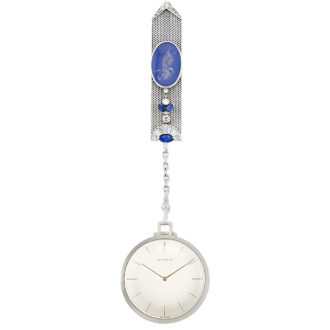
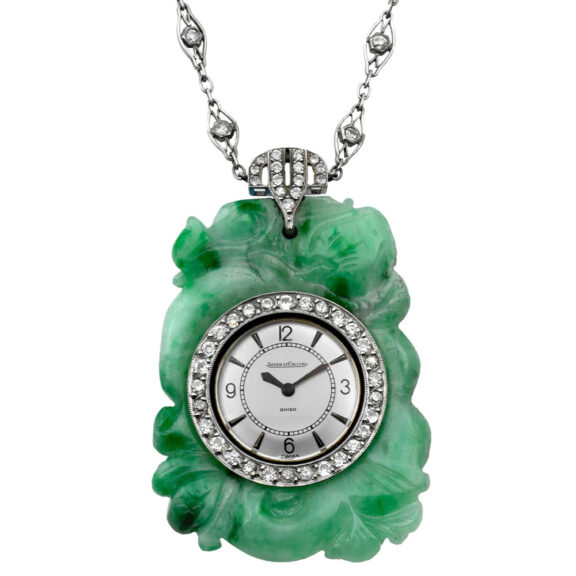
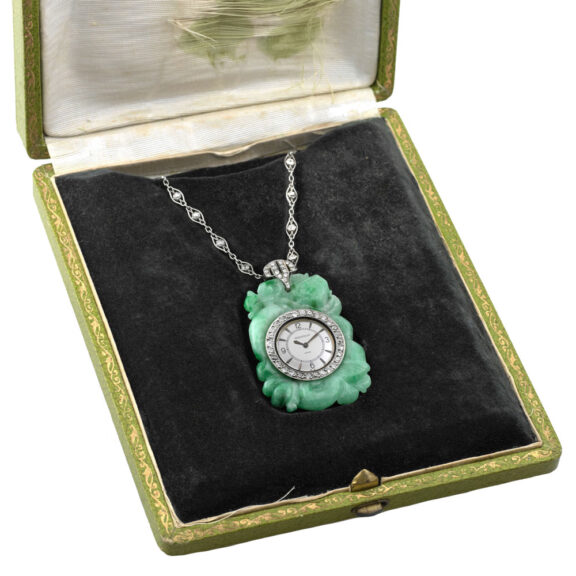
Swiss platinum, jade and diamond set pendant watch Circa 1930
- Kenmerk
- TA3562
- Diameter
- -
- Estimate
- € 4.000 - 8.000
- Price sold
- € 8.150
Platinum Art Deco keyless pendant watch
–
An extremely fine and rare Swiss jade and platinum, gold mounted and diamond set Art Deco keyless pendant watch, circa 1930. Comes with a matching diamond set chain. Accompanied by the original fitted box. The watch with a diamond set bezel fitted within a finely carved and pierced green jade panel, the bow and chain are also set with diamonds. Silver dial with faceted baton indexes, Arabic numerals and blued steel epee hands. A rhodium plated movement, Geneva striping decoration, 18 jewels, straight line lever escapement, cut bimetallic balance, five adjustments, blued steel Breguet balance spring and index regulator. Dial and movement signed.
–
Dimensions: 46 x 35 mm
–
Signed: Jaeger-LeCoultre Swiss
–
The dial is reprinted.
–
LeCoultre. The earliest records of the LeCoultre family in Switzerland date from the 16th century, when Pierre LeCoultre (circa 1530 – 1600), a French Huguenot, fled to Geneva from Lisy-sur-Ourcq, France to escape religious persecution. In 1558, he obtained the status of inhabitant but left the following year to acquire a plot of land in the Vallée de Joux. Over time, a small community formed and in 1612, Pierre LeCoultre’s son built a church there, marking the founding of the village of Le Sentier where the company’s manufacturing is still based today.
In 1833, following his invention of the machine to cut watch pinions from steel, Antoine LeCoultre (1803-1881) founded a small watchmaking workshop in Le Sentier where he honed his horological skills to create high quality timepieces. In 1844, he invented the world’s most precise measuring instrument at the time, the millionomètre and in 1847, he created a keyless system to rewind and set watches. Four years later, he was awarded a gold medal for his work on timepiece precision and mechanization at the first Universal Exhibition in London.
In 1866, at a time when watchmaking skills were divided up among hundreds of small workshops, Antoine and his son, Elie LeCoultre (1842-1917), established the Vallée de Joux’s first full fledged manufacture, LeCoultre & Cie, bundling their employees’ expertise under one roof. Under this setup, they developed the first partially mechanized production processes for complicated movements in 1870. By the same year, the manufacturer employed 500 people and was known as the Grande Maison of the Vallée de Joux. By 1900, it had created over 350 different calibres of which 128 were equipped with chronograph functions and 99 with repeater mechanisms. From 1902 and for the next 30 years, LeCoultre & Cie produced most of the movement blanks for Patek Philippe of Geneva.
Signed: Jaeger-LeCoultre Swiss
Share this page: