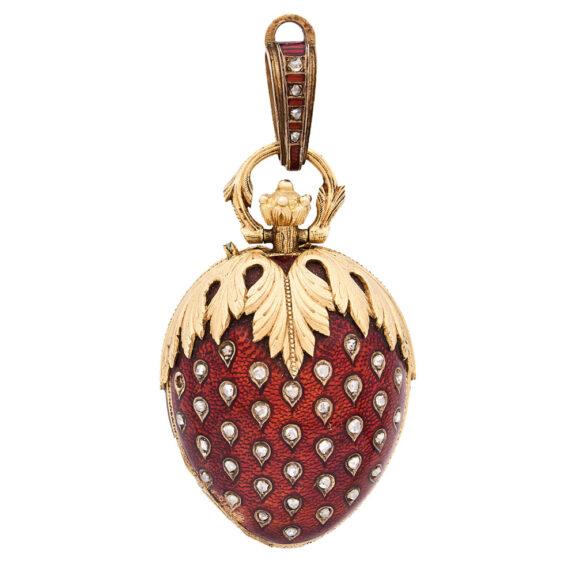
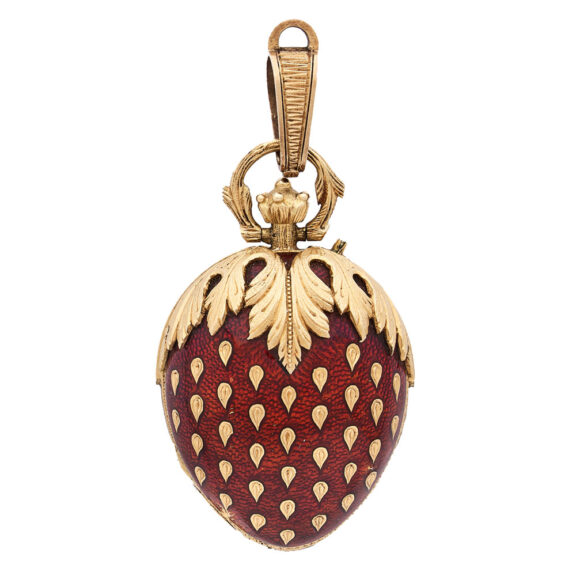
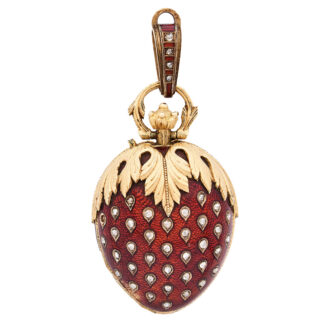
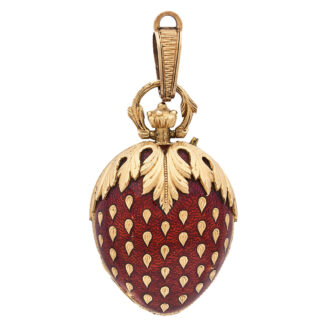
Swiss 18K gold and red enamel strawberry form watch Circa 1880
- Kenmerk
- AL3463
- Diameter
- -
- Estimate
- € 4.000 - 8.000
- Price sold
- € 4.200
Gold crown winding cylinder watch
–
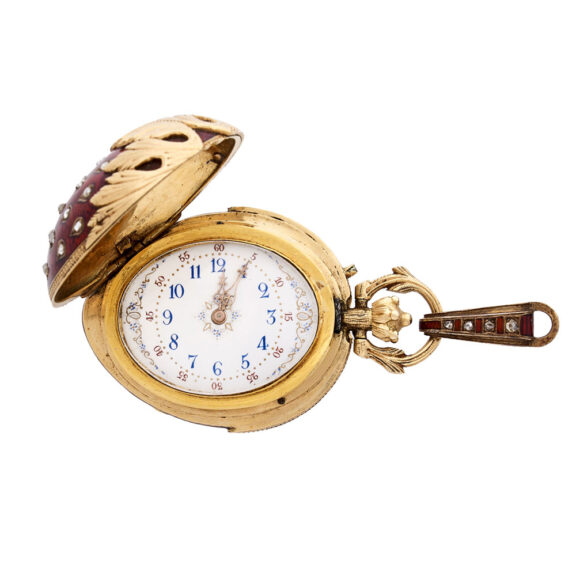
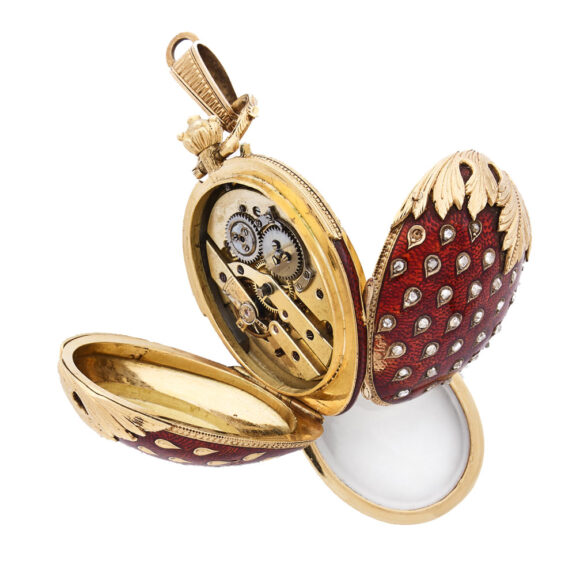
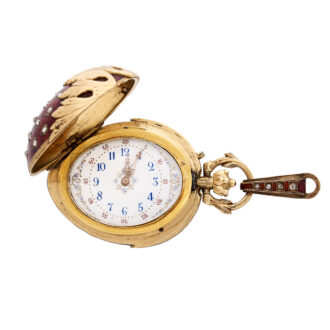
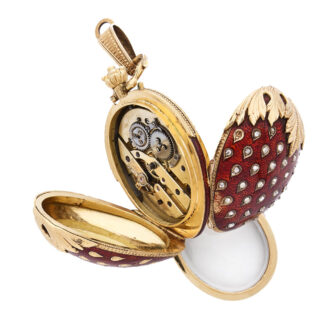
A fine Swiss 18 carat gold and translucent red enamel watch shaped like a strawberry, circa 1880. It has a mechanical crown winding movement with a cylinder escapement, three arm spiral balance and an advance/delay adjustment on the balance bridge. The concealed white enamel dial features striking blue Arabic numerals for the hours, an outer dot minute track with red Arabic five minutes, delicately pierced gold Louis XV hands and an asymmetrical gold painted foliage flourish decorating the dial face.
–
This whimsical timepiece is housed in a refined strawberry form hinged case finished in vibrant red translucent enamel. It features a stylized pendant ring, a corrector button in the middle of the case to adjust hours and minutes and an intricately worked gold bezel symbolizing natural leaves.
–
Dimensions: 30 × 43 mm
–
Weight. 48.1 gr.
–
Signed: No name
–
A form watch, made in the image of another object like most Western artworks of the period, was often ecclesiastical or shaped by natural forms.
–
The beginnings of the form watch in the history of watchmaking
The crucifix and twelve lobed flower watches were the most recognizable forms. Some were made from carved rock crystal, others set with gemstones or enamel. These timepieces were impressive and expensive, instantly conveying the owner’s high status to contemporary observers.
–
The century’s preoccupation with life’s brevity inspired one of the most popular themes in the form of the watch: the skull watch, or memento mori. The movement and dial were concealed within a silver skull shaped case, often made realistically.
–
The golden age of the shaped watch with the era of the ‘fancy watch’
The years between 1790 and 1820 were the golden age of the shaped watch. Geneva became the centre for making what were then called ‘toys’, where the surprise watch and its mechanism were hidden. These enchanting miniature watches, made of precious metals and set with stones or pearls, were often exquisitely enamelled, a skill Genevan artisans excelled in. They were inspired by various subjects, including flower baskets and flowers such as tulips, pansies, and roses. Others took the form of fruits or animals such as strawberries, cherries, peaches, apples, shells, birds, beetles, fantastic fish, or exotic butterflies.
–—
The present example from the second half of the 19th century follows the exact codes of the golden age of the costume watch. It symbolizes Geneva’s golden age as the world capital of enamelled watches, with some being extraordinary, such as certain watches signed by Piguet & Capt.
Share this page: