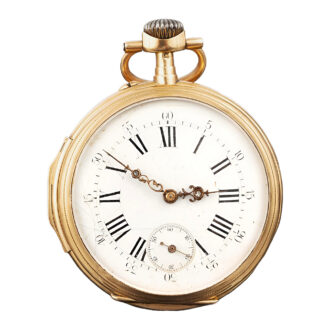
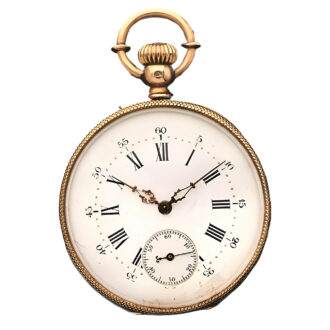
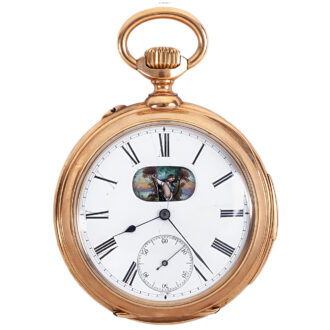
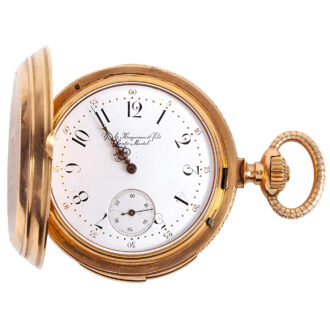
Swiss 18k gold double dialed hunting cased lever Circa 1890
- Kenmerk
- TA1906
- Diameter
- 51 mm
- Estimate
- € 8.000 - 15.000
- Price sold
- -
Gold double dialled watch by H.R. Ekegren
–
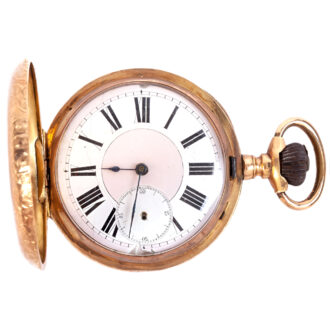
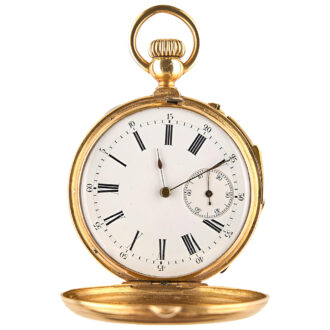
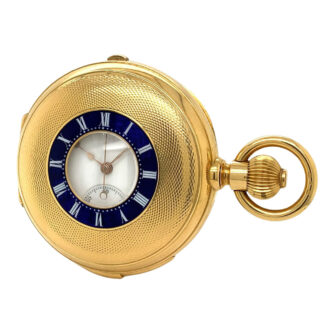
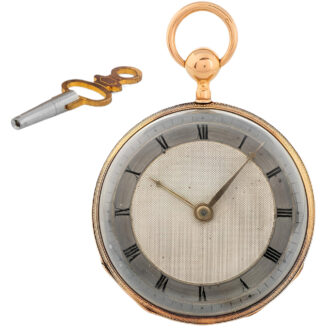
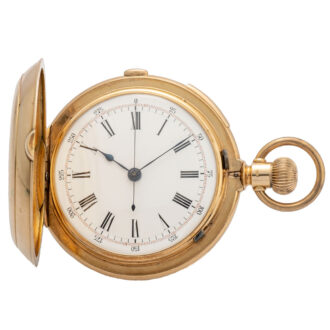
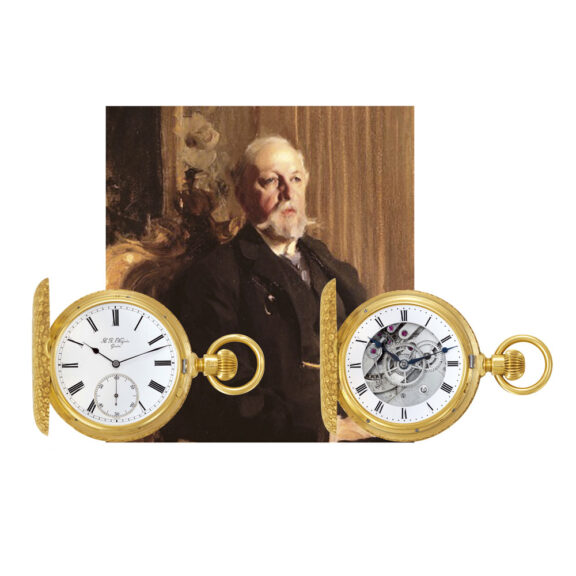
A very fine and rare Swiss, double dialed, two-time zone, 18K yellow gold, hunting cased, a keyless pocket watch with a special gravitational locking device for the covers, circa 1890. King Oscar II of Sweden Royal Presentation by H. R. Ekegren, Geneve. Presented by His Majesty King Oscar of Sweden to Monsieur Raoul Gunsbourg. An entirely engraved case with geometric snowflake pattern, the front cover with a foliate monogram, the interior engraved Sa Majeste le Roi Oscar de Suède a Mr Raoul Gunsbourg, the back cover opening to reveal the second dial, the interior engraved Raoul Gunsbourg a son ami d’enfance, Nathan Steinfeld, gravitational locking device for the covers.
–
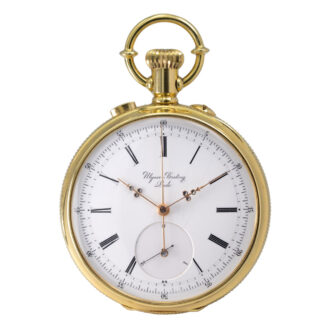
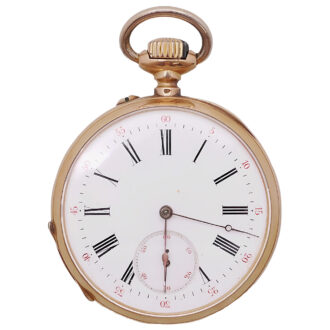
White enamel dial with radial Roman numerals, outer minute track, subsidiary seconds. Blued steel spade hands. Second dial: white enamel, annular, radial Roman numerals, outer dot minute indexes. Blued steel circle hands. A nickel movement, 19 jewels, counterpoised straight-line lever escapement, cut bimetallic compensation balance, blued steel Breguet balance, index regulator. Dial signed.
–
Diameter: 51 mm
–
Signed: H.R. Ekegren Genève
–
This watch has a mystery opening feature: only one cover can be opened at a time, due to a special gravitational device that allows only the cover facing upwards to be opened. Thus, when the watch is turned, the cover that had remained closed no matter how much the push-button was depressed, suddenly and mysteriously opens.
–
Henri-Robert Ekegrén, (1823-1896) was the son of Daniel Ekegrén, a Swedish watchmaker, he worked for Jules Jürgensen in Le Locle, Winnerl in Paris, and Henri Golay in Geneva, where he arrived in 1847. In 1857 he formed a partnership with Ferdinand Westermann. At the 1867 Exhibition, he displayed thirty-six watches, winning a gold medal. Subsequent exhibitions – Vienna in 1873, Paris in 1875, Philadelphia in 1876, Paris again in 1878, and Zurich in 1883 – brought him and his collaborator, Louis Chevalier, further honours and recognition.
–
Oscar II of Sweden and Norway (1829-1907) was the king of Sweden and Norway, son of Oscar I, born in Stockholm on the 21st of January 1829. He entered the navy at the age of eleven and was appointed junior lieutenant in July 1845. Later he studied at the University of Upsala, where he distinguished himself in mathematics. In 1857 he married Princess Sophia Wilhelmina, youngest daughter of Duke William of Nassau. He succeeded his brother Charles XV on the 18th of September 1872. He was largely responsible for the peaceful solution eventually adopted for the separation of the Crown. His acute intelligence and his aloofness from the dynastic considerations affecting most European sovereigns gave the king considerable weight as an arbitrator in international questions. He won many friends in England by his outspoken and generous support of Great Britain at the time of the Boer War (1899-1902), expressed in a declaration printed in The Times on the 2nd of May 1900. Himself a distinguished writer and musical amateur, King Oscar proved a generous friend of learning and did much to encourage the development of education throughout his dominions. In 1858 a collection of his lyrical and narrative poems, Memorials of the Swedish Fleet, published anonymously, obtained the second prize of the Swedish Academy. His “Contributions to the Military History of Sweden in the Years 1711, 1712, 1713,” originally appeared in the Annals of the Academy, and were printed separately in 1865. His book Memoirs of Charles XII were translated into English in 1879. His eldest son, Oscar Gustavus Adolphus, Duke of Warmland (b. 1858), succeeded him as King Gustavus V.
–
Raoul Gunsbourg (1859-1955) was a French composer and impresario of Romanian birth. After managing opera in Russia (from 1881) and in Lille (1888) and Nice (1889/91), he became director of the Monte Carlo Opera in 1893, a position he held until 1951. Under his long and brilliant régime, Monte Carlo saw the premieres of many important works.
Signed: H.R. Ekegren Genève
Share this page: