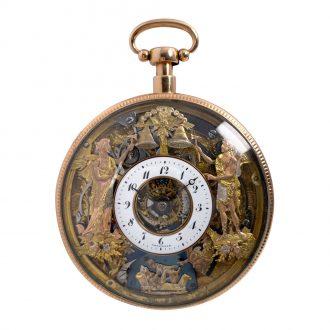
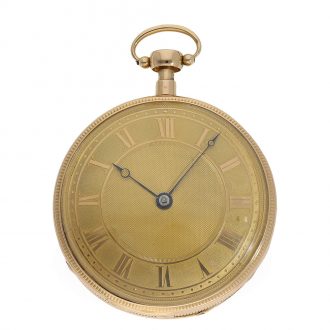
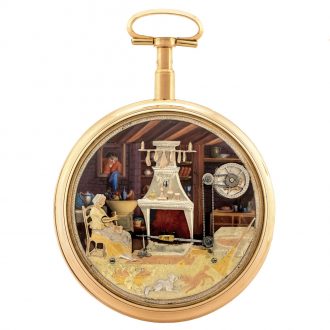
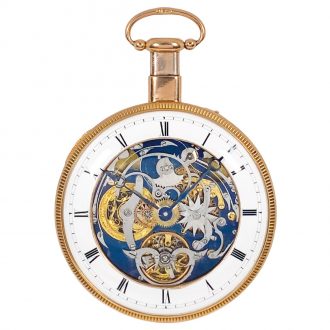
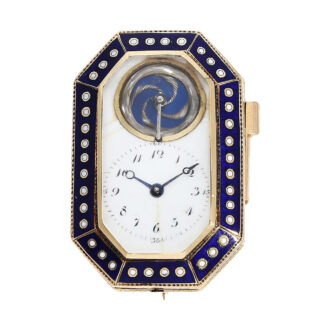
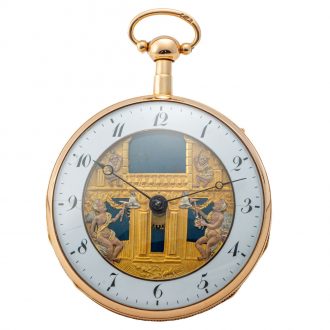
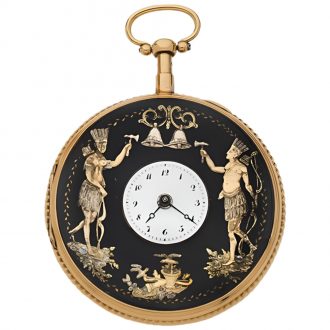
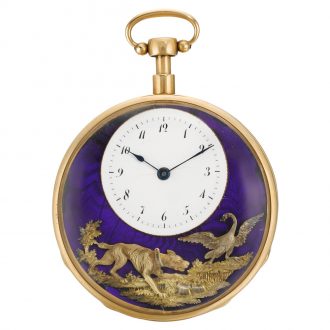
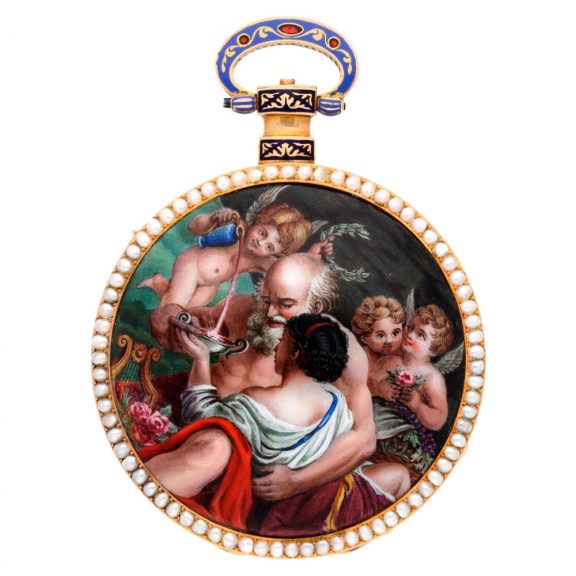
Swiss gold, enamel and pearl set musical cylinder watch Circa 1815
- Kenmerk
- AS2325
- Diameter
- 52 mm
- Estimate
- € 75.000 - 140.000
- Price sold
- € 103.250
Decorative watch for the Chinese market by Piguet & Meylan
–
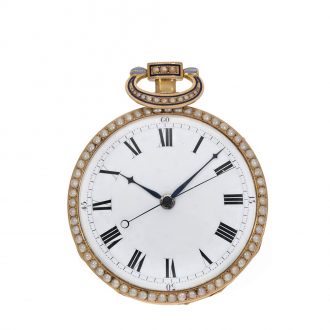
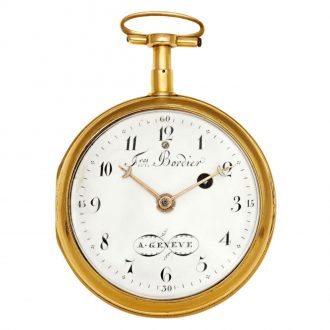
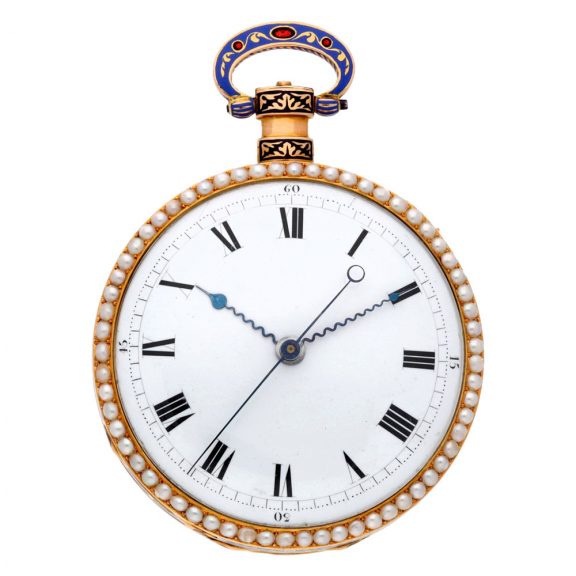
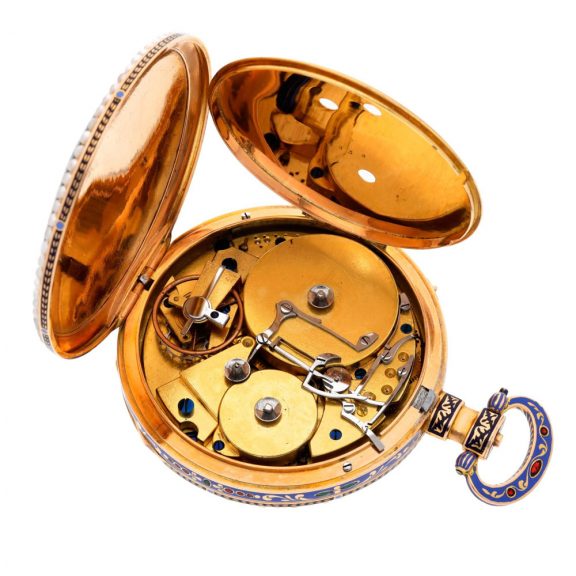
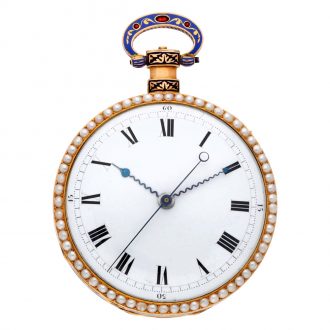
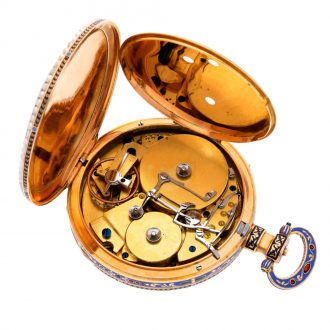
A Swiss gold, later polychrome enamel painted and pearl set musical cylinder watch playing on the hour or on demand, circa 1815. Made for the Chinese market. The gilded movement features a cylinder escapement, a three arm gold balance, and two barrels for both going and musical trains. It includes a pinned disc sur plateau musical movement with blued steel tuned tines, a slide for music/silence at the movement edge, and is stamped PM for Piguet Meylan beneath the dial. The white enamel dial boasts Roman numerals, blued steel serpentine hands, elongated centre seconds, and an outer minute/seconds ring.
–
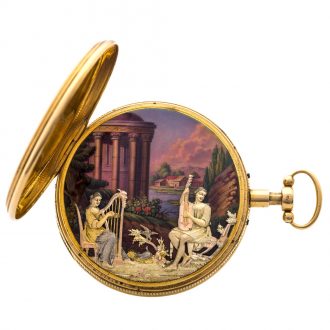
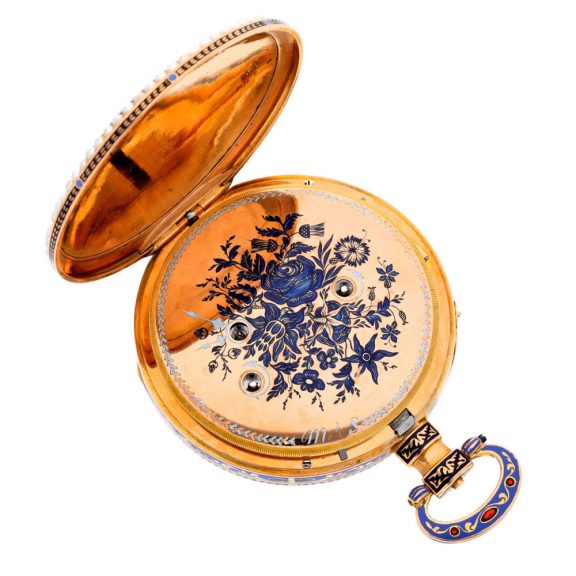
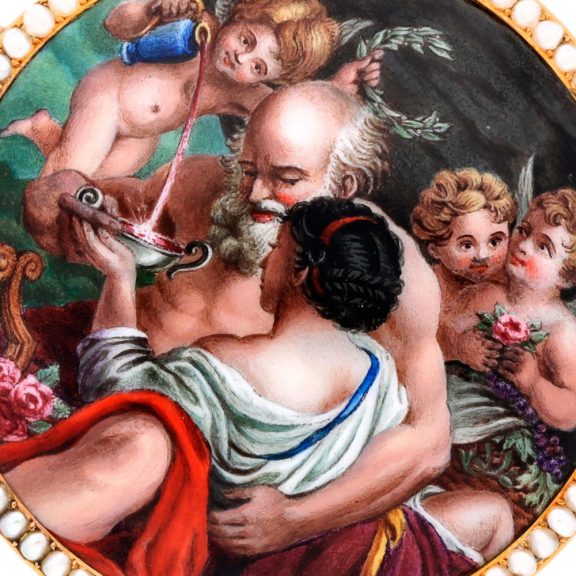
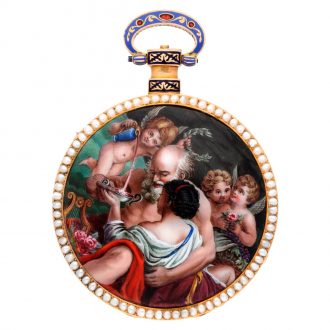
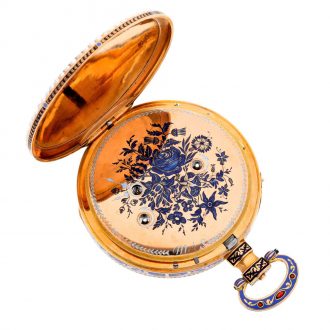
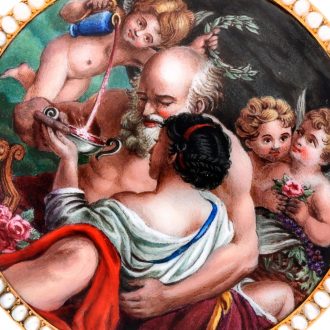
The gold case has a back adorned with a later painted polychrome enamel classical scene, probably depicting the crowning of Homer. It features pearl set bezels and a band decorated with opaque black and pale blue enamel, enhanced with stylised gold foliate designs and roundels of translucent green and red enamel. The pendant and bow are similarly decorated. There is a start/stop slide for music positioned on the band at 2 o’clock, with a gold cuvette featuring three apertures for winding and hand setting, accompanied by directionals in white enamel and markings for the musique/silence slide. A central bouquet of flowers in blue champlevé enamel is present, with the rim of the case back and the back of the cuvette numbered.
–
Diameter: 52 mm
–
Signed: Piguet & Meylan
–
Movement is running, and the music is playing well. The slide for music on/off to the case band is operational, but the tension will need some adjustment as it will intermittently continue to run until the music’s spring barrel is out of power. Music sounds on the hour when the music slide beside the cuvette is selected. Hands are moving smoothly. The ‘M’ of the Piguet Meylan stamp beneath the dial is faint. The dial is in good condition. The case has some scuffs and scratches, and there is chipping and possibly a repair to the band at 4 o’clock. The scene on the case back has one small repair area in soft enamel at the edge between 3 and 4 o’clock; otherwise, the back scene is in hard enamel. There are a couple of minor losses to the enamel decoration of the cuvette.
–
The case back panel was restored or repainted in the 20th century, and the scene most likely depicts the crowning of Homer. A similar yet original scene attributed to Jean-Abraham Lissignol can be found on a gold and enamel box by Jean-Georges Rémond. Despite the restoration of the panel, the watch exhibits many of the sumptuous design elements that have made Piguet & Meylan’s watches—particularly those created for the Chinese market—so highly admired.
–
The firm of Piguet & Meylan was established in 1811 by Daniel Isaac Piguet (1775-1841) and Philippe-Samuel Meylan (1772-1845). This partnership lasted until 1828. Piguet was born in Chenit, located in the Vallée de Joux, and later settled in Geneva, where he became a Burgher in 1812, one year after entering into the partnership with Philippe Samuel Meylan to undertake the ‘manufacture of watches, jewellery, and mechanisms of all kinds. Piguet specialises in complex watches featuring carillons and clock watches. Meylan was born in Bas-du-Chenit and is credited with adapting ‘tongues’ of sonorous metal for the combs of musical movements suitable for watches and other small objects. Many advances in creating extremely small and extra thin movements for watches, musical boxes, and highly refined automata are attributed to Piguet & Meylan and the invention of the sur-plateau musical movement. The automata produced by the firm are regarded as some of the finest ever made, including singing birds, barking dogs, and even magicians who could ‘answer’ a series of questions. Examples of Piguet & Meylan’s work can be found in many of the world’s foremost collections, including the Patek Philippe Museum in Geneva, the Metropolitan Museum of Art in New York, and the Sandoz Collection.
Signed: Piguet & Meylan
Share this page: