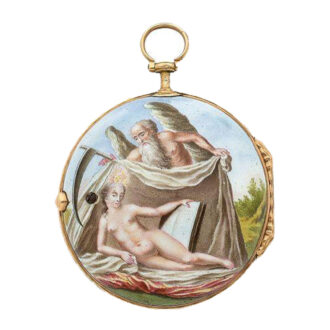
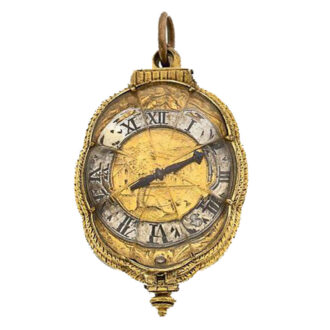
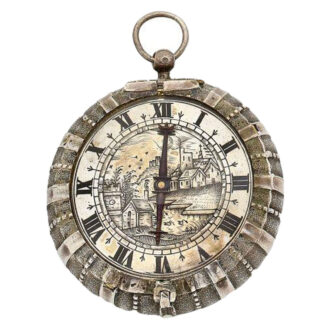
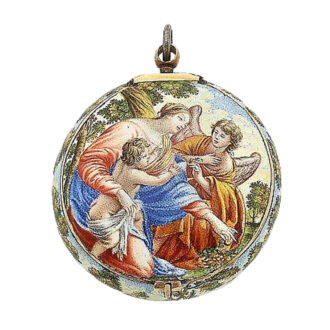
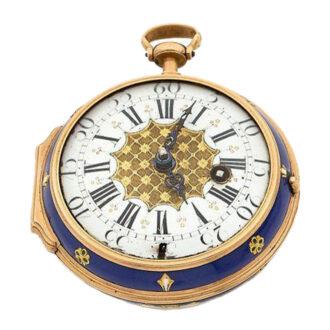
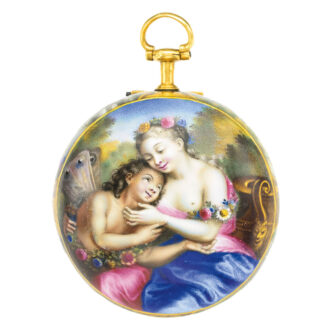
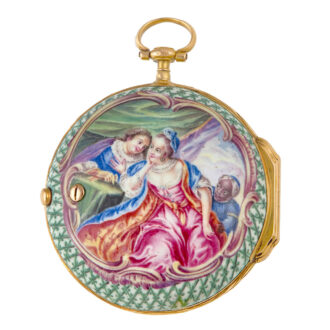
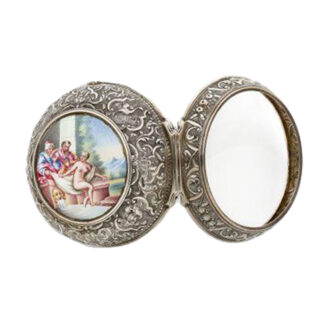
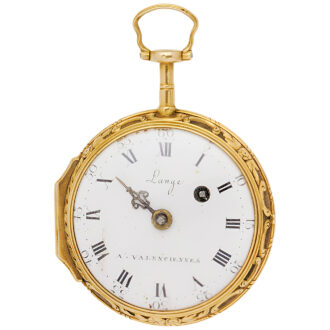
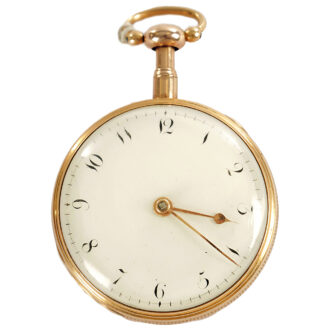
Important Swiss silver open faced virgule pocket watch Circa 1788
- Kenmerk
- DT0698
- Diameter
- 46 mm
- Estimate
- € 6.000 - 12.000
- Price sold
- -
Silver virgule watch
–
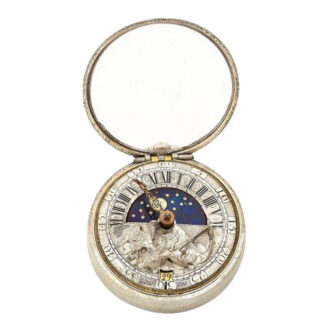
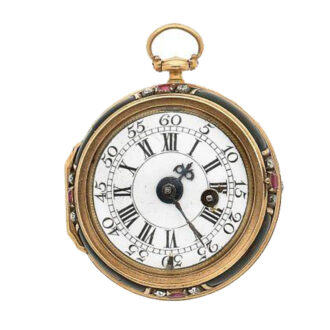
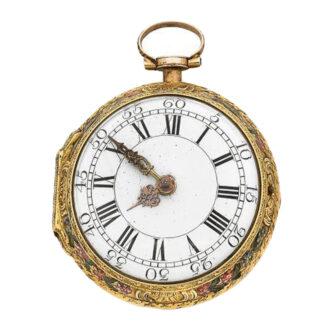
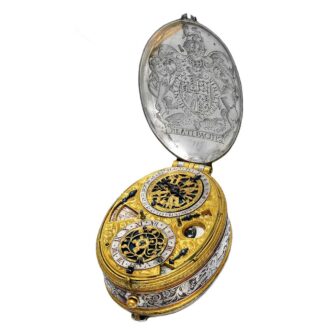
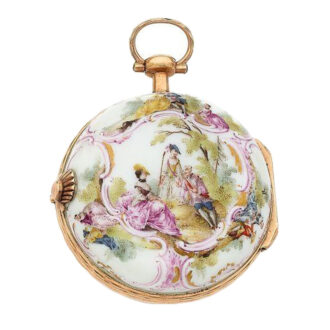
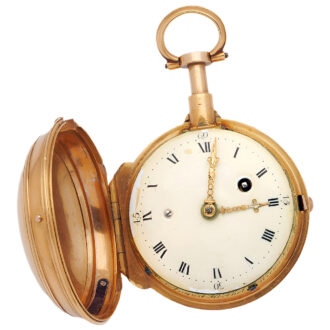
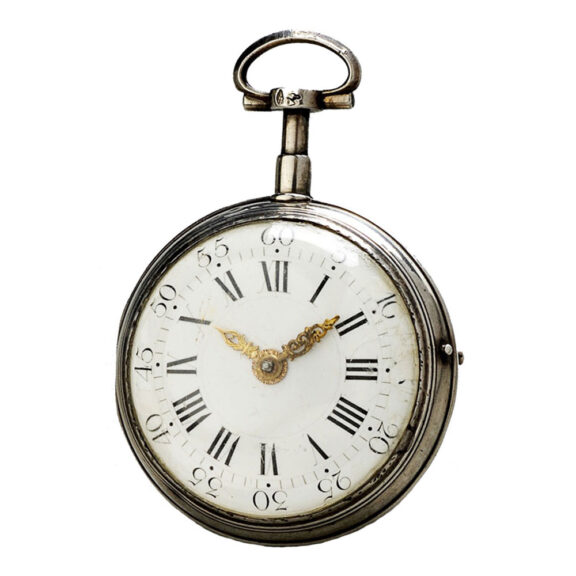
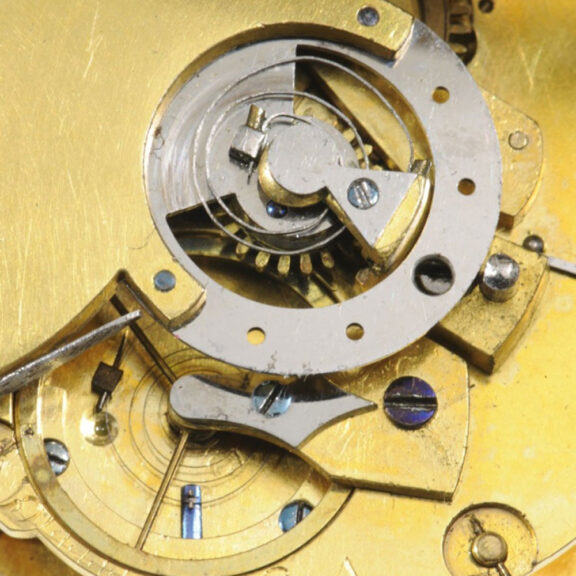
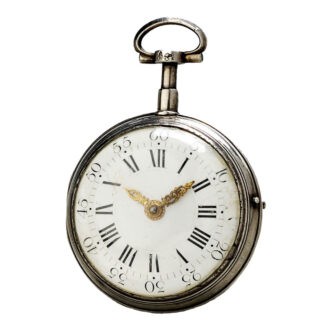
An important Swiss silver open faced virgule pocket watch of museum quality, circa 1788. An early oscillating weight winding full plate movement, virgule escapement, three-arm brass balance. White enamel dial with Roman hours, outer Arabic five-minute numerals and decorative hands. Plain case.
–
Diameter: 46 mm
–
Weight: 86 g
–
Signed: Abraham-Louis Perrelet Neuchâtel
–
This timepiece is one of seven known in total. Six of them are held in important collections and museums or have been mentioned in every kind of relevant literature. The Patek Philippe Museum, Geneva, Collection du Château des Monts, Le Locle, the British Museum, London, Deutsches Uhrenmuseum, Furtwangen, illustrated and described in Jean-Claude Sabrier’s ‘The Self-winding Watch – 18th-21st Century’, Paris 2011 and Chapuis et Jaquet ‘La Montre automatique ancienne’, 1952.
–
Swiss watchmaker and inventor Abraham-Louis Perrelet (1729-1826) is regarded as the inventor of self-winding pocket watches. However, Hubert Sarton of Paris is also known for having invented an automatic winding system with a rotor mechanism for pocket watches – historians are still undecided here. Similar watches are illustrated and described in ‘The Self-winding Watch, 18th-21st Century’ by Jean-Claude Sabrier, Paris 2011. His father, Daniel was a carpenter and a farmer and as soon as the young man was in a position to do some favours, he helped his parents on the farm. At the age of twenty years, he gave up his modest work to learn watchmaking. After an apprenticeship of 15 days at someone named Prince in Le Locle, who worked little, very badly and where he learnt absolutely nothing he started to work independently and so became his own master. At the beginning of 1777, Perrelet invented a self-winding mechanism for automatic watches. It worked on the same principle as a modern wristwatch and was designed to wind as the owner walked, using an oscillating weight inside the large watch that moved up and down. The Geneva Society of Arts reported in 1777 that 15 minutes of walking was necessary to wind the watch sufficiently for eight days and the following year reported that it was selling well. Perrelet is thus widely acknowledged as the inventor of the automatic watch. However, his watch probably used a weight pivoting at the side of the movement. The first drawing and accurate description of an automatic watch with a central rotor was created in 1778 by the watchmaker Hubert Sarton and that design is attributed to him. Following the work of Perrelet, other watch makers also created automatic watches from about 1777 on. Perrelet’s first perpetual watch ran for eight days. Although this was the first serious attempt to do away with the winding key, the hands still had to be set with a key. The watches were very large. Perrelet also made a device to wind the watches with a key while they were not in use. After his invention of the pedometer-wind perpetual watches, circa 1780, Perrelet made several of these watches for Breguet and for Recordon in London, both of whom made new and improved versions. He also sold to Philippe du Bois and Jaquet-Droz. In 1900 Abraham Perrelet’s face was on the notes issued by the Neuchateloise bank.
Signed: Abraham-Louis Perrelet Neuchâtel
Share this page: