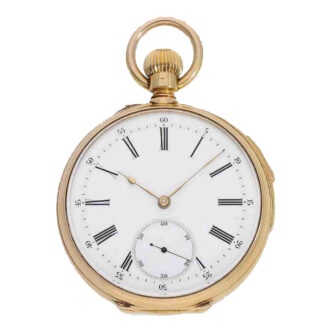
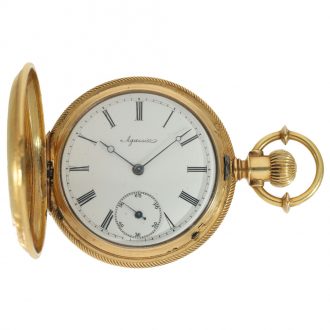
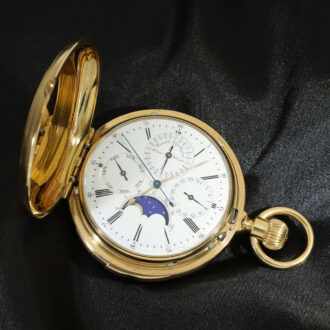
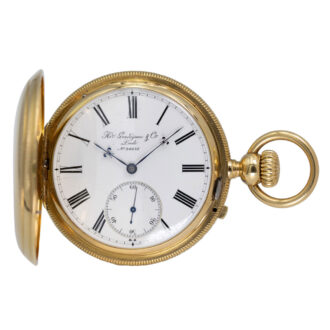
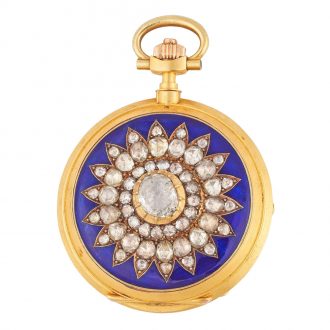
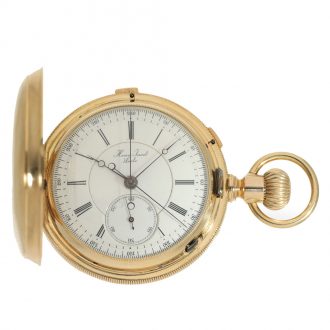
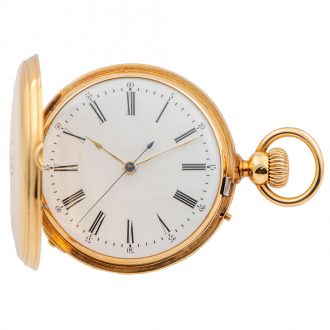
Swiss gold watch with montre à tact and calendar Circa 1870
- Kenmerk
- FA0237
- Diameter
- 53 mm
- Estimate
- € 20.000 - 35.000
- Price sold
- -
Gold montre à tact watch by H.R. Ekegrén
–
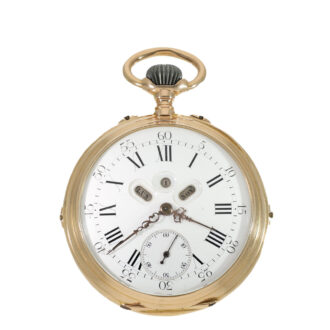
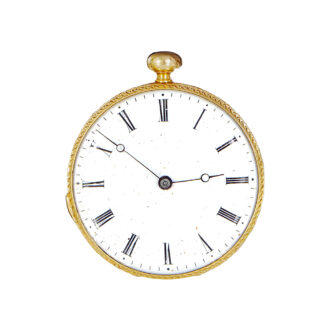
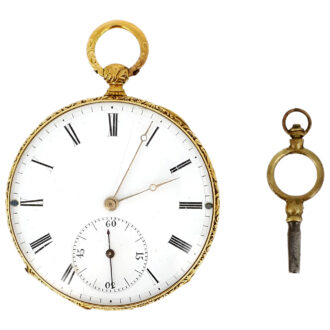
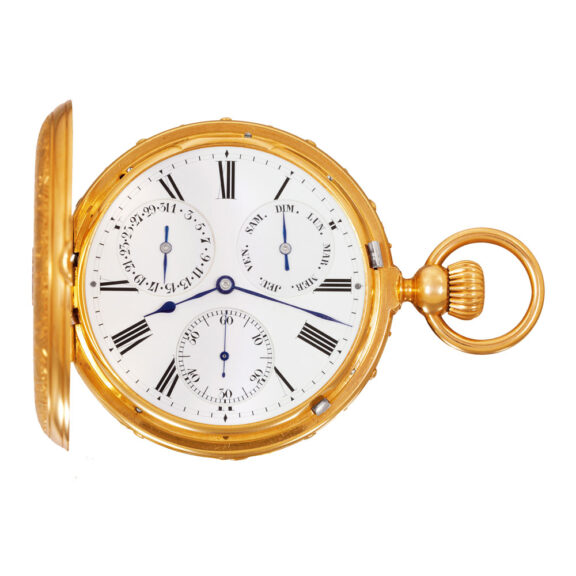
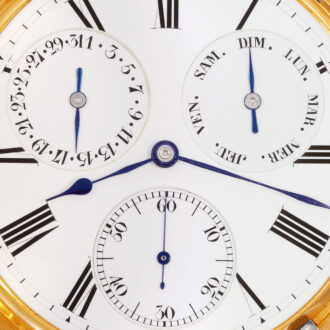
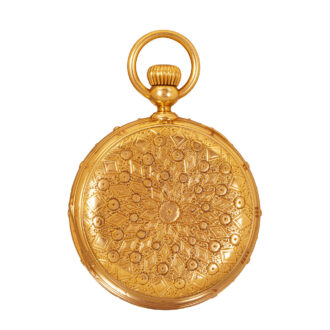
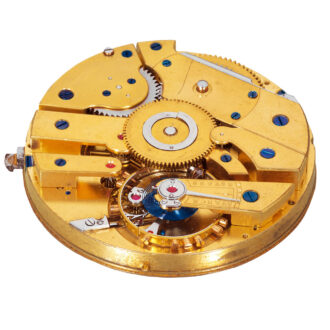
A fine Swiss extremely rare 18K gold hunting cased, keyless montre à tact with double calendar and chronometer escapement, circa 1870.
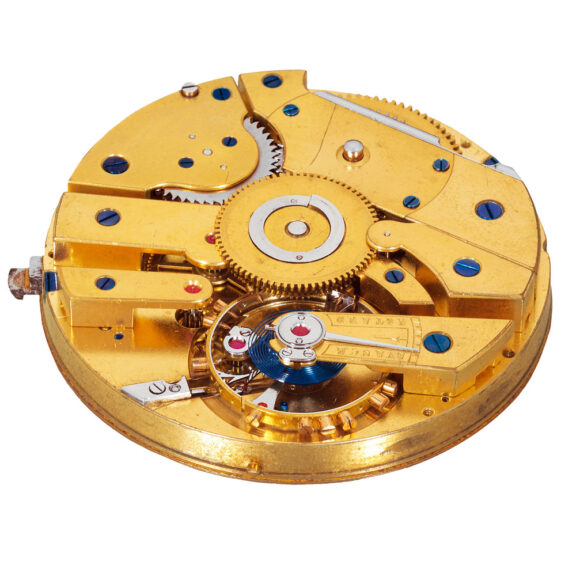
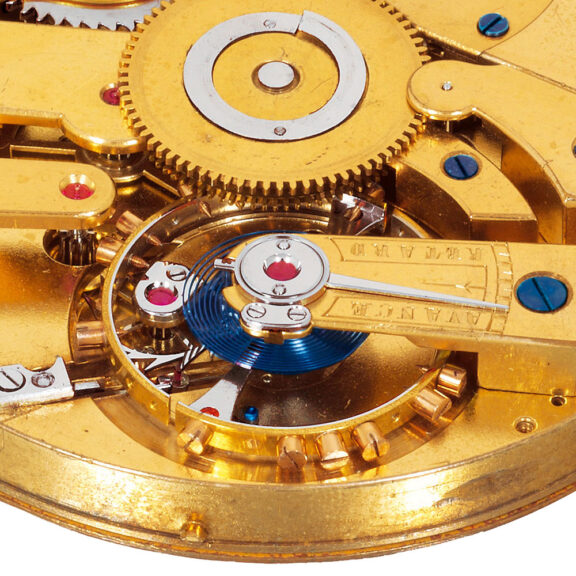
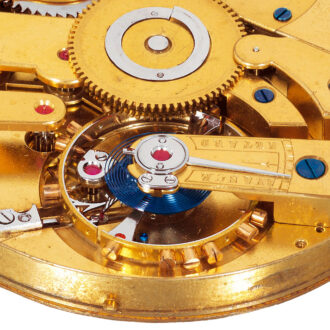
Gilt, bar movement with going barrel fitted to the centre with the à tact device, 15 jewels, spring detent escapement, cut bimetallic balance, blued steel balance spring with terminal curve.
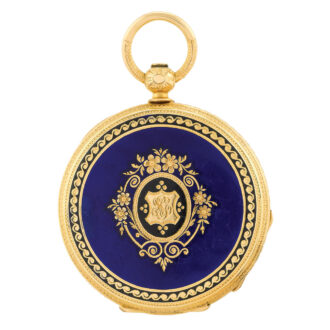
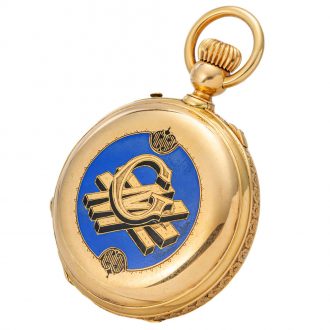
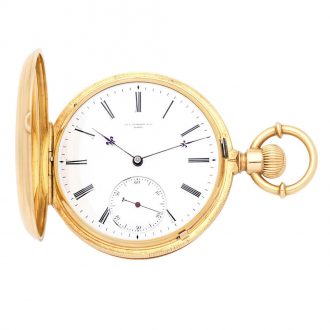
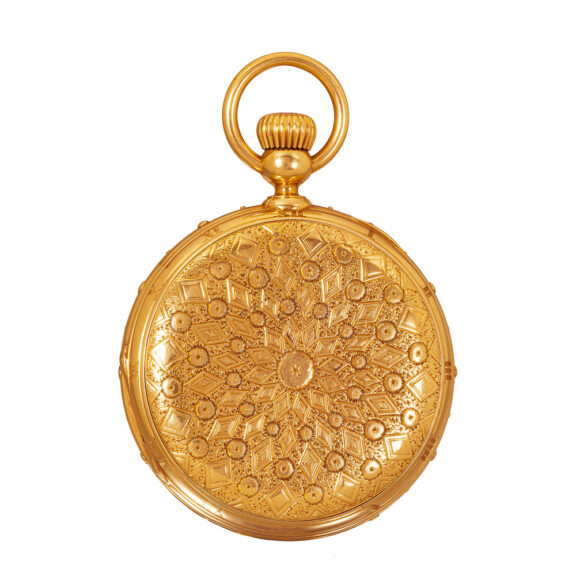
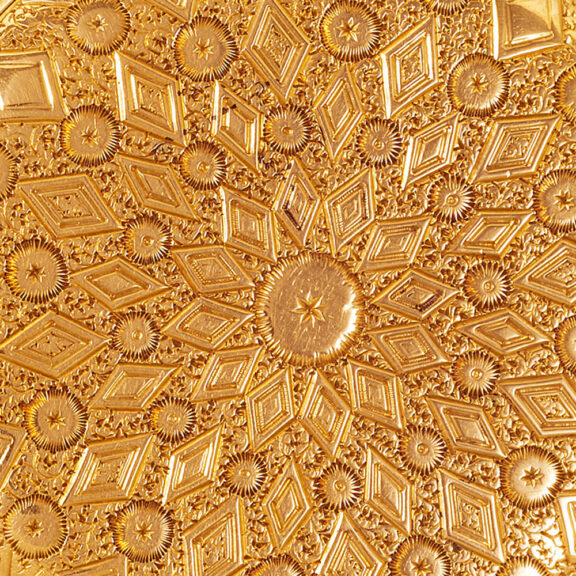
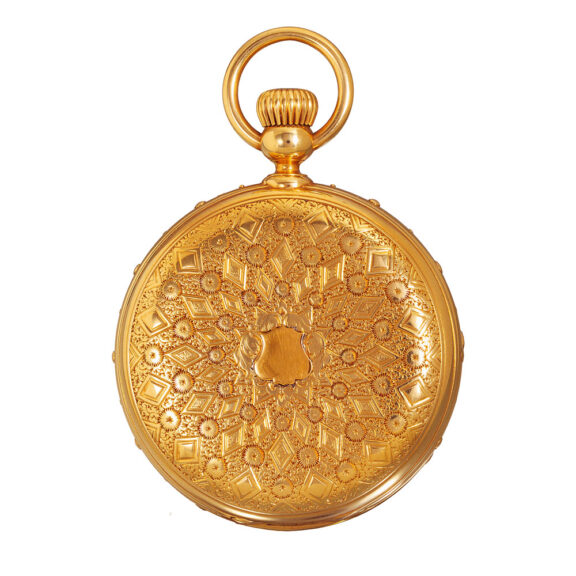
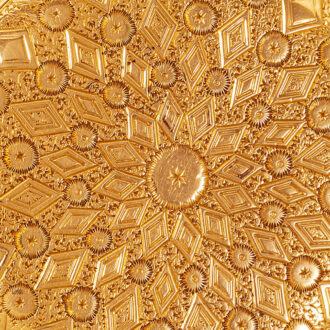
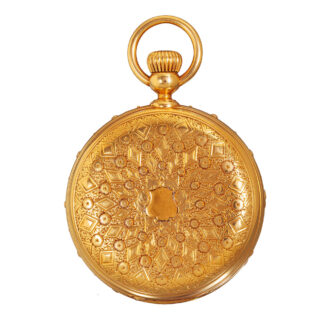
Case cover and back engraved with formal decoration in a rosette pattern, the back panel fitted with a tiny touch-piece, revolving within a bezel engraved with Roman numerals, the band with touch-pieces. Hinged gold cuvette centred with the à tact aperture and inner hinged bezel above the dial.
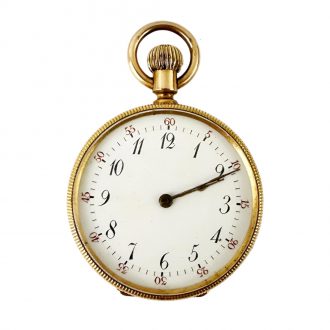
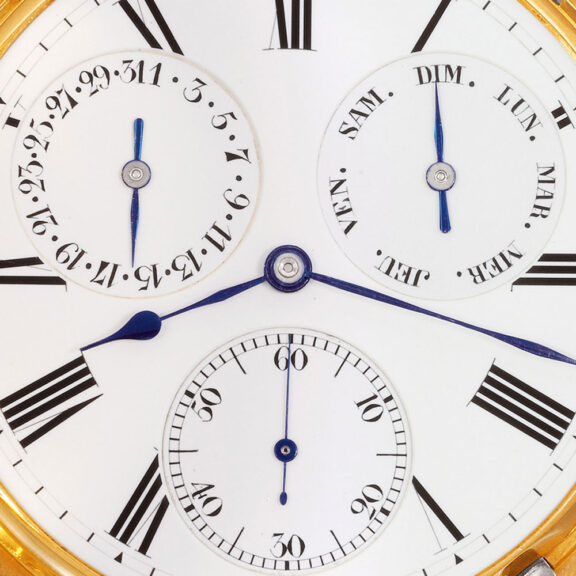
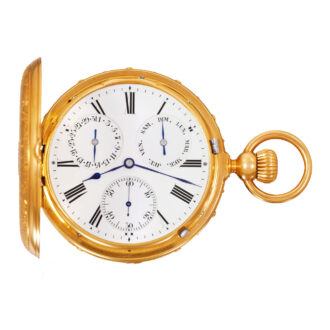
White enamel with Roman numerals, sunk subsidiary seconds, dates and days of the week. Blued steel spade hands. Signed on the cuvette.
–
Diameter: 53 mm
–
Signed: H.R. Ekegrén Genève
–
A chronometer escapement combined with an à tact device on a watch with double calendar from that period are features certainly unique. This watch was certainly made on special request. Henri-Robert Ekegrén, (1823-1896) Henri-Robert Ekegrén, was the son of Daniel Ekegrén, of Swedish origin, who had settled, and married a Danish woman in Copenhagen. Though a skilful watchmaker, he devoted himself to merchandising clocks, watches and works of art. At the early age of twelve, he became interested and skilful in watchmaking and engraving.
After his apprenticeship, able to speak the Swedish, Danish and German languages, he obtained a government fellowship to travel to other watchmaking countries. During a winter he worked for his fellow countryman, Jules Jürgensen, at Locle. In London, he worked for a well-known firm and acquired a command of English. In Paris, he worked for the celebrated Winnerl and became friendly with Adolph Länge. In 1847, he arrived at his longed-for destination, Geneva. There he worked the first year with Henri Golay, an expert watch finisher. The following ten years he worked with Golay-Leresche where he did finishing, repairing, timing, and waited on customers. In 1857, deciding that it was time to benefit from his experience, he formed a partnership with Ferdinand Westermann, who had the necessary capital. Mr. Ekegrén took as his firt understudy a young man, Louis Chevalier, who had been at the Geneva School of Horology. Chevalier remained with him for thirty-seven years. At the end of five years Mr. Westermann withdrew to seek a climate agreeable to his health.
Mr. Ekegrén served several years on a committee to reorganize the School of Horology, that it might serve the manufacturing interests of Geneva. At the Exhibition of 1867, he displayed thirty-six watches of his design that won him the gold medal as well as a report from Professor Wartmann which brought him honour and new clients. Subsequent exhibitions – Vienna in 1873, Paris in 1875, Philadelphia in 1876, Paris again in 1878, and Zurich in 1883 – brought him, as well as his collaborator Louis Chevalier, further honours and recognition. The competitions in trials by the Society of Arts, and later the Observatory of Geneva, gave his watches very high ratings. He was one of the first régleurs to apply the theories of Phillips. He made no striking inventions but constantly worked to improve each detail and to make a product of the highest merit. His success is evidenced by the high esteem in which his watches are held in Europe and America even to the present day.
Signed: H.R.Ekegrén
Share this page: