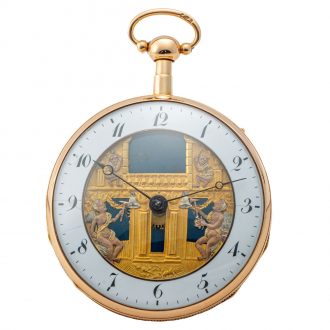
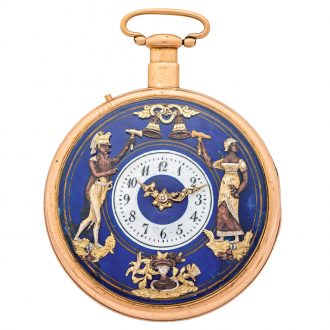
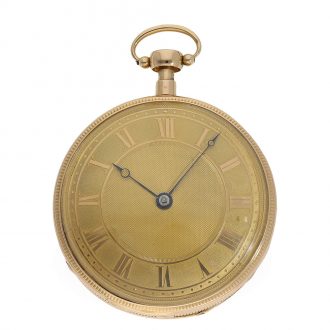
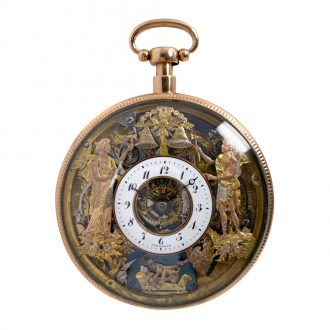
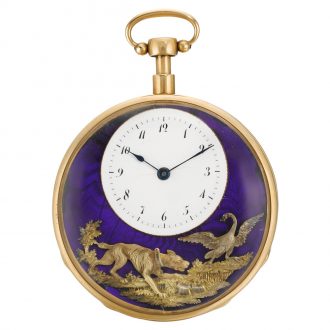
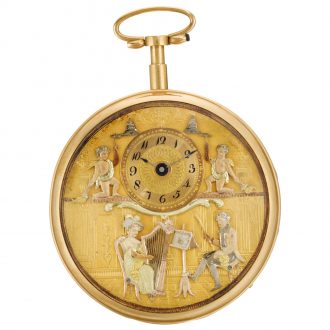
Swiss 18K gold watch made for the Chinese market Circa 1815
- Kenmerk
- TA1595
- Diameter
- 56 mm
- Estimate
- € 120.000 - 200.000
- Price sold
- € 267.700
Gold cylinder watch with centre seconds
–
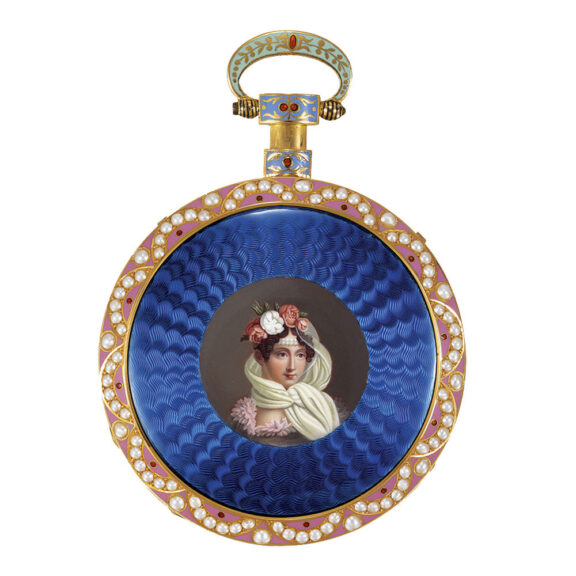
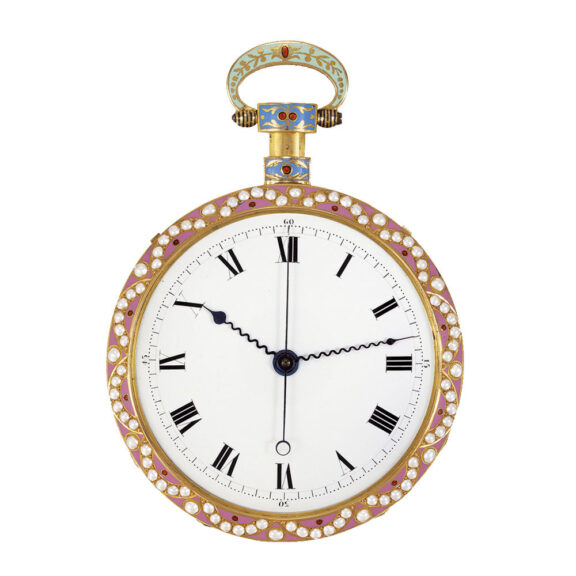
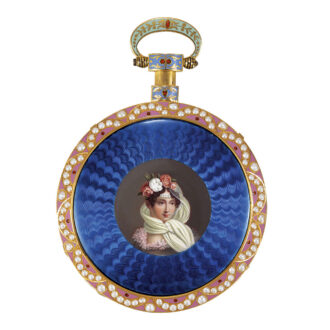
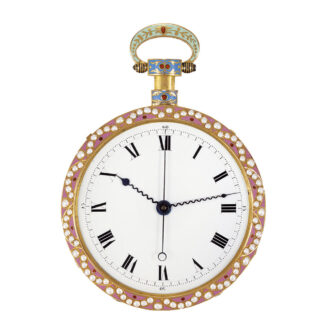
An extremely fine and very rare Swiss 18-carat gold, enamel and pearl-set quarter-repeating pocket watch with centre seconds, made for the Chinese market, circa 1815: “Allegory of Summer” by Piguet & Meylan
–
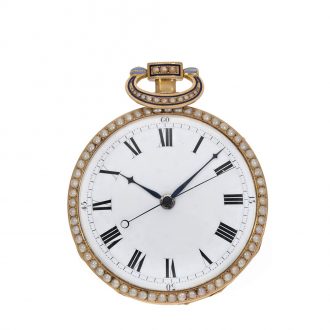
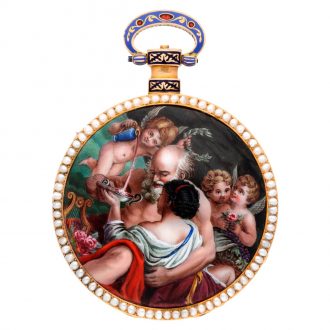
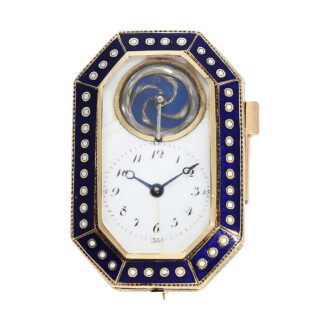
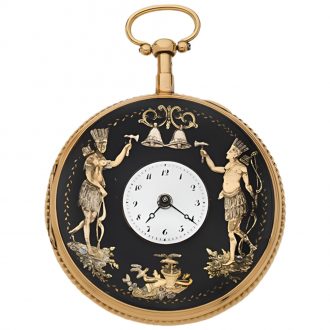
The Empire-style open-face case is by Frères Oltramare. Its bezels, pendant and bow have pink champlevé enamel and are set with split pearls in a scalloped pattern. The band, stem and bow carry floral and geometric designs in blue, pale green, red and black enamel. The back is engine-turned under translucent imperial blue enamel. At its centre is a painted enamel portrait of a young woman representing Summer. She wears a cream scarf and has roses and pearls in her hair. The portrait can be attributed to Jean Abraham Lissignol.
–
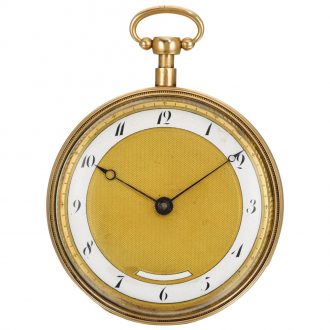
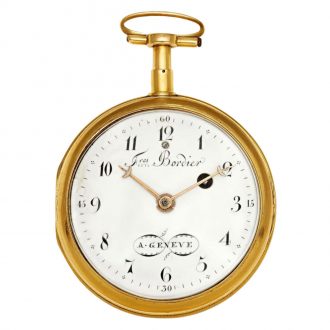
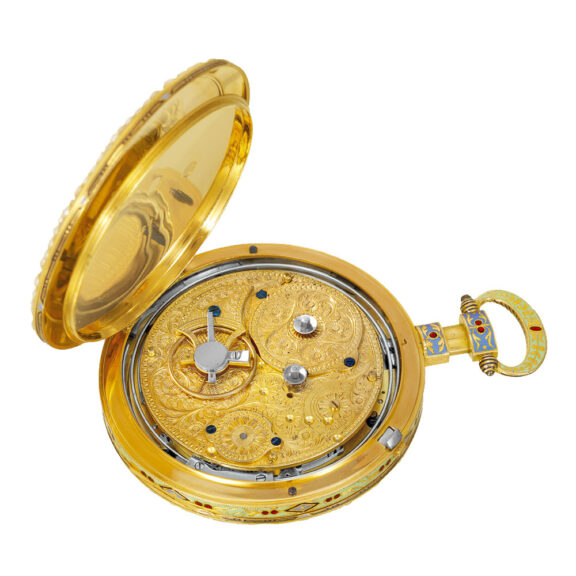
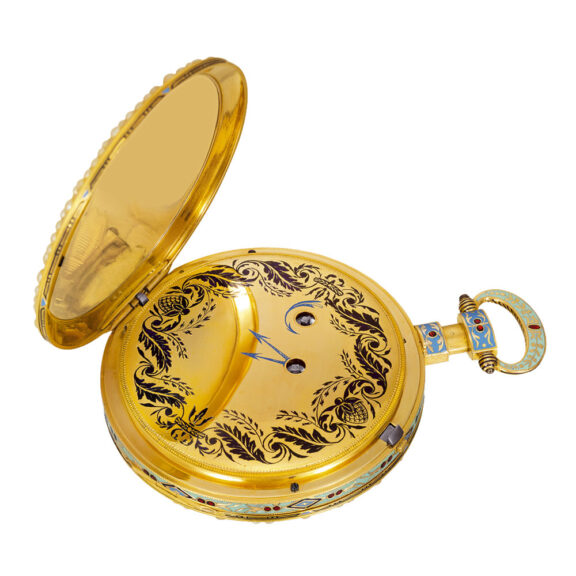
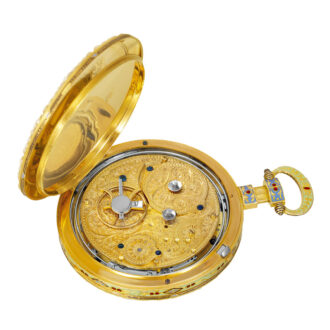
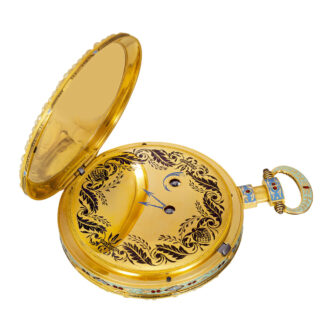
The hinged gold cuvette is decorated with flowers and foliage in imperial blue champlevé enamel. The white enamel dial has radial Roman hours and an outer minute and seconds track, with Arabic numerals every 15 seconds and blued steel serpentine hands.
–
The frosted gilt full-plate movement is richly chased and engraved with flowers and foliage in the Chinese taste. It has a going barrel, a cylinder escapement, a three-arm gold balance with a polished steel endplate, a flat blued steel balance spring and an index regulator. It repeats the quarters on gongs when the pendant is pressed.
–
The case is stamped “FO” for Frères Oltramare, and the dial plate of the movement is stamped “PM” for Piguet & Meylan.
–
Diameter: 56 mm
–
Signed: Piguet & Meylan Genève
–
A watch from this series, ‘Winter’, is in the Patek Philippe Museum in Geneva and a similar watch from the same series is in the Rolex Wilsdorf Collection (Montres et Émaux de Genève).
–
Piguet & Meylan
Isaac Daniel Piguet (1775–1841) and Philippe Samuel Meylan (1772–1845) both came from the village of Le Chenit in the Vallée de Joux. They moved to Geneva as young men and were partners from 1811 to 1828. Their firm was based at 45 Rue Jean-Jacques Rousseau in Geneva. It specialised in elaborate, beautifully decorated musical watches, as well as skeleton and automaton watches and mechanical animals. After the partnership ended, each man went on working with his sons for some time.
–
Frères Oltramare
The Oltramare family came from Genoa, Italy, and settled in Geneva in the 17th century. By the second half of the 18th century, branches of the family were working in the watch trade. The watchmaker Pierre Oltramare (1753–1827) had been apprenticed to the master watchmaker Jean Pattey of Passiery in 1768.
–
The “FO” mark belongs to the brothers Louis-David-Benjamin and Jean Hughes Oltramare. Both trained as monteurs de boîtes en or, or makers of gold watch cases. They first worked together informally, and in 1810–1811 they registered a maker’s mark as Frères Oltramare. After Geneva was freed from French occupation, they registered the same mark again on 4 November 1815. Their workshop was at 82 Rue de Coutance. The brothers ended their partnership on 31 March 1826.
–
Jean Abraham Lissignol
Jean Abraham Lissignol was a Swiss painter, a revolutionary, and one of the finest enamellers of his day. He was born in Geneva on 7 May 1749 and died in Plainpalais on 28 June 1819. He trained under Jean-Marc Roux and later became his partner. He specialised in snuff boxes and watch cases, and worked for Jaquet-Droz & Leschot, the Rochat brothers and John Rich.
Signed: Piguet & Meylan Genève
Share this page: