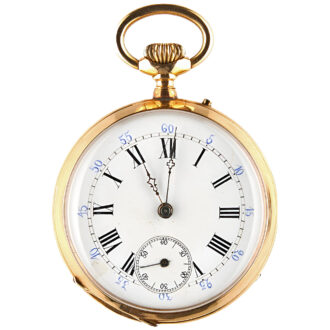
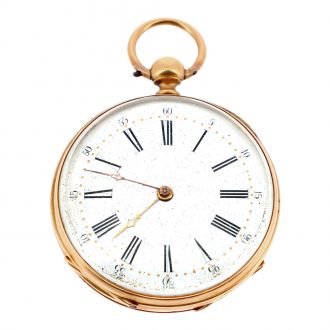
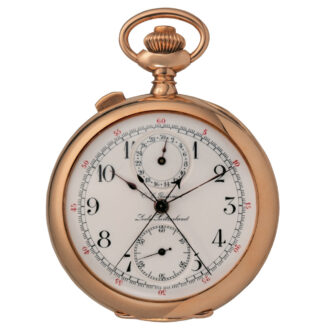
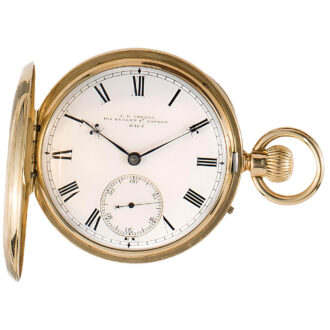
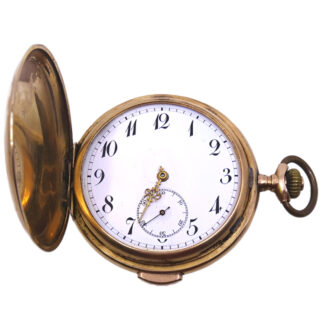
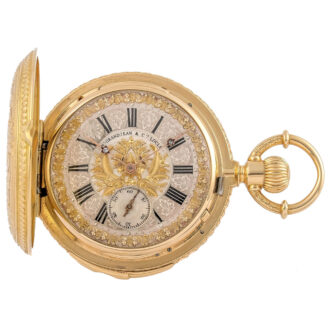
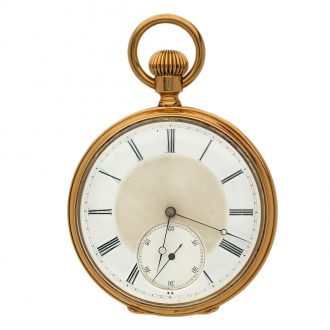
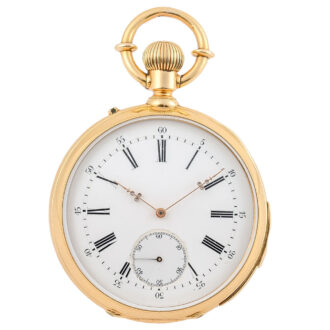
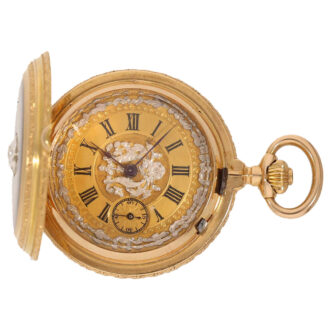
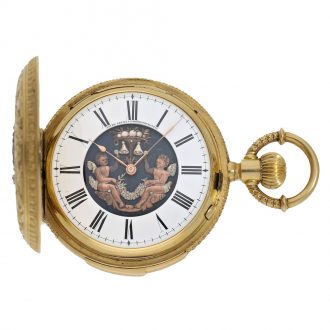
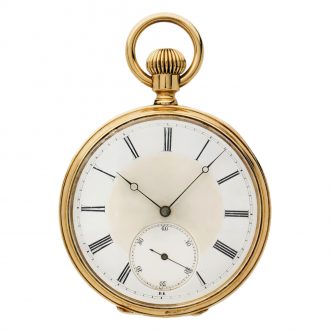
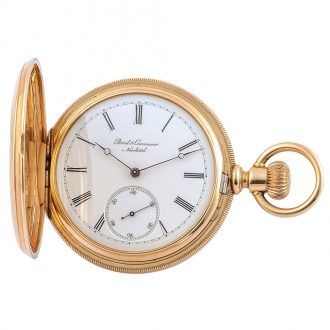
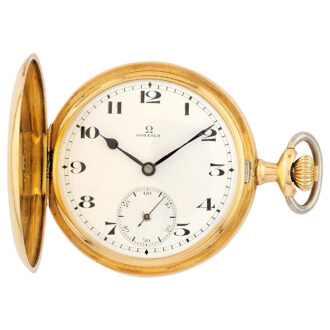
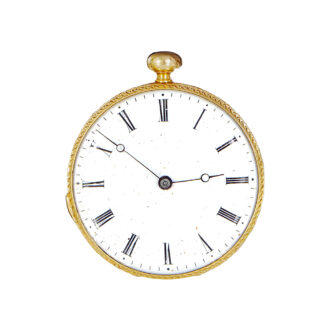
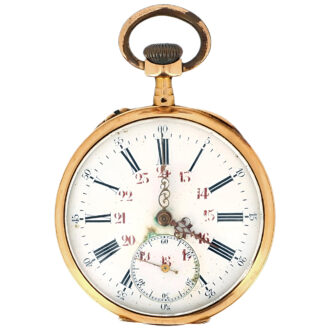
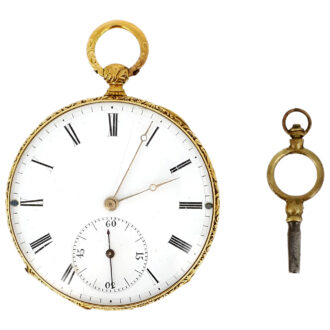
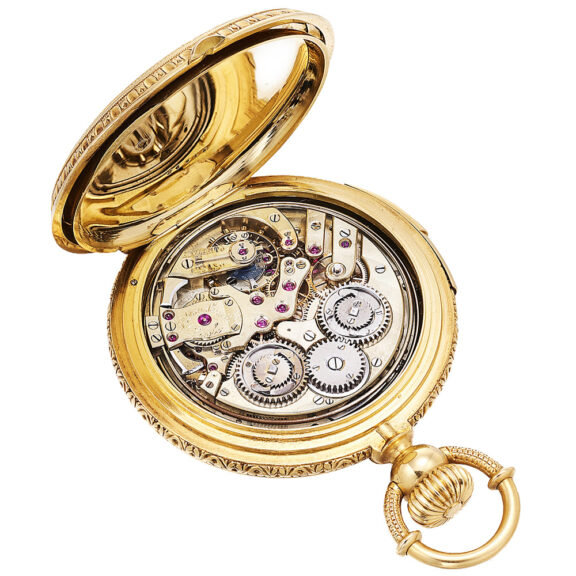
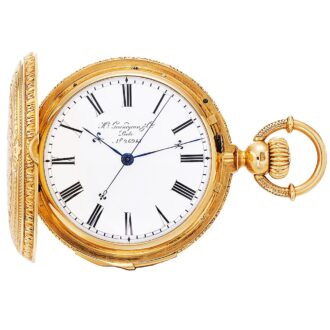
Swiss gold repeating pocket watch with second morte Circa 1880
- Kenmerk
- AA0159
- Diameter
- 53 mm
- Estimate
- € 7.000 - 14.000
- Price sold
- -
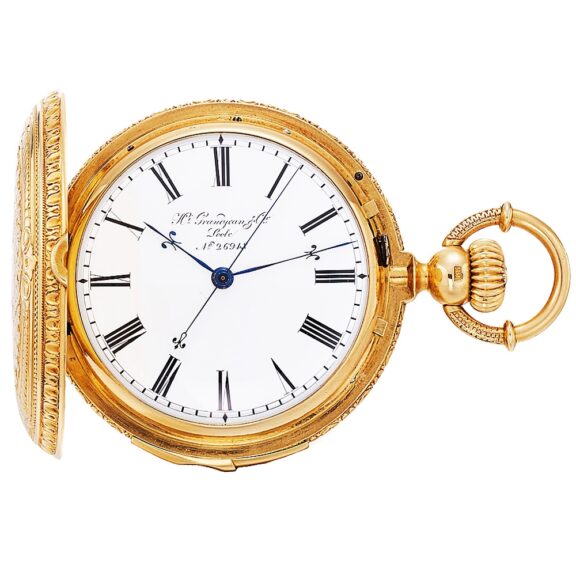
Gold hunting cased quarter repeater by H. Grandjean & Co
–
A technical interesting historical Swiss yellow 18K gold hunting cased quarter repeating lever pocket watch made for the South American market, circa 1880. –
The round-shaped case is engraved in taille-douce with stylized foliage and geometric patterns on both sides, the band chiselled, the front cover with a central escutcheon with the cypher AAC, the inside of the front cover with a dedication to Alejandro A. Cameron, 1868-1950, for 18 years services at the Sociedad Explotadora (a mining company), Tierra del Fuego, Chile, as General manager from 1893 till 1915. White enamel dial with Roman hours, an outer minute track, blued steel fleur-de-lys hands and a centre seconds hand. Rhodium-plated movement with two going barrels with differential gears and bidirectional winding inspired by Sylvain Mairet‘s (1805-1890) works (1850-1855), gold train of wheels, straight-line equilibrated lever escapement, compensated balance with gold and platinum poising screws, blued steel hairspring with a terminal curve, repeating the quarter hours on two steel gongs activated by a slide at 6 o’clock, dead independent seconds exterior graduated with the central hand activated by the rectangular push-piece located on the border of the bezel at 4 o’clock. Dial, case and movement signed.
–
Diameter: 53.2 mm
–
Signed: H. Grandjean & Co Locle
–
Henry Grandjean or Henri Grandjean (also Grandjean Perrenoud-Comtesse) was born in Le Locle on December 14th, 1803, to David-Henri Grandjean Perrenoud-Comtesse (1772-1846) and Suzanne Marie Lenoir (1776 – ?). He was baptized in Le Locle on December 31st. Henry was the brother of Henri Gustave Grandjean, Eugène Grandjean and Lucien Grandjean. Brother Henri Gustave Grandjean settled in 1830 in Peru and then tried to find the South American branches. His brother Eugene Grandjean travelled to Russia and Poland, and Lucien Grandjean worked as a case maker and eventually a watchmaker in Naples.
–
As a 12-year-old, he is said to have started his watchmaking apprenticeship at La Maltournée in Les Monts and then worked in his hometown with his father. Grandjean went to Brazil to develop the branches and commercial relationships created by his father. He disembarked in Marseille for the crossing to Rio de Janeiro on February 26, 1823, and received a passport pour le Brésil in 1824. After his return to the port of Marseille on November 21st, 1828, he went to Le Locle and took over his father’s business, Grandjean Pere et Fils. After the takeover, he changed the name to Henri Grandjean & Cie. Around 1830, he began to manufacture English-style marine chronometers in his factory. His business partner was Edouard Thévenaz. Together with Louis JeanRichard and Ulysse Nardin, Henri Grandjean founded the Swiss marine chronometer production.
–
Grandjean married Elise Montandon (1813-1878), on May 7th, 1831, in Les Ponts-de-Martel. Elise was the daughter of Isaac Pierre Montandon and Marianne Stauffer. However, this marriage remained childless. He requested and received permission to set up watchmaking schools. The founding of the observatory in Neuchâtel is his excellent work. Later, he also worked in politics. He was a member of the Revolutionary Committee of Le Locle and the provisional republican government, a member of the Constituent Assembly of 1848, radical member of the Great Council of Neuchâtel (1848-1879), Prefect of Le Locle, and was a member of the National Council (1858-1861, 1867-1880). In Le Locle, he campaigned for the Quartier-Neuf, built in 1855 to curb real estate speculation and create affordable housing for working-class families.
–
A street in Le Locle is named after him, the Rue Henri-Grandjean.
–
On March 21st, 1879, Henry Grandjean died after a long illness in Le Locle. He lived at 90 Rue du Verger. His brother Lucien’s daughter, Oline Rossel-Grandjean (1840-1922), inherited the company.
Dead independent seconds (seconde morte indépendante). A large hand in the centre of the dial, driven by a separate train to the hours and minutes, makes one jump forward every second.
Signed: Henri Grandjean & Co Le Locle
Share this page: