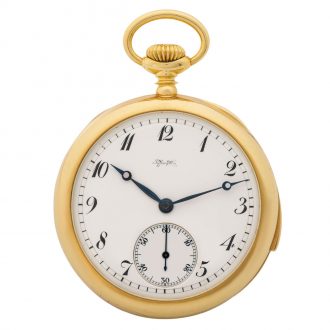
Swiss independent dead center seconds lever watch Circa 1888
- Kenmerk
- AD0341
- Diameter
- 50 mm
- Estimate
- € 11.000 - 18.000
- Price sold
- -
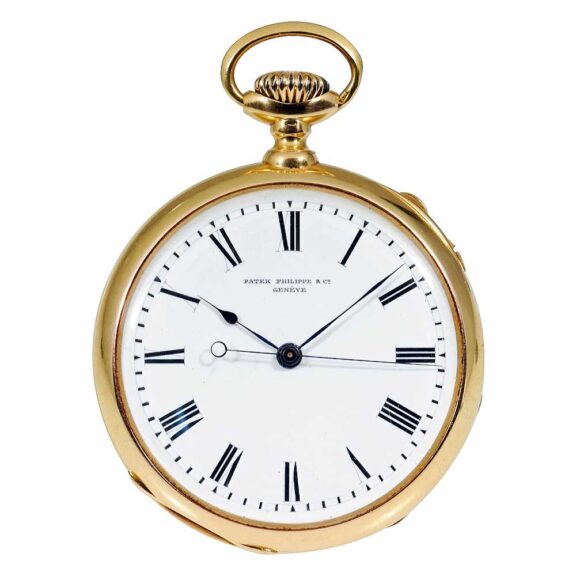
Gold pocket watch with open face by Patek Philippe & Co.
–
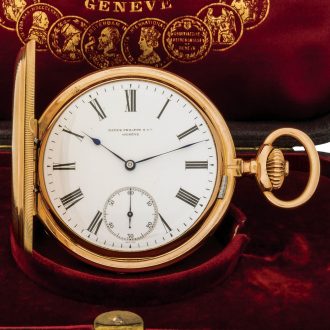
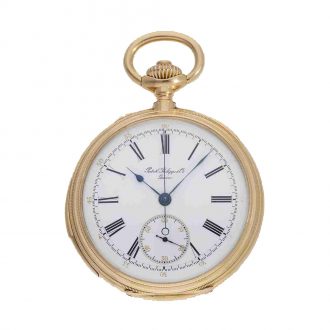
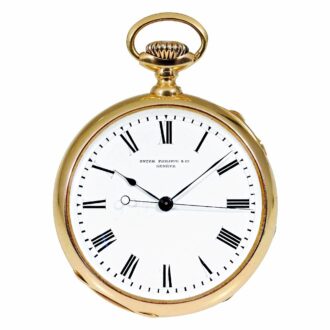
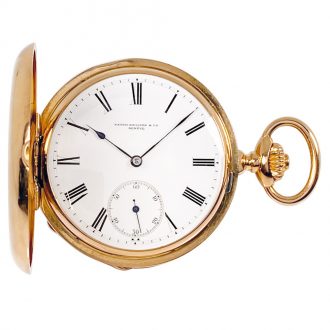
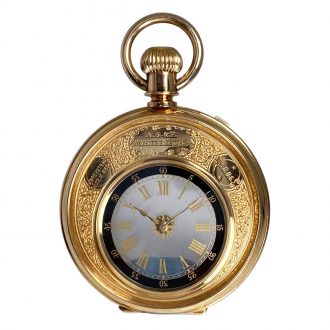
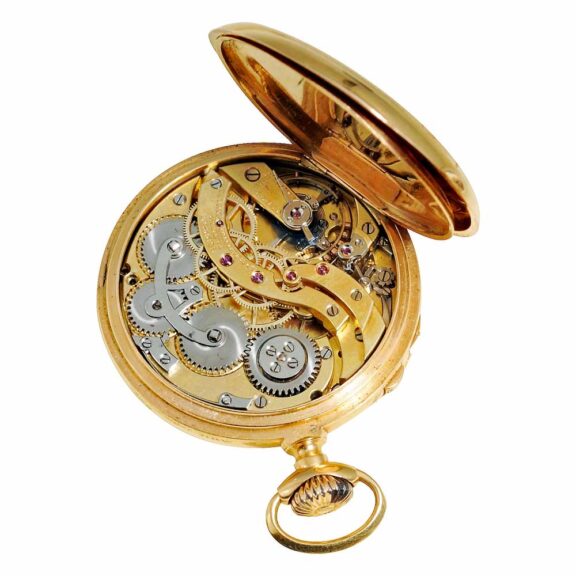
A fine and extremely rare, key less winding, Swiss 18 carat gold pocket watch, with two horological complications, circa 1888, and accompanied by the extract from the Archives.
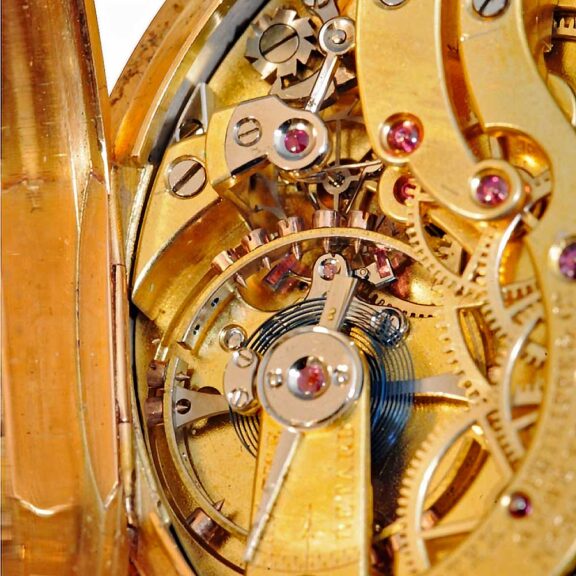
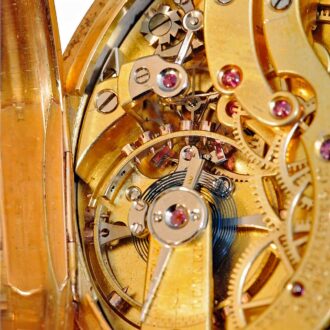
Gilded brass movement with two going barrels (the one of the dead second mechanism with slipping mainspring, so called free spring), double train of wheels, straight line equilibrated lever escapement, cut compensated balance and blued steel hairspring with a terminal curve.
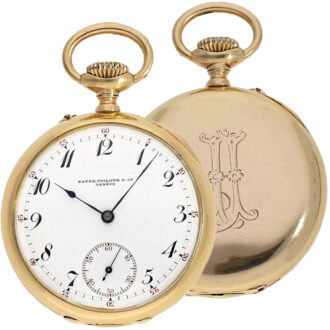
Round shaped 18 carat gold with hinged case back. Originally the case back was engraved in taille douce with the cypher ER.
Enamel dial with Roman radial hours, outer minutes and seconds track and spade hands. Dead independent seconds (exterior graduation with a central hand activated by the rectangular push piece located on the case band, at 1:15), safety bolt locking the dead seconds’ functions (slide at 1:50) and two mounting barrels in series with unidirectional winding and free mainspring.
Case, dial and movement signed.
–
Diameter: 50 mm
–
Weight: 106 g
–
Signed: Patek Philippe & Co. Geneva
–
Jean-Moîse Pouzait developed his novel movement with two trains – one conventional, one with a sweep seconds hand that could be stopped independently of the main train – in 1776 in Geneva. However, the independent dead second mechanism invented by Adrien Philippe was radically different from that of Pouzait; Philippe positioned the seconds train over the central bridge and thus gave additional space to the going train and the balance. This arrangement allowed a larger balance and, consequently, more accurate timekeeping.
–
Patek Philippe only produced less than two dozen watches with an independent dead seconds mechanism – this even includes the very early ones created by Czapek and Patek. This timepiece is based on Adrien Philippe’s two patents for tandem winding; he received the first one on June 16, 1863, in France for a “free”, or “slipping” mainspring, while the second was a Swiss patent (No. 1017) for winding two mainsprings with one crown, dated May 23, 1889. A similar watch is illustrated on page 195 of Martin Huber & Alan Banbury’s “Patek Philippe, Genève”.
Signed: Patek Philippe & Co. Geneva
Share this page: