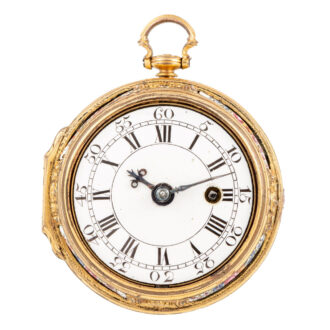
English gilt-metal verge made for the Chinese market Circa 1770
- Kenmerk
- TA1868
- Diameter
- 105 mm
- Estimate
- € 17.500 - 35.000
- Price sold
- € 17.350
Large gilt metal coach watch with centre seconds
–
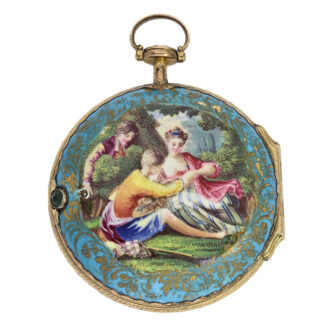
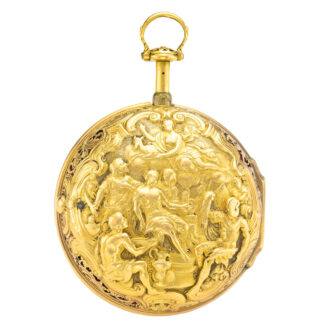
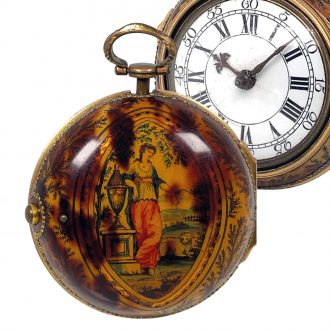
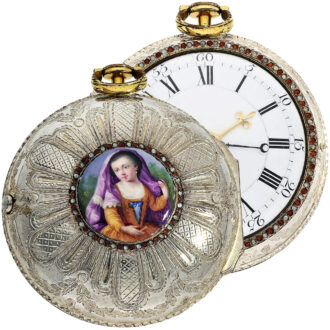
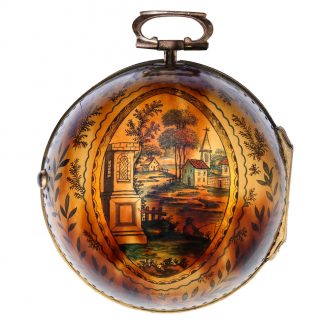
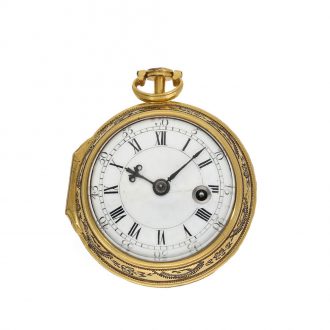
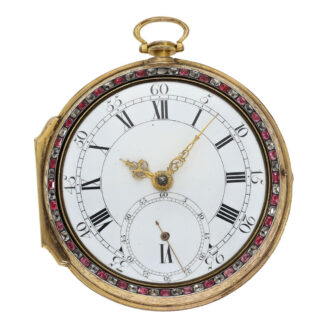
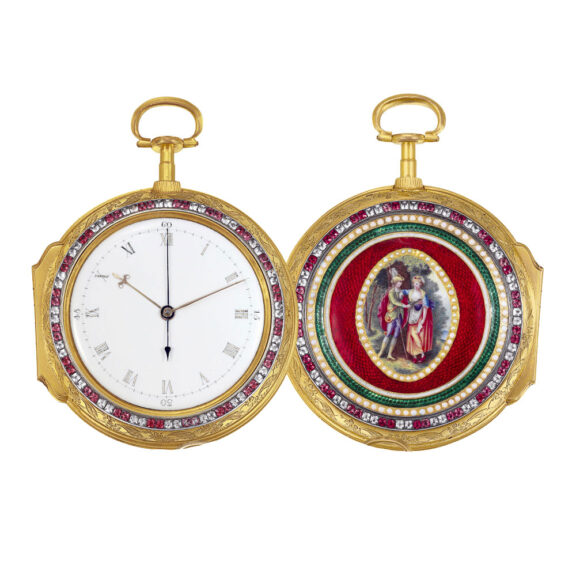
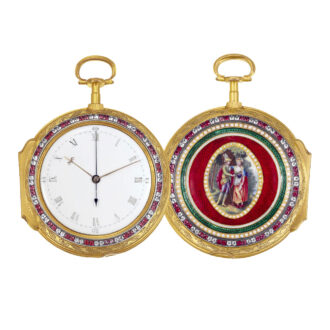
A very fine and very rare, large English gilt metal, enamel and paste-set pair-cased centre seconds coach and table watch with a stop-feature made for the Chinese market, circa 1770. Palemon & Lavinia by William Story. Foliate engraved bezels, set with alternating pairs of white and red paste stones, the back with an oval reserve decorated with a painted on enamel scene of Palemon & Lavinia from the inside to the outside surrounded by a white enamel pearl frame, translucent guilloché red enamel, a white enamel rim, translucent red enamel and another white enamel pearl border.
–
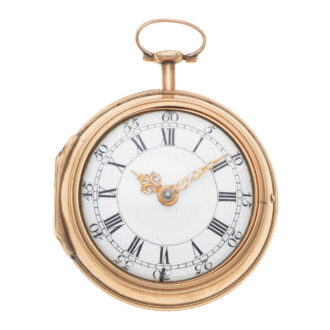
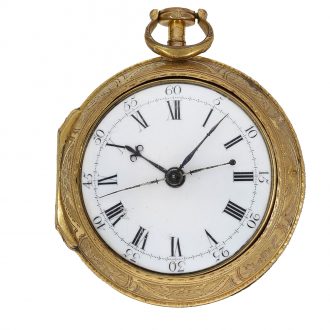
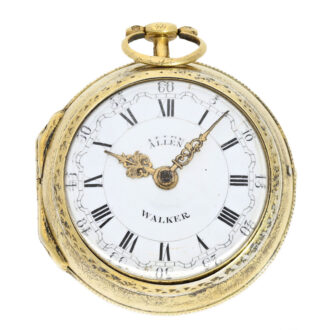
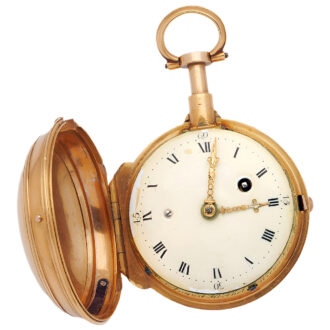
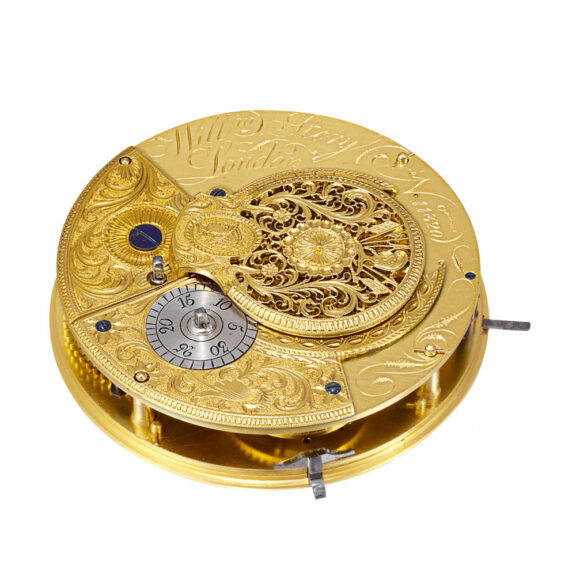
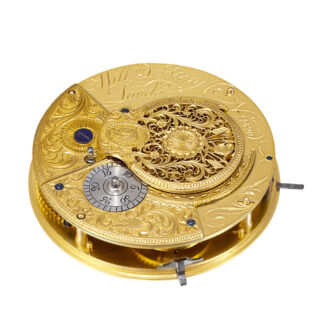
White enamel dial, radial Roman numerals, outer minutes and seconds divisions, Arabic 15-minute numerals, gold beetle & poker hands, blued steel centre seconds hand. A gilt-brass full plate movement with cylindrical pillars, fusee and chain, verge escapement, plain three-arm balance, single-footed cock pierced and engraved with leaf decoration, military trophy and warrior profile at the base, silver regulation disc, stop lever at 8 o’clock. Movement signed.
–
Diameter: 105 mm
–
Signed: William Story London
–
The former property of a European Collector.
–
The painting on the back of this watch illustrates the story from James Thomson’s popular poem ‘The Seasons’ dating from 1726-1730. The rural lovers Palemon and Lavinia appear in Thomson’s Autumn. They are adapted from the Biblical story of Ruth and Boaz. Palemon, a gentleman, professes his love for the country girl Lavinia, in a harvest-time setting. Thomson’s sentimental fantasy of rural romance was particularly attractive to a generation brought up on the ideals of Sensibility. The poem that accompanies this scene is as follows: And are thou then Acastos’ dear remains She whom my restless Gratitude has sought, So long in vain, O Heav’ns! the very frame The softened Image of my Noble Friend.
–
William Story worked in Red Lion Street, London and died in 1784. A musical clock by him is in the British Museum.
Signed: William Story London
Share this page: