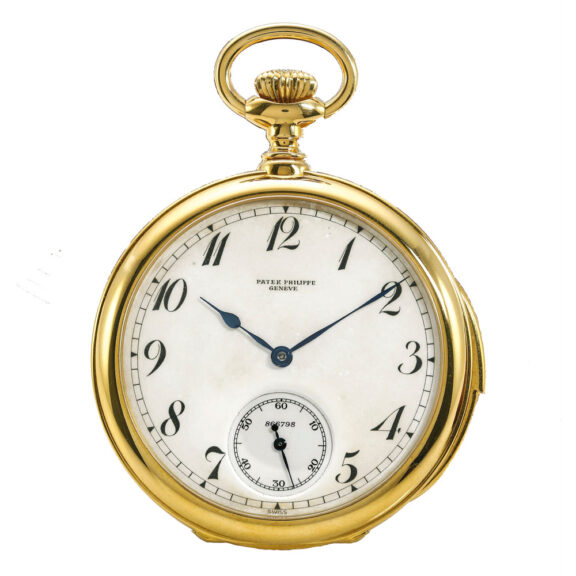
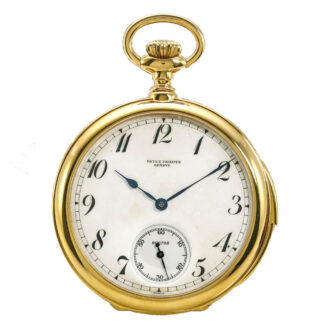
Swiss gold minute repeating pocket chronometer Circa 1989
- Kenmerk
- SA0931
- Diameter
- 56 mm
- Estimate
- € 100.000 - 200.000
- Price sold
- € 192.000
Gold chronometer with minute repeater
–
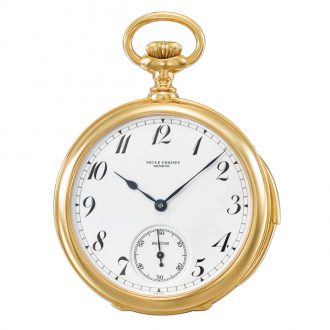
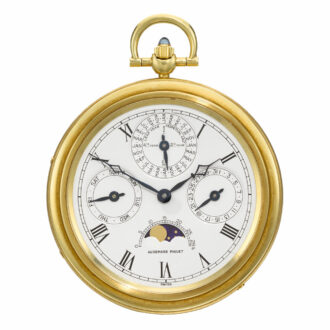
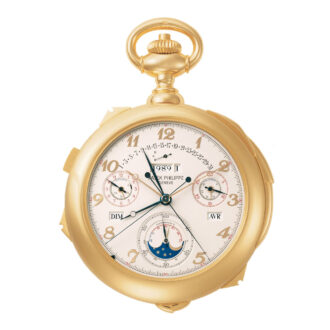
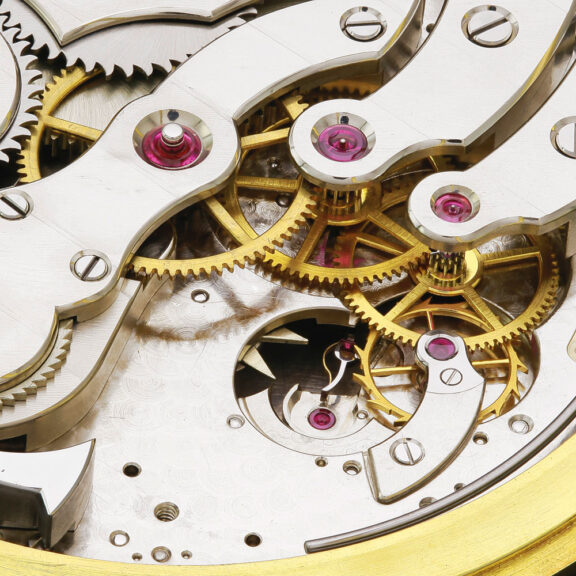
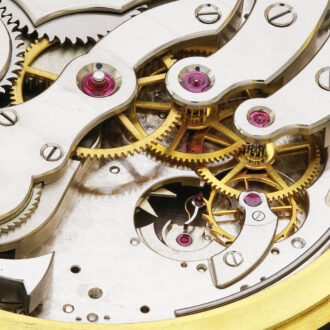
An exceptional and possibly unique Swiss yellow 18K gold open faced minute repeating keyless pocket chronometer with detent escapement, circa 1989. Manual winding nickel finish movement, detent chronometer escapement, 30 jewels, bimetallic compensation balance, blue steel helical hairspring, free-sprung, two polished hammers repeating on two steel gongs. White enamel dial, Breguet hours, outer minute track, subsidiary dial for constant seconds and blued pear hands. Polished case, hinged sapphire crystal display back, repeating slide in the band. Case, dial and movement signed.
–
Diameter: 56 mm
–
Signed: Patek Philippe Genève
–
–
An exceptional and possibly unique Swiss yellow 18K gold open faced minute repeating keyless pocket chronometer with detent escapement, circa 1989. Manual winding nickel finish movement, detent chronometer escapement, 30 jewels, bimetallic compensation balance, blue steel helical hairspring, free-sprung, two polished hammers repeating on two steel gongs. White enamel dial, Breguet hours, outer minute track, subsidiary dial for constant seconds and blued pear hands. Polished case, hinged sapphire crystal display back, repeating slide in the band. Case, dial and movement signed.
–
Diameter: 56 mm
–
Signed: Patek Philippe Genève
–
The detent escapement at Patek Philippe: During the final 20 years of the twentieth century Patek Philippe started to case and complete a small number of movements with detent escapements (numbers 866’xxx). This extremely limited production appears to have consisted of no more than 2 movements every 3 years. At the present time only 31 Patek Philippe movements with detent escapement are known and according to research:
• Between 7 and 8 movements have never been cased
• 5 movements are known to incorporate quarter repetition
• 1 movement with minute repeater (present watch) plus between 9 and 12 movements
• 5 movements are known to incorporate quarter repetition
• 1 movement with minute repeater (present watch) plus between 9 and 12 movements
with starting number 866’xxx
• 3 deck marine chronometers
• 2 detent escapement movements with Tourbillon
• 3 deck marine chronometers
• 2 detent escapement movements with Tourbillon
The complexity and skill required to produce the detent escapement has resulted in historically low production numbers. It is interesting to note that, by comparison, 93 tourbillon movements are known to have been cased as pocket watches by Patek Philippe, three times the number of detent movements known.
–
The chronometer: It is to Pierre Le Roy, son of the famous French watchmaker Julien Le Roy, that we owe thanks for the three fundamental principles that led to the development of the modern chronometer timepieces:
–
The chronometer: It is to Pierre Le Roy, son of the famous French watchmaker Julien Le Roy, that we owe thanks for the three fundamental principles that led to the development of the modern chronometer timepieces:
1. The free escapement
2. The self-regulating balance
3. The isochronous hairspring
2. The self-regulating balance
3. The isochronous hairspring
Comparing the construction of the free escapement introduced by Pierre Le Roy, represented in his ‘Works’ in 1748, published in the History of the Academy of Sciences and applied in 1763, one can see how this device differs from its earlier version. The innovations capture the huge amount of effort which Le Roy deployed during this long period in order to achieve both principles with the free escapement and conditions of isochronous oscillations linked to the adjustment of temperature compensation. In his ‘Précis des recherches …’, Pierre Le Roy mentioned, in 1768, a work that he had already announced in 1750, called ‘Essai de physique et de dynamique sur les ressorts des corps’, which was never published. The manuscript of this essay shows that, from this period, his researches on friction, the elasticity of springs and the phenomena of metal dilatation had led him to conceive a primitive form of equalizing winder and a mechanism to compensate the effects of temperature on the functioning of watches. Pierre Le Roy presented many papers to the Academy, concerning both watches and clocks. However, his work in the field of marine clock making is so important that it possible to speak of him as a true genius. In 1748 he conceived a detent escapement whose design, published by Gallon in ‘Machines et inventions approuvées par l’Académie Royale des Sciences’, does not entirely explain its way of functioning. It does, however, show the first attempt at making an escapement which ensured that the balance would have complete freedom of motion, outside the phases of unlocking and impulse. The successful design of the escapement, which enabled the vibrations of the balance all the freedom and necessary regularity, allowed Pierre Le Roy to realize that in any spiral spring of sufficient stretch, there was a certain length in which all vibrations are isochronous. This meant that the oscillations, large or small, could be fulfilled in the same period of time. Consequently, this finding led Pierre Le Roy to vary the length of the spiral setting to compensate for temperature variations. It was mandatory that the compensation be made directly on the balance itself. He therefore devised a circular cut bimetallic balance, in which the segments were distorted inward or outward, due to the difference in coefficient from the thermal expansion of its components, thus compensating for temperature variations. In England, based on Le Roy’s principles, John Arnold, followed by Thomas Earnshaw, produced the very first truly operational marine chronometer watches, which equipped the ships of the British Navy. On the continent, it was Louis Berthoud who was the first, along with his nephew and pupil, Henri Motel, who also built on these principles, the chronometer watches which equipped the French Navy. Thereafter, the pivoted detent escapement allowed the -development of this device in almost all Swiss watches.
Signed: Patek Philippe Genève
Share this page: