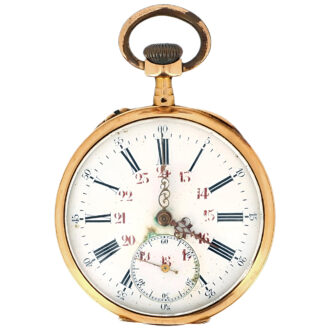
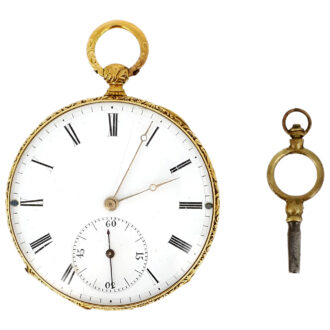
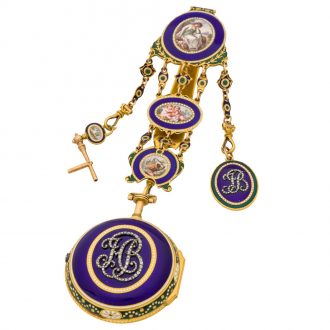
Swiss gold repeater with grande and petite sonnerie Circa 1890
- Kenmerk
- AD3391
- Diameter
- 54 mm
- Estimate
- € 30.000 - 55.000
- Price sold
- -
Gold, enamel and diamond-set full hunter by Piguet Frères
–
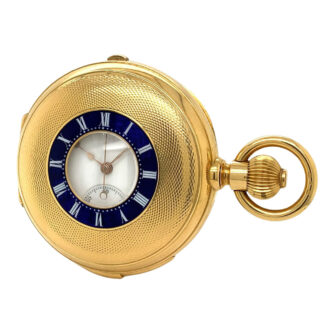
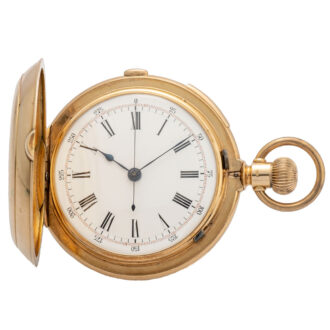
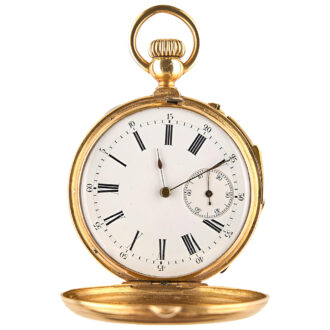
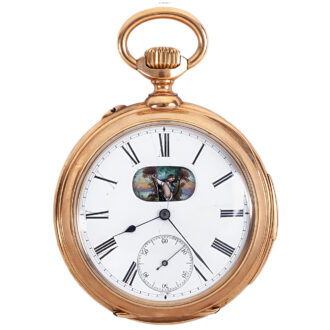
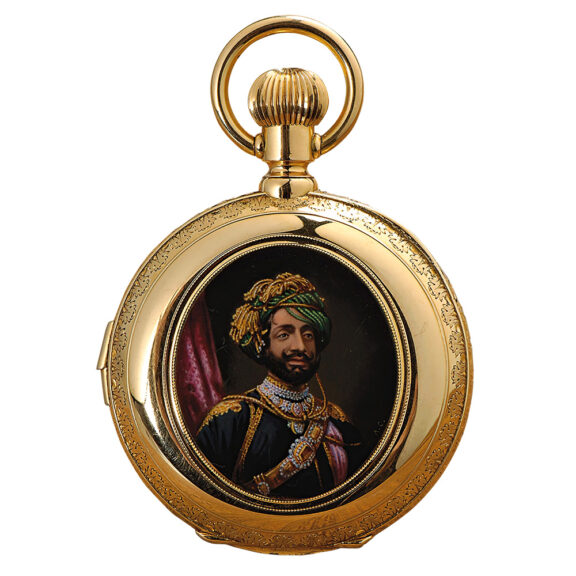
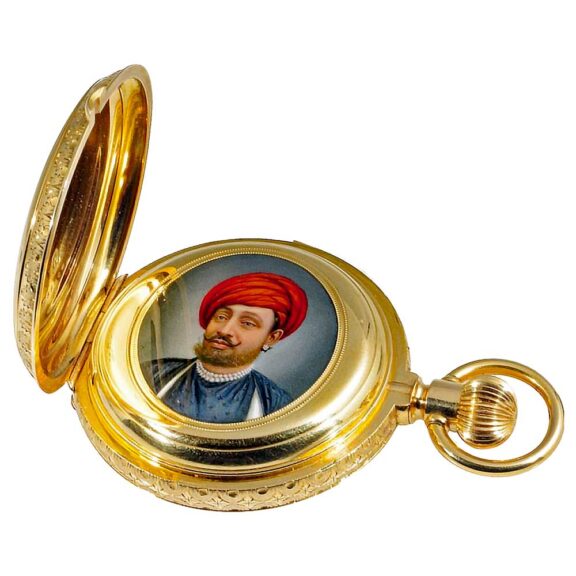
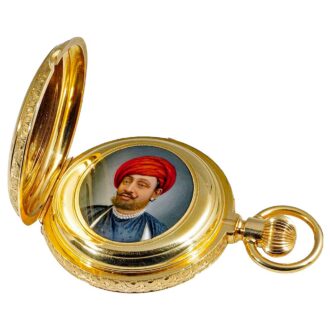
An important Swiss 18 Carat gold, enamel and diamond-set hunting cased grande and petite sonnerie quarter repeating lever pocket watch, circa 1890. Made on special order for the Nawab of Junagadh, Bahadur Khanji III, reign from 1882 to 1892 and most probably presented to the vizier of Junagadh, Bahaduddinbhai Hasainbhai.
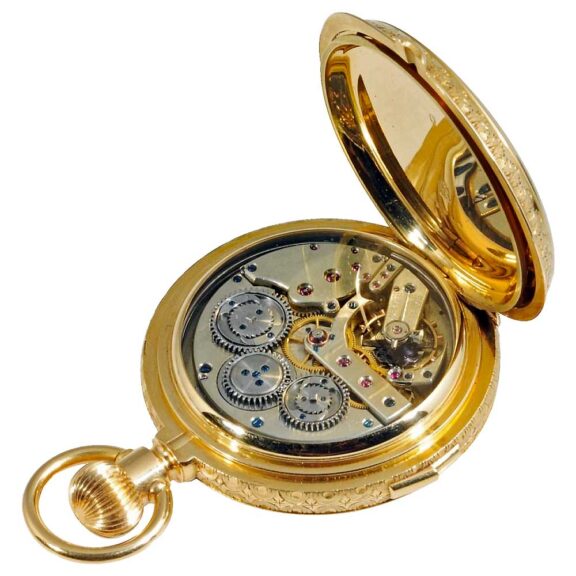
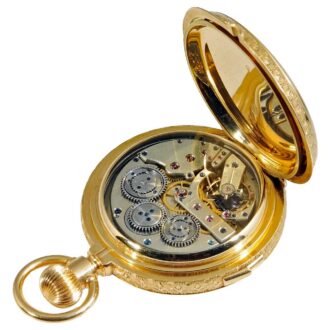
Glazed bridge movement, tandem winding with mirror polished click works on the top, two hammers/two gongs, gold screw compensation balance.
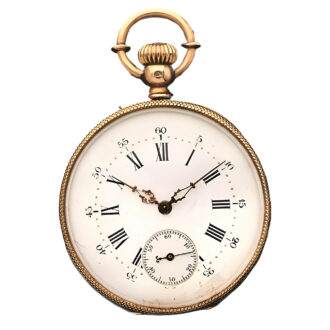
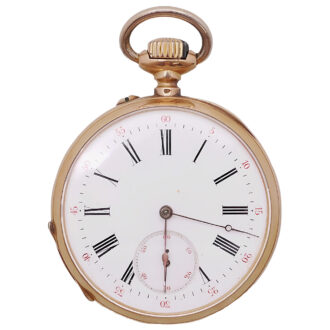
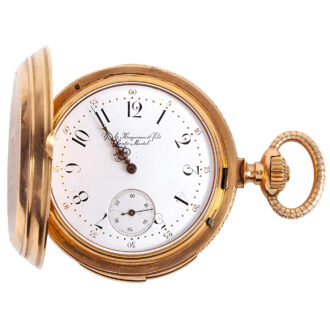
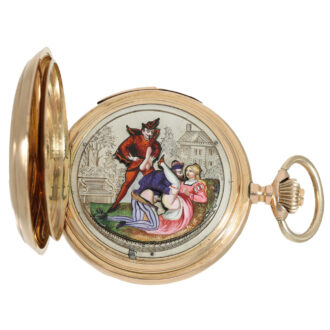
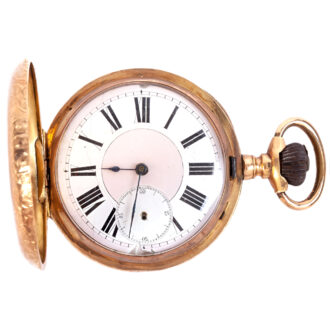
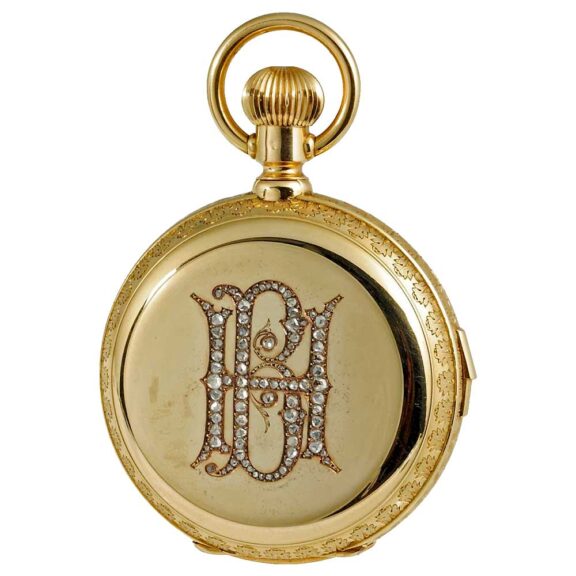
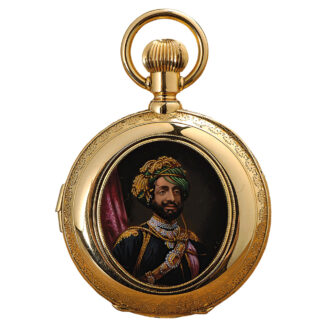
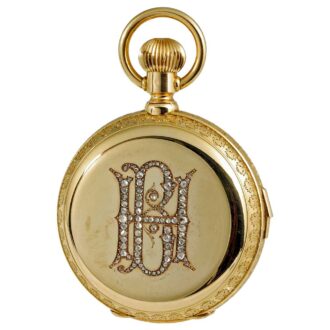
White enamel dial with Roman numerals, sunk subsidiary seconds and spade hands. The case band and both bezels are lavishly engraved, the front with a very fine polychrome enamel portrait of Bahadur Khanji III, Nawab of Junagadh in his regalia, the miniature signed A.C., on the back the diamond studded initials of the vizier of Junagadh, Bahaduddinbhai Hasainbhais (BH), whose enamel portrait adorns the inside of the gold cuvette, case maker’s mark J&Co. The two enamel portraits on this piece are made by the most famous enamel painter of the late 19th century Pierre-Amédée Champod, Geneva.
–
Diameter: 54 mm
–
Weight: 162 g
–
Signed: Piguet Frères
–
The distinctive ebauche was supplied by Piguet Frères. The company was founded in 1887 by Albert Piguet and his brother Edouard. A very similar movement is illustrated and described in the catalogue of the grand Jürgensen exhibition at the museum in Le Locle “Les Jürgensen”, Musée d’Horlogerie, Le Locle 1974, pages 38 and 48.
–
Pierre-Amédée Champod (1834-1913) was one of the most celebrated enamel painters of the end of the 19th century, he specialized in portraits of important figures from the Orient and from Europe. He also painted beautiful landscapes and dramatic hunting scenes for the Chinese and Indian markets. He worked for important makers such as Bovet, Vaucher, Vrard and Courvoisier Frères.
–
Mohammad Bahadur Khanji III was born in 1856 and ruled the Muslim state of Junagadh from 1882 until his death in 1892. He was the seventh Nawab of Junagadh and a descendant of Mohammad Sher Khan Babi, who had founded the state and declared its independence in 1730 after the Maratha invasion. Junagadh was a tributary to Maratha Empire until it became part of the British Empire in 1807 after the second Anglo-Maratha War. After the Indian independence and the partition of India in 1947, the last ruler of Junagadh Mohammad Mahabat Khanji III signed accession to Pakistan. However, India did not accept the Nawab’s decision because most of the population of Junagadh was Hindu. In a referendum in February 1948, an overwhelming majority chose India over Pakistan.
–
Vizier Bahaduddinbhai Hasainbhai, CIE. Junagadh was vizier to Nawab Bahadur Khanji and to his successor, Nawab Rasulkhanji (1892-1911). His Mausoleum in Junagadh paid for with his own funds, is often referred to as the Taj Mahal of Gujarat.
Signed: Piguet Frères
Share this page: