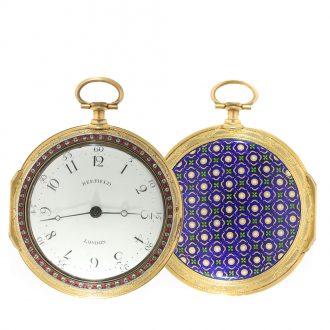
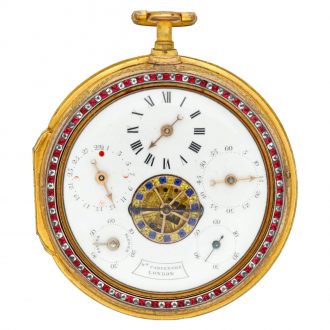
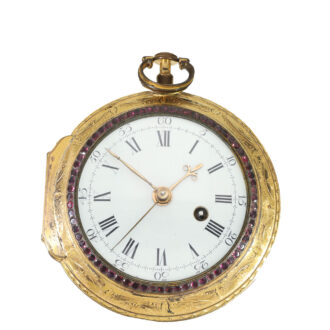
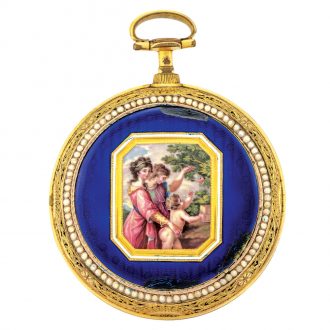
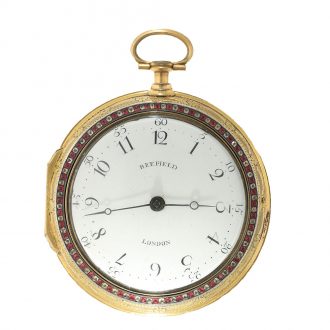
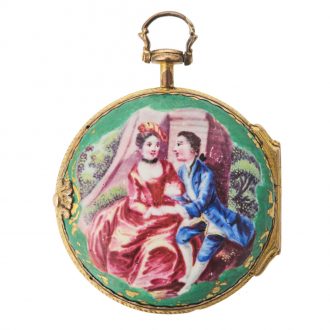
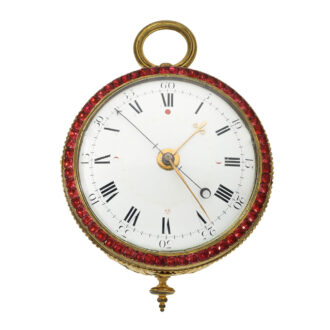
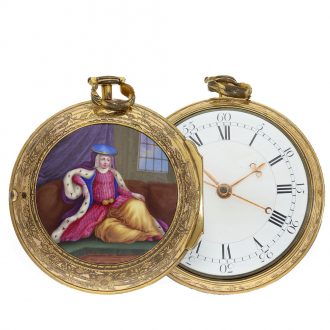
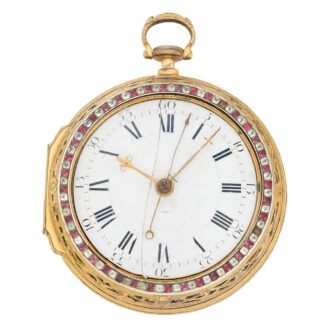
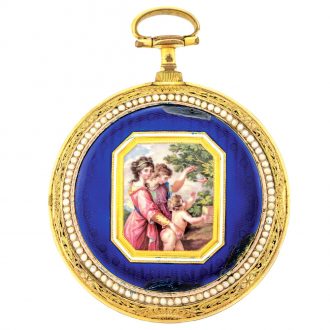
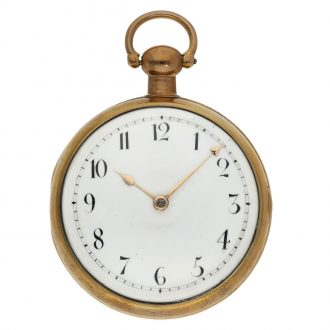
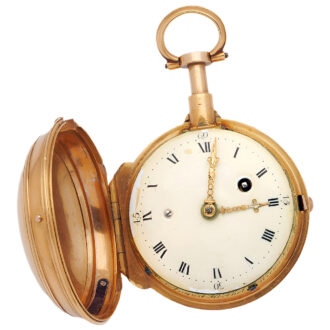
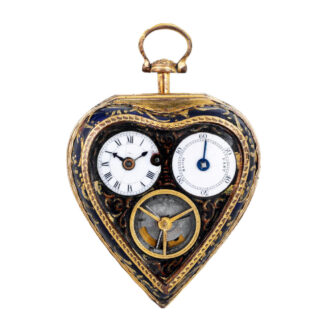
English gilt metal erotic watch for the Chinese market Circa 1780
- Kenmerk
- TA2391
- Diameter
- -
- Estimate
- € 15.000 - 30.000
- Price sold
- € 38.500
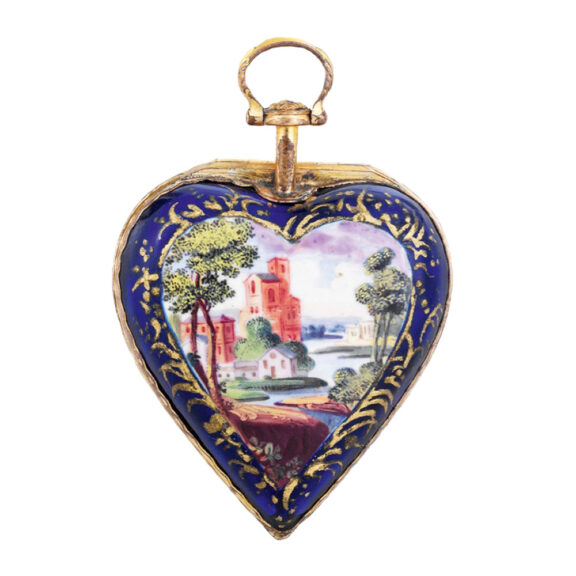
Gilt metal form watch in the shape of a heart
–
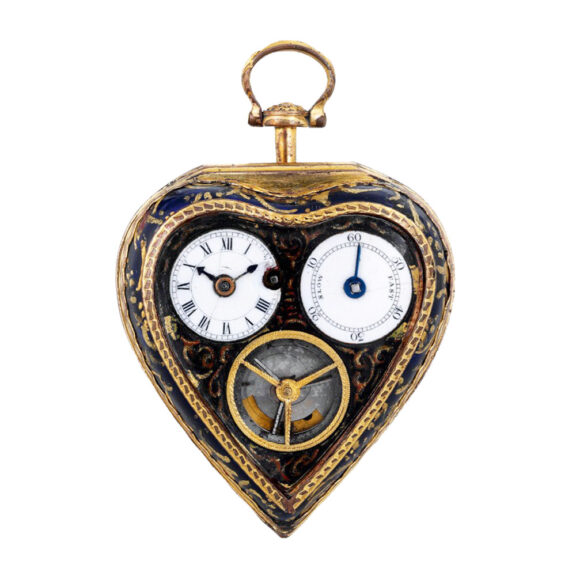
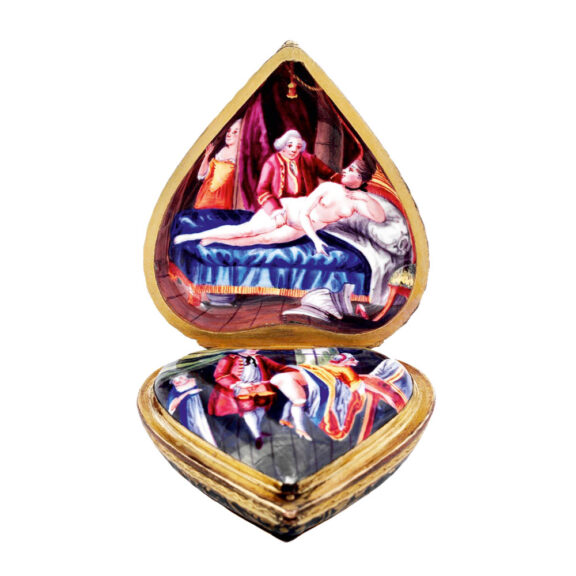
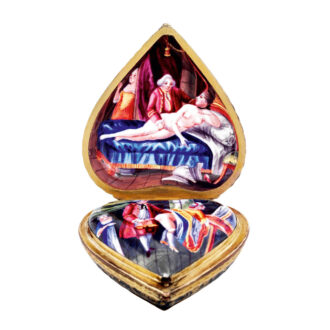
A very fine and rare English gilt metal and enamel heart shaped watch with two concealed erotic scenes and visible balance made for the Chinese market, circa 1780. Affairs of the Heart by James Cox. Case in the shape of a heart, hinged back with a polychrome enamel riverside landscape, on the inside a scene in which a gentleman considers his options in the preliminaries to the art of love while a servant secretly watches, on the inside dome, another painting of the couple as the scene continues, the counter enamel with a bouquet of forget me nots.
–
White enamel dial with radial Roman numerals and outer minute track on the top left, on the right slow/fast regulator dial, at the bottom aperture for the balance oscillating against a polished plate, all set into a blue enamelled mask painted with gold scrolls, blued steel hands. Heart shaped, hinged gilt brass full plate movement, cylindrical pillars, fusee and chain, verge escapement, plain polished steel three arm balance, flat balance spring, three arm cock. Movement signed.
–
Dimensions: 52 x 42 mm
–
Signed: James Cox London
–
The case has slightly restored soft enamel.
–
James Cox (circa 1723 – 1800) was born in London around 1723, he was the son of Henry Cox, a tailor. He became Free in 1745, at which time he was described as a goldsmith. Cox also called himself a jeweller. In December 1745, Cox married Elizabeth Liron. In June of that same year, he set up a shop in Racquet Court, where he remained until 1756. An elaborate trade card has survived from this period with text in English, French, and German, it offers a “Great Variety of Curious Work in gold, silver and other metals, also in amber, pearl, tortoiseshell and curious stones”. In 1756 Cox entered into a partnership with Edward Grace and moved to larger premises in Shoe Lane. However, Cox & Grace declared bankruptcy in November 1758. The list of Cox and Grace’s stock, which was advertised for sale in 1760, was said to comprise “things in the jeweling and toy business suitable both for foreign and home trade”.
–
The Cox & Grace bankruptcy did not stop Cox from advancing, on the contrary, he retained the premises in Shoe Lane and continued working. In July 1763, his bankruptcy proceedings terminated with his discharge. It was during the 1760s and early 1770s that Cox became famous for a very specific genre: elaborate and luxurious musical and automaton clocks and watches, made of precious metals and studded with precious stones, destined particularly for the Ottoman, Indian and Chinese empires, and especially for the court of the Chinese Emperor himself. The first record of such activity on Cox’s part is a “notice of two curious Clocks” which appeared in the Gentleman’s Magazine of December 1766. During this period, and until 1773, Cox’s chief mechanic was a brilliant Belgian, John Joseph Merlin (1735-1803).
–
Merlin is generally considered to have been Cox’s “right hand man”, and any pieces signed by Cox which can be securely dated to before 1773, may have been designed or even made by Merlin. Later, many clocks-, watch- and singing bird movements were made for Cox by the Jaquet Droz firm. Cox earned great renown through the Museum he maintained in London’s Spring Gardens from 1772 to 1775. It was a lavish venue draped with crimson curtains, whose ceilings were decorated with “chiaroscuro paintings of the liberal arts”, by a “celebrated artist” of the day, probably Angelica Kauffmann. In 1769, Cox purchased the Chelsea Porcelain Works, intending perhaps to further diversify his trade it has been suggested that he planned to collaborate with Matthew Boulton in the making of ormolu-mounted porcelain vases. However, for reasons that remain unknown but may have to do with Cox’s persistently precarious financial situation, the porcelain works were sold again only five months later.
–
Both profits and demand continued to decline, and Cox soon found himself in difficult financial straits, with insufficient cash at hand, and a large stock in which he had invested hugely. To remedy this situation, Cox held two sales of items from his stock at Christie’s, in July and December 1772. In addition, early that same year he opened his mechanical museum in the Great Room at Spring Gardens. For the three years of its existence, “Cox’s Museum” – with its astonishingly high entrance fee of half a guinea – was the talk of London. James Boswell, who went to see it in April 1774 at the insistence of Dr Johnson, found it “a very fine exhibition” for “power of mechanism and splendour of show”, while Fanny Burney considered it impressive but somewhat shallow.
Signed: James Cox London
Share this page: