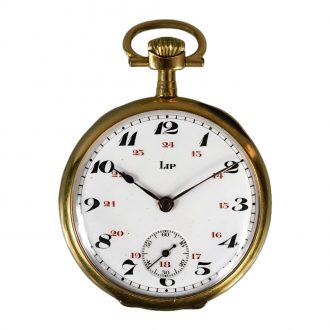
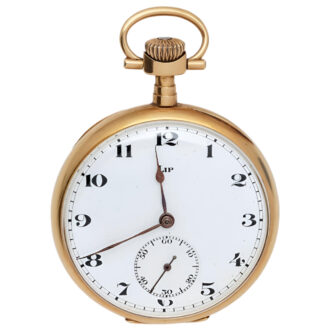
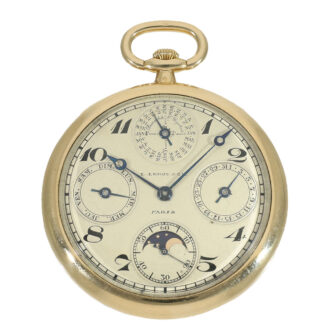
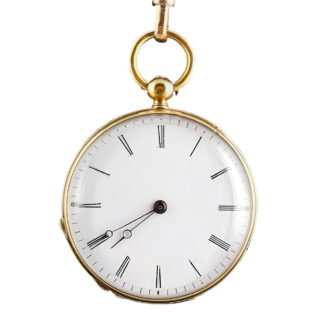
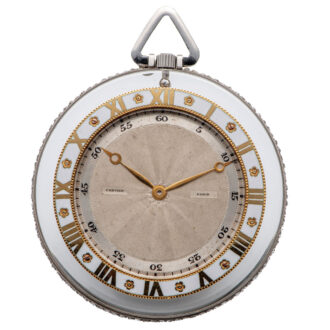
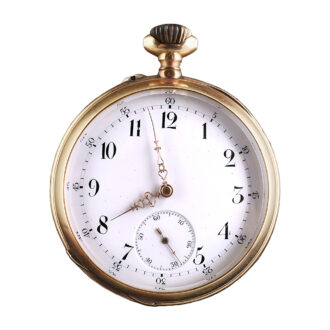
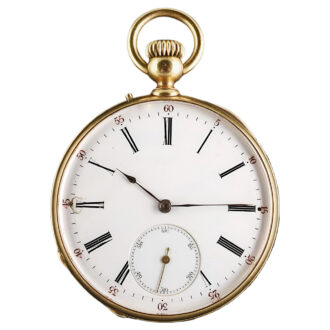
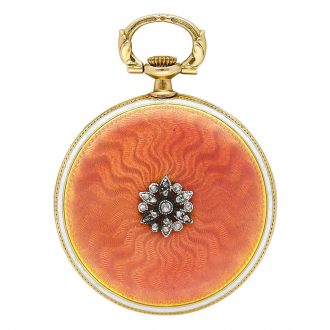
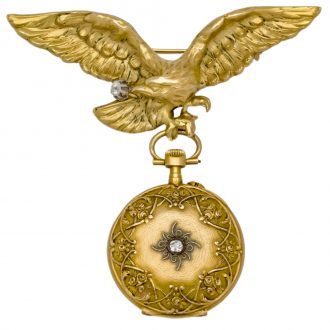
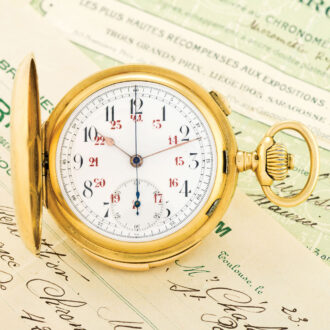
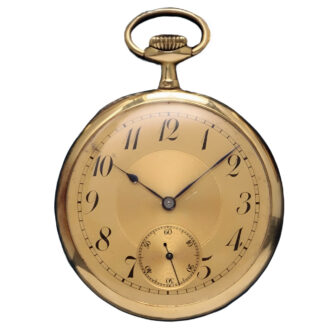
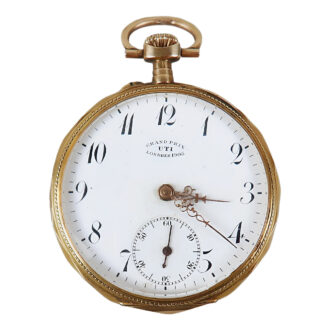
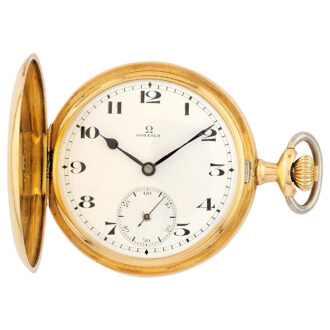
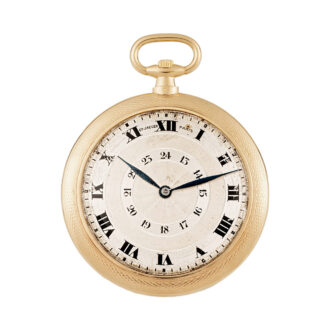
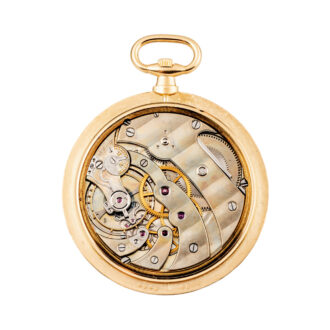
Ultra-thin French 18K gold Art Deco pocket watch Circa 1910
- Kenmerk
- AA0298
- Diameter
- 47 mm
- Estimate
- € 2.000 - 4.000
- Price sold
- -
Gold Art Deco pocket watch by Edmond Jaeger
–
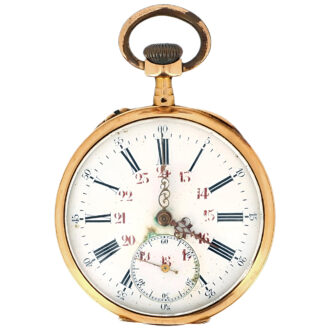
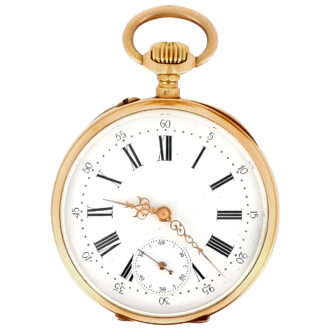
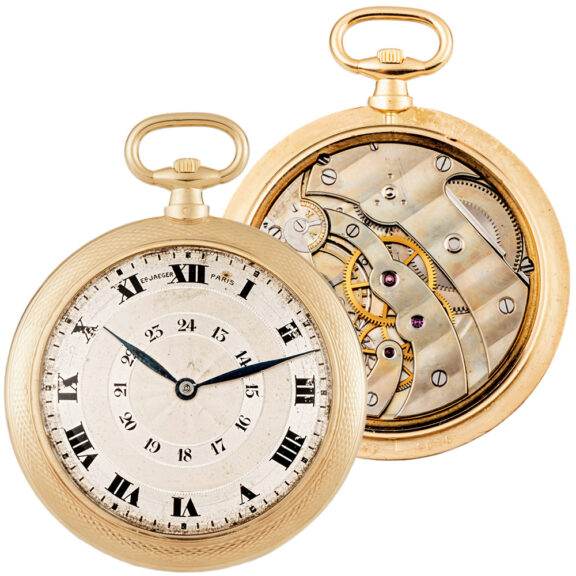
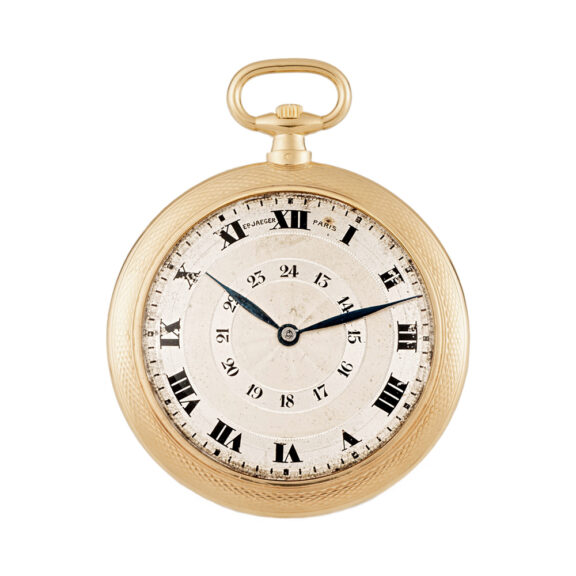
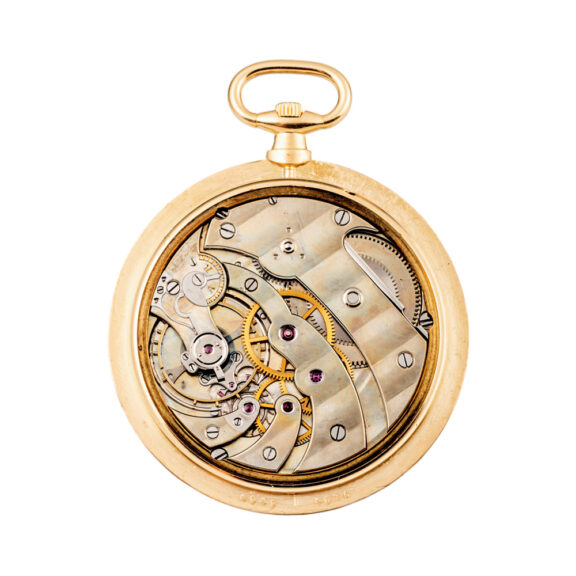
A fine and elegant, ultra-thin, manual wind, French 18K yellow gold Art Deco pocket watch, circa 1910.
Two-tone silvered dial, inner 24-hour track with painted Arabic numerals, outer Roman 12-hour ring, outer minutes track, and blued hands. Signature on dial and case with enamel initials.
–
Diameter: 47 mm
–
Signed: Ed. Jaeger Paris
–
Edmond Jaeger, French watchmaker
Edmond Jaeger was probably born on February 15, 1858, April 16, 1850, in Alsace, in Andlau, a small town between Strasbourg and Colmar, Bas-Rhin department. His father, Bernard Jaeger (1807-1874), was believed to have bought Clockmaker’s title from Berthoud’s descendants to the King of France, but this has not been proven. Other sources write that he was born on April 16, 1850. Father Bernard was a saddler and married Catherine Weber (1815-1900).
–
The Franco-Prussian War of 1870-1871 is a reason for Edmond to flee his birthplace. In 1870 he went to Épernay, a city in Champagne, south of Reims, where he learned his craft from watchmaker Lebert and chronometer maker Gabriel. He then goes to Paris and works at Breguet on rue de la Paix under the direction of Edward Brown.
–
According to some sources, Jaeger set up his shop in Paris in 1880; others named Épernay as the company headquarters. He married Marguerite Wenner from Hollerich, Luxembourg on November 25, 1889 in Carrières-sur-Seine. Possibly he had a business in Paris but also in Épernay at the same time. In 1890, Jaeger’s company was appointed Horloger de la Marine. In 1902, the young Henri Rodanet began working in Jaeger’s studio. Since 1904, the entire manufacture of clocks and mechanical instruments has been housed in Paris, Rue Saint-Sauveur 75.
–
In 1903, Jaeger contacted Jacques-David LeCoultre, Charles Antoine LeCoultre’s grandson. Edmond Jaeger wanted to have very flat watches made according to his ideas and designs. He was looking for a competent manufacturer in Switzerland who was able to build such flat watches. Jacques-David LeCoultre met these requirements. In 1907, Jaeger signed a watch delivery contract with Cartier. This contract formed the basis for LeCoultre’s breakthrough into the luxury watch market. In addition to the economic relationship, the two watchmakers are also connected by a friendship for decades. 1908 Jaeger relocates to Rue Reamur ( show this location) and manufactures the first total stations there, delivered to the French railway company Les Compagnies Françaises de Chemins de Fer. During the First World War, the production range was expanded to include numerous instruments in the development of which Rodanet played a key role.
–
Edmond Jaeger S.A
Edmond Jaeger’s creative influence was maintained even after the company was converted into a stock corporation in 1919: he continued to act as president and technical director of the company, although he reduced his business activities to a minimum in 1918 for health reasons. Co-director was aviator Edmond Audemars, great-grandson of watchmaker Louis-Benjamin Audemars. Edmond Jaeger is still named Honorary President in the archives in 1921. Edmond Jaeger died in Gournay-sur-Marne on September 8, 1922. But he was buried in Épernay; his successor at Jaeger SA was Henri Rodanet. Paul Lebetdirected managed the watch department. The company was based in Paris with three factories, rue Vernier 1 and rue Baudin 2 in Levallois-Perret. Later also at Rue Baudin 83. In Great Britain, a branch was founded in London to deliver car and aircraft instruments. Smiths bought 75 per cent of Ed. Jaeger (London) Ltd in 1927 was renamed British Jaeger Instrument Company Ltd in 1931. The firm was at North Circular Road, London, N .W.2. resident.
Signed: Ed. Jaeger Paris
Share this page: