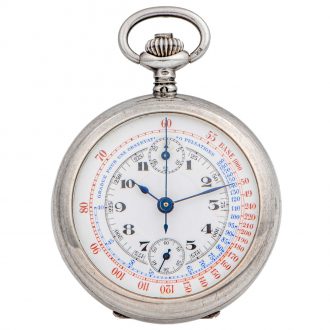
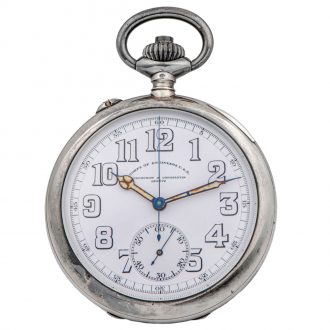
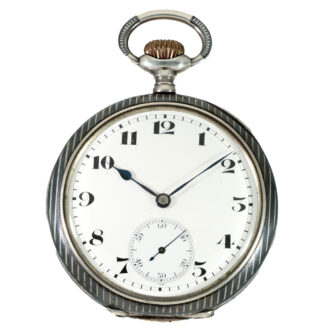
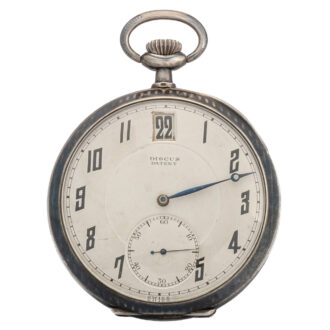
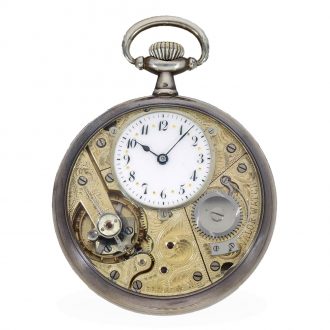
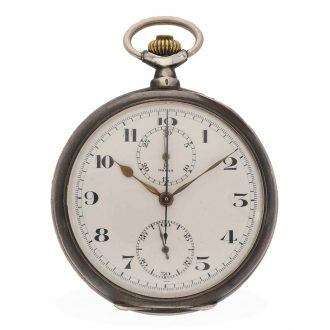
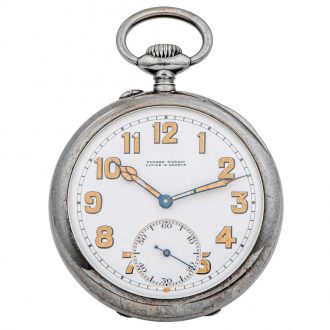
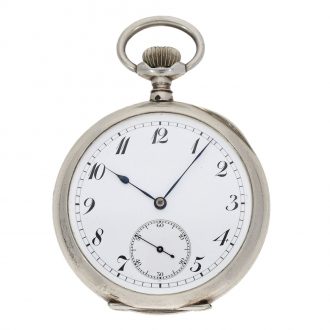
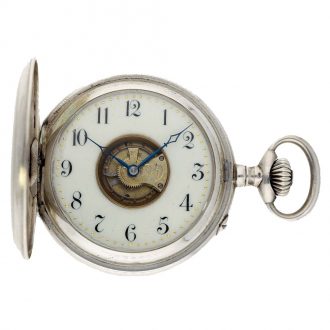
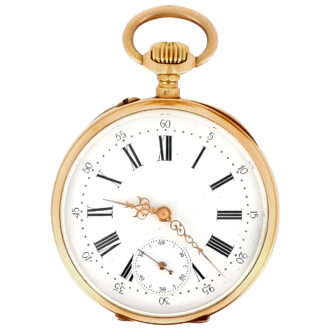
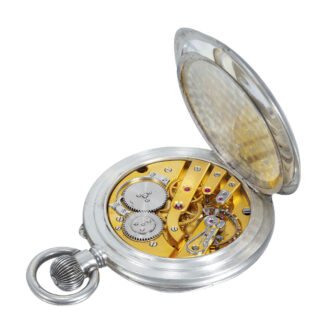
Swiss silver astronomical keyless lever deck watch Circa 1920
- Kenmerk
- TA1582
- Diameter
- 60 mm
- Estimate
- € 20.000 - 32.500
- Price sold
- € 31.200
Silver open faced lever deck watch
–
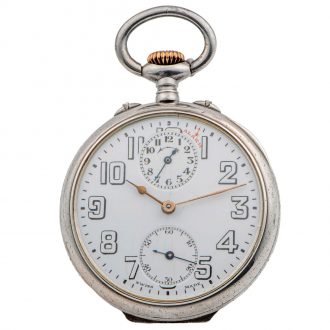
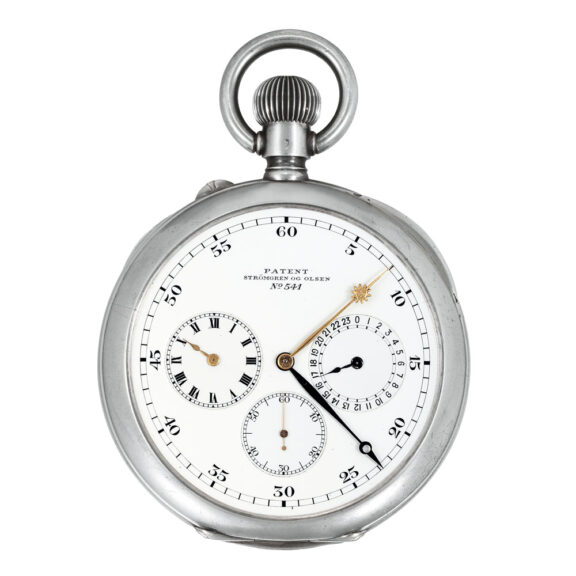
A very fine and extremely rare Swiss, silver, keyless deck lever chronometer designed for astronomical navigation, circa 1920. With indications for Equation of Time and Sidereal Time. Marchant & Sidereal time deck watch, patent Stromgren of Olsen.
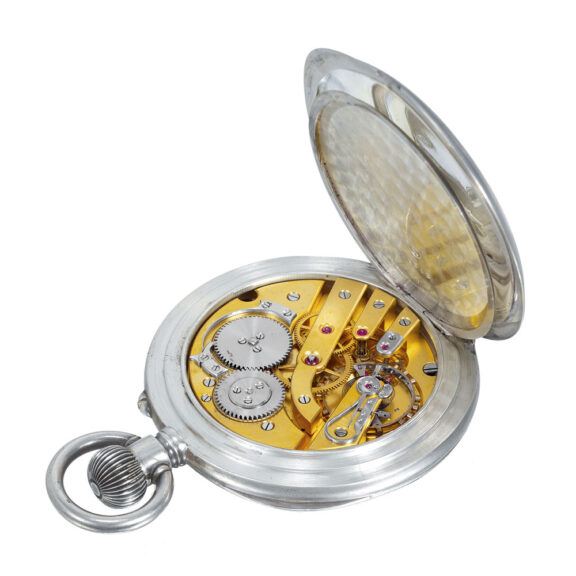
A massive, polished case. Hinged silver cuvette. White enamel dial with outer minutes and Equation of Time track with Arabic five minute numerals, subsidiary dials for the hours at 9 with radial Roman numerals, 24-Sidereal time hours dial at 3, seconds at 6. Gold hour, seconds and minute hand with sun terminal, blued steel Breguet equation hand and spade 24-hour hand. A frosted gilt movement, 17 jewels, wolf’s tooth winding, straight-line lever escapement, cut bimetallic compensation balance, blued steel Breguet balance spring, swan-neck micrometre regulator. Case stamped with Alexandre Huning’s trademark AH, Geneva, dial signed Patent Stromgren of Olsen.
–
Diameter: 60 mm
–
Signed: Alexandre Huning Geneva
–
Watches with Equation of Time are extremely rare, especially with this type of Equation of Time display, the equation hand is concentric with the minute hand. As opposed to most watches with the equation of time, on which the difference between the meantime and the solar time is only shown on a sector, giving the number of minutes that must be withdrawn or added to the solar time to find the meantime, in this watch, the solar time is permanently shown by the Breguet minute hand which revolves, following or preceding the regular minute hand of the meantime. Most Equation of Time watches was produced in Switzerland and carry the most prestigious of signatures, such as Louis Audemars, Audemars Piguet and Patek Philippe. The movement of this watch was also registered as German patent No. 283094 dated February 25th,1914, and the Swiss patent No. 73312. Dr Svante Elis Stromgren, the Director of the Copenhagen Observatory and Jens Olsen, a Danish watchmaker collaborated to invent this watch, the main purpose of the patent was to register the setting functions of the watch. The hands can be coupled for setting the Equation of Time and then uncoupled when set, i.e. set separately or synchronised. If the watch was stopped for a long period of time, it could be quickly and accurately re-set to both times again. Alexandre Huning Precision watchmaking, founded in Geneva in 1893 and recorded at 15, rue Levrier. The successor of Emile Fiebiger (or Tiebiger), he registered a patent for a device to adjust balance springs in 1907. Won the Geneva Observatory Contest for the best watch in 1905 and 1908. The company was listed as making precise and complicated watches. Do his registered brands include Fides, Fides Genève, and Logos. Equation of time. Indicates the time difference between the true solar day and the mean solar day (or time told by a clock or watch). It has two major causes. The first is that the plane of the Earth’s Equator is inclined to Earth’s orbital plane. The second is that the orbit of the Earth around the Sun is an ellipse and not a circle. Equation of Time due to Obliquity (the Earth’s tilt). If the Earth’s rotational axis was not tilted with respect to its orbit around the Sun, the apparent motion of the Sun along the Ecliptic would fall directly on the Equator, covering the same angles along the Equator in equal time. However, this is not the case, since the angular movement is not linear in terms of time because it changes as the Sun moves above and below the Equator. The projection of the Sun’s motion onto the Equator will be at a maximum when its motion along the Ecliptic is parallel to the Equator (at the summer and winter solstices) and will be at a minimum at the equinoxes. Equation of Time due to Unequal Motion (the Earth’s elliptical orbit). The orbit of the Earth around the Sun is an ellipse. The distance between the Earth and the Sun is at a minimum around December 31 and is greatest around July 1. The Sun’s apparent longitude changes fastest when the Earth is closest to the Sun. The Sun will appear on the meridian at noon on these two dates and so the Equation of Time due to Unequal Motion will then be zero. The mean solar day, calculated by averaging all the days of the year, was invented by astronomers for convenience so that the solar day would always be 24 hours. True solar time and mean solar time coincide four times a year, on April 16, June 14, September 1, and December 25. On these days, the equation will equal zero. During the other 361 days, the equation of time must be used to indicate the difference between the two times, amounting to over 16 minutes at certain times of the year. The minimum difference occurs on November 1 with a loss of 16 minutes and 23 seconds and the maximum occurs on February 11 with an increase of 14 minutes 20 seconds. This positive and negative value is offset in the time of the local noon and those of sunrise and sunset. Equation of time, often represented by a figure eight, called an analemma, can be approximated by the following formula: E = 9.87 * sin (2B) 7.53 * cos (B) 1.5 * sin (B) Where: B = 360 * (N-81) / 365 Where: N = day number, January 1 = day 1. Sidereal time. Unit of time used by astronomers; the sidereal day is the interval between two consecutive upper transits of the vernal point in the plane of the meridian. Since in practice this can be measured as the earth’s rotation with respect to distant celestial objects, it is called sidereal or star time (sider means star in Latin). The sidereal day is 23 hours, 56 minutes and 41 seconds. The sidereal year contains one more day than the solar year.
Signed: Alexandre Huning Geneva
Share this page: