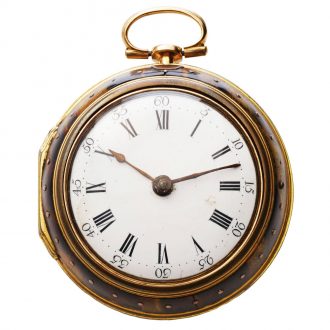
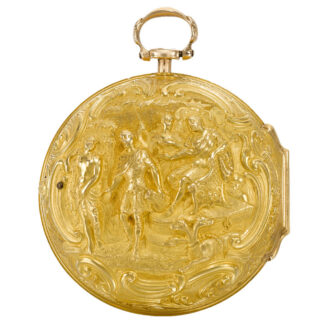
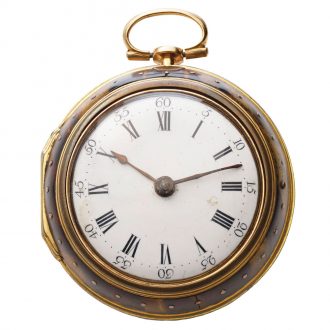
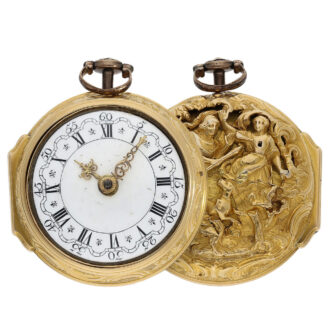
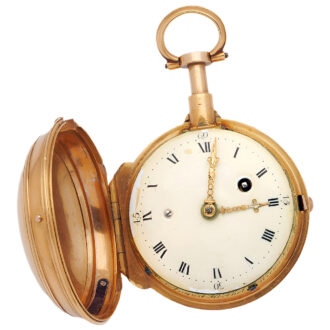
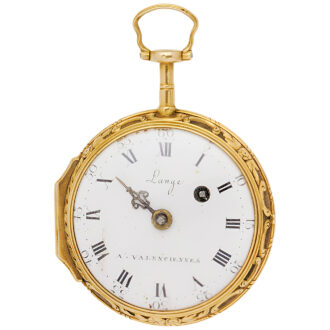
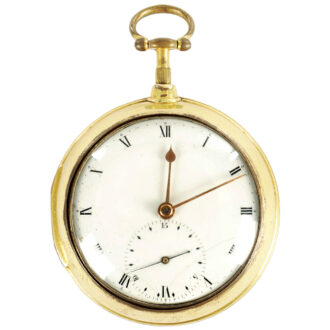
English gold erotic verge made for the Chinese market Circa 1770
- Kenmerk
- SA0062
- Diameter
- 40 mm
- Estimate
- € 20.000 - 40.000
- Price sold
- € 44.500
Gold quarter repeating watch with erotic scene
–
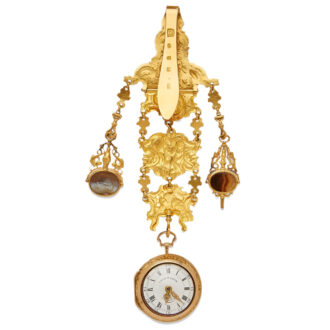
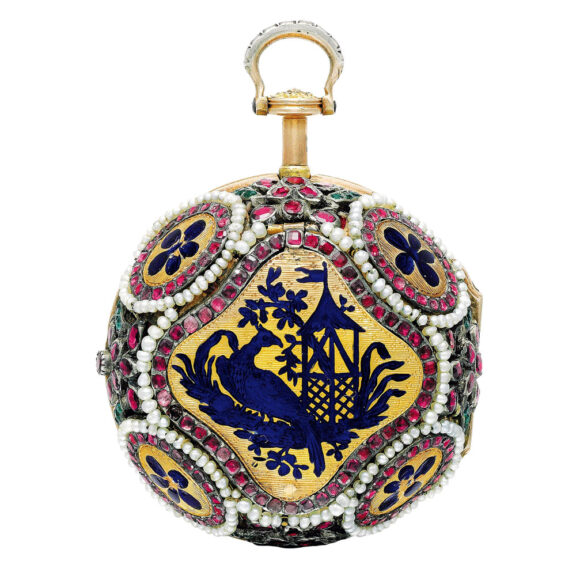
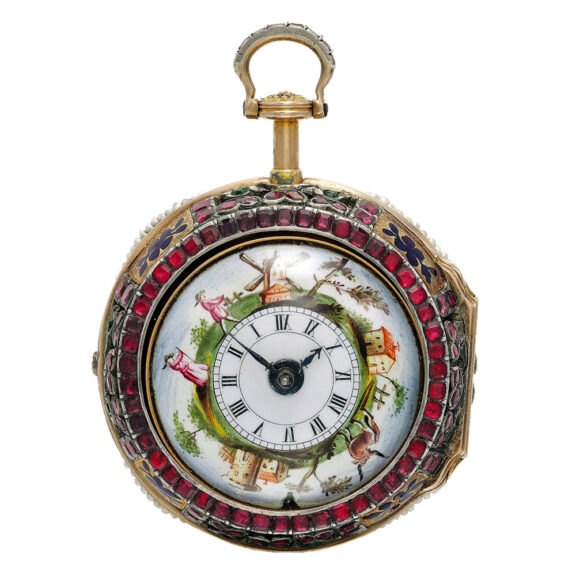
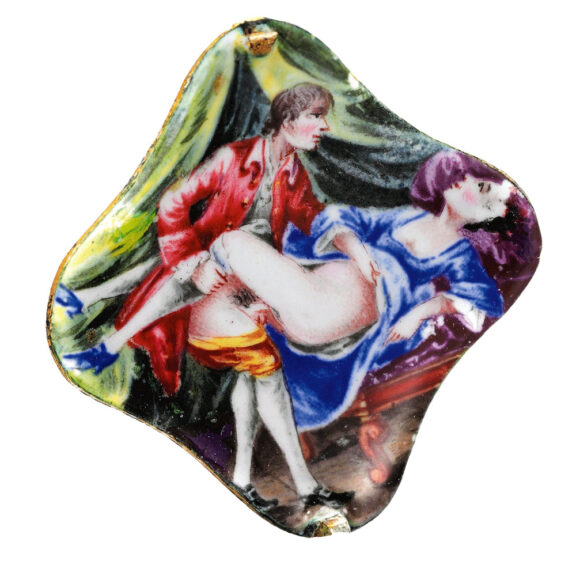
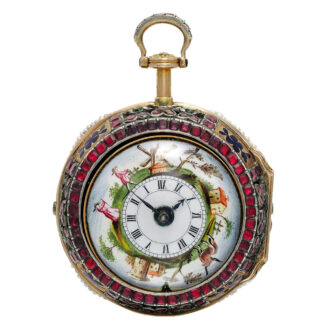
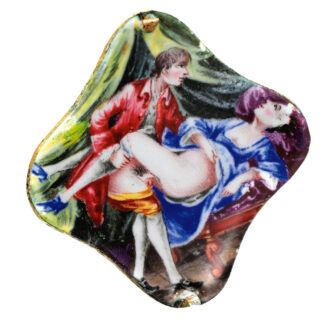
A very rare English unusual gold, enamel, ruby and pearl set quarter repeating verge pocket watch with a concealed erotic scene made for the Chinese market with matching chain, circa 1770. Gilt full plate movement, verge escapement, pierced and engraved balance cock, fusee and chain, turned pillars, two steel hammers repeating on a bell to the inside case back, gilt metal dust cap.
Polychrome painted enamel dial, the outer edge with a continuous pastoral scene, the center with white enamel time indication and black Roman numerals, blued steel hands.
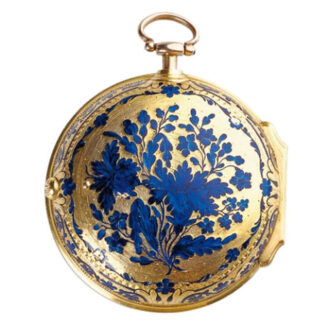
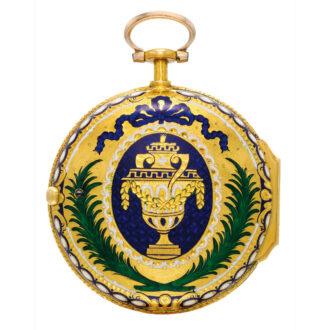
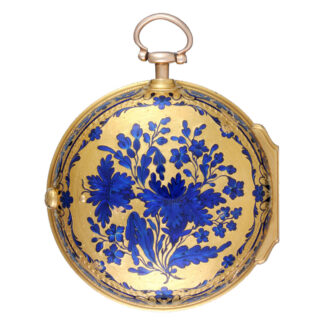
Gold inner case with decoratively pierced and engraved band, engraved scene of a town by a lake below the pendant and grotesque mask to the base, ruby set bow, outer case with a central panel depicting a pheasant and pagoda in basse taille enamel, the panel with a secret catch within the seed pearl border beneath, opening to reveal a polychrome enamel scene of an amorous couple, surrounded by ruby and seed pearl set borders, the edge with four oval panels each with a blue enamel flower surrounded by pearl and ruby set borders, the panels interspersed with rubies and emeralds, the front bezel decorated en suite, dust cap signed Jams Cox London. Comes with a contemporary matching decorative gilt metal and seed pearl set chain interspersed with blue and red star shaped panels, each with a white enamel flower set with a ruby, red and white enamel panels also set with a ruby.
–
Diameter: 40 mm
–
Signed: James Cox London
–
The pheasant was a symbol of beauty and good fortune in Chinese mythology and was one of the twelve elements found on the imperial robes. James Cox frequently created blued steel hands with poker style bodies and arrowheads.
James Cox was the leading 18th century retailer of jewelled automata and ‘toys’ and, as such, his name has become indelibly linked with these objects. Born in London in about 1723, he was apprenticed in 1738 to Humphrey Pugh of Fleet Street, a silver spinner in business as a toy man. Thus, although Cox was described as a goldsmith when he became free of the London Goldsmiths’ Company in 1745 and years later registered a mark as such, any skills as a craftsman were always secondary to his inventiveness and marketing abilities. His career was tumultuous. After an inauspicious start, followed by an early bankruptcy, he began anew on a grander scale, focusing his attention on exporting his increasingly fanciful objects to the Far East. When the inherently risky Chinese market waned, he opened a museum in Spring Gardens to display his wares, famously dispersed by lottery in 1775. Although the lottery was profitable, and despite significant sales to Catherine the Great, Cox declared bankruptcy again in 1778. He continued trading as a jeweller until he retired and moved to Watford in 1795.
Basse taille is an enamelling technique in which the artist creates a low relief pattern in metal, usually silver or gold, by engraving or chasing. The entire pattern is created in such a way that its highest point is lower than the surrounding metal. A translucent enamel is then applied to the metal, allowing light to reflect from the relief and creating an artistic effect. It was used in the late Middle Ages, and then again in the 17th century.
Signed: James Cox London
Share this page: