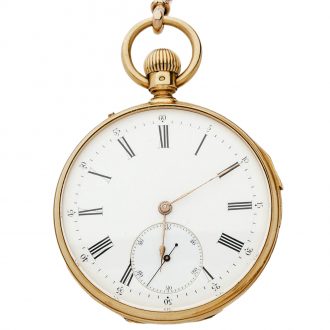
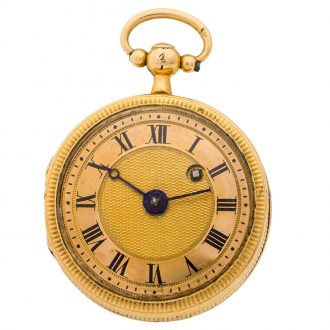
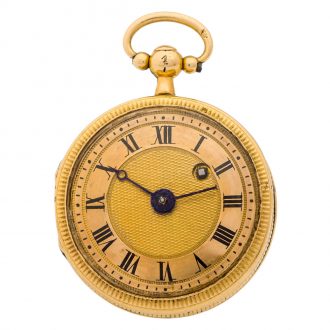
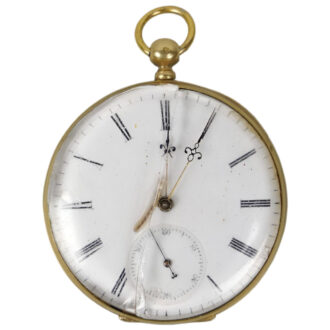
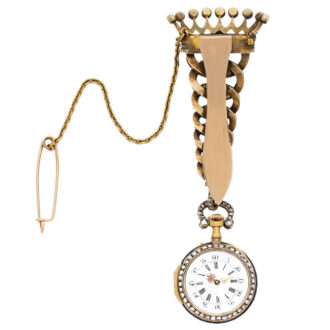
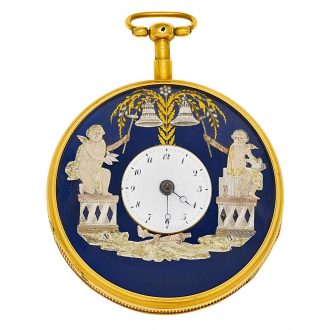
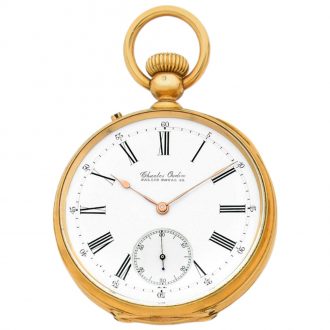
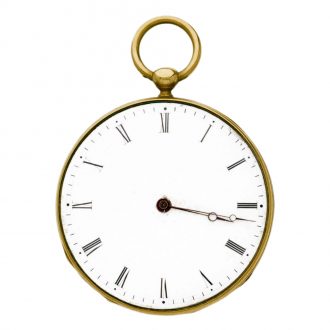
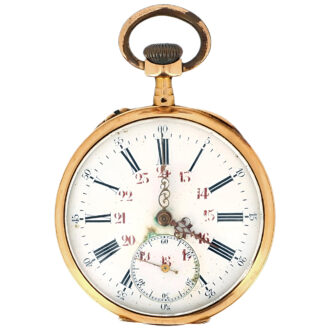
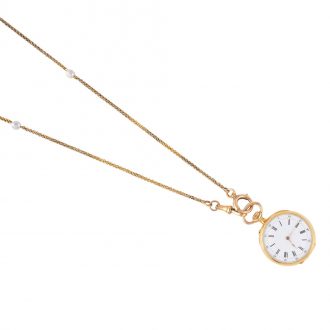
Fine French 18 carat gold keyless cylinder ladies’ watch Circa 1880
- Kenmerk
- BB1104
- Diameter
- 31 mm
- Estimate
- € 3.250 - 6.000
- Price sold
- € 3.200
Gold open faced pocket watch
–
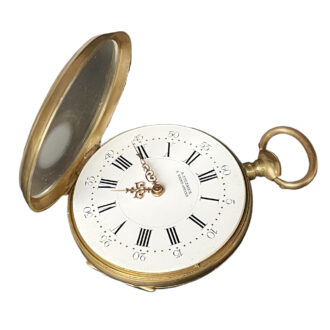
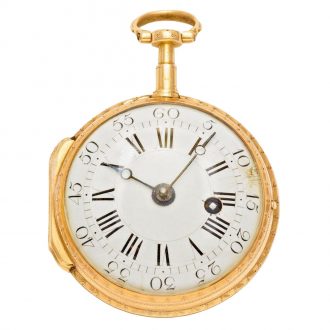
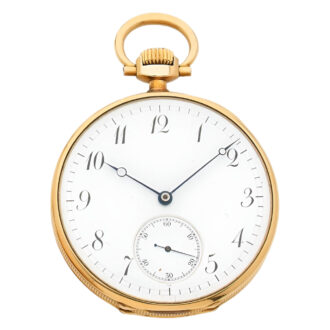
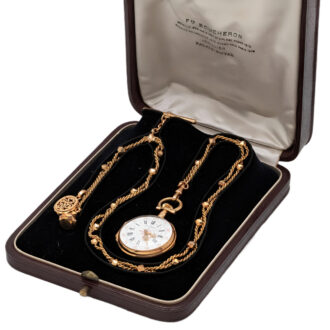
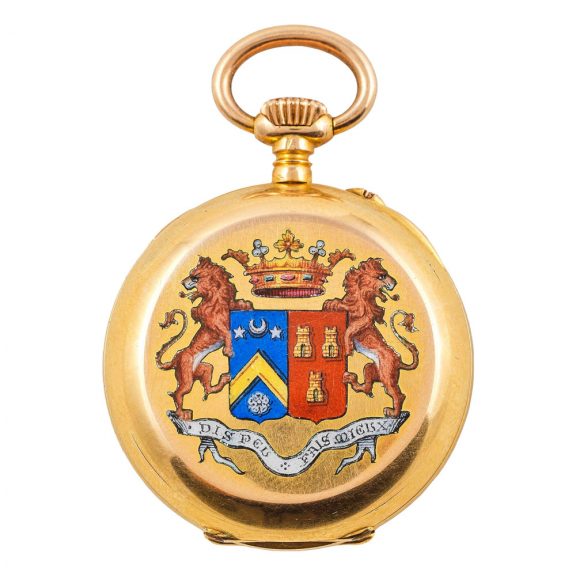
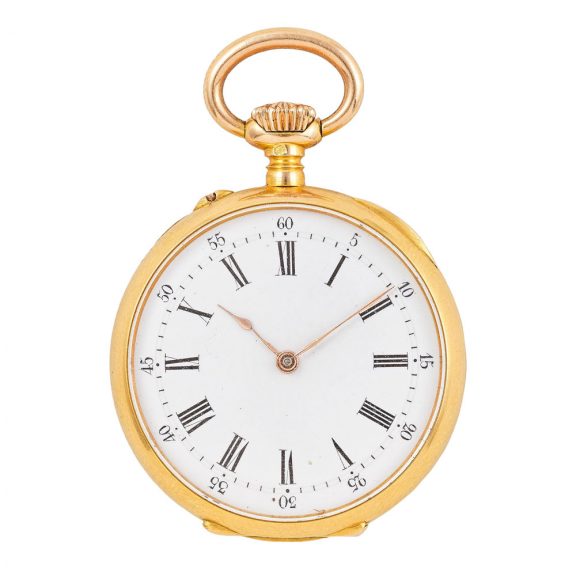
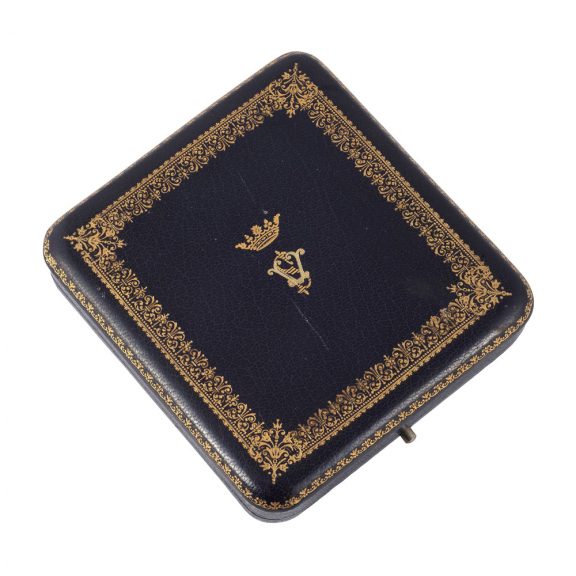
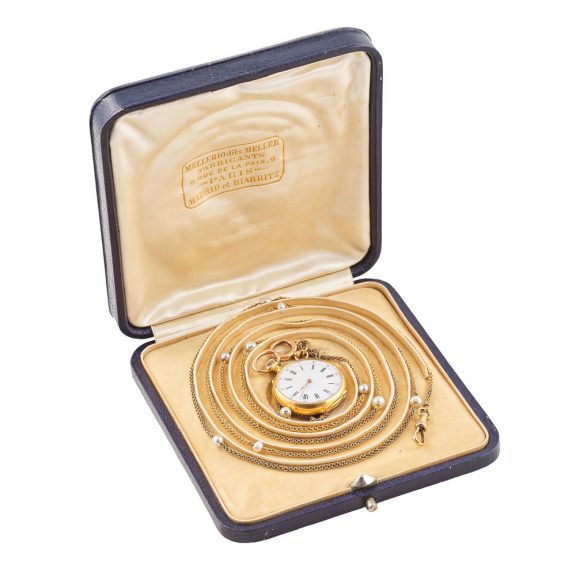
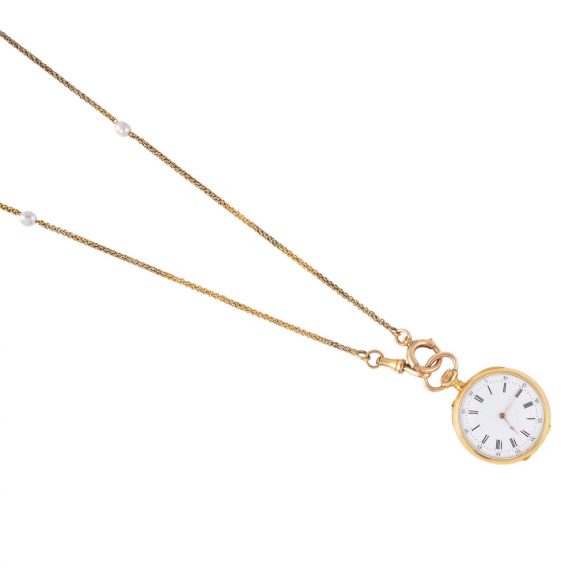
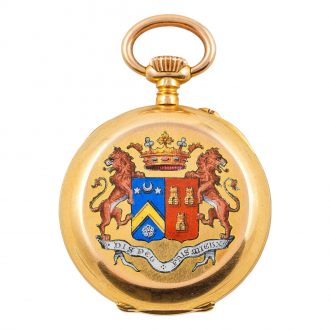
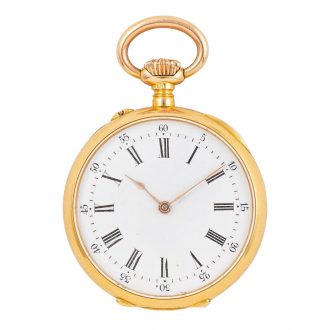
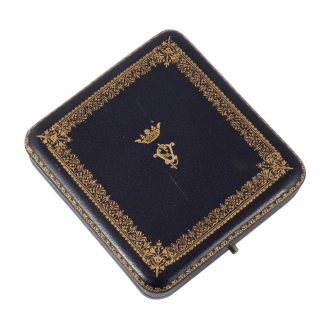
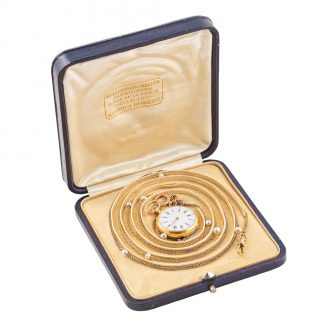
A fine French 18 carat gold open faced keyless pocket watch made by Mellerio dits Meller in Paris, circa 1880. The gilt full plate movement with a cylinder escapement and three arm balance. White enamel dial with Roman hour numerals, outer minute divisions and gilt spade hands. The polished hinged case with the polychrome enamelled coat of arms of the Villoutreys de Brignac and Sesmaisons families, bearing the motto Dis Peu Fais mieux (Say Little Do Better) on the back. Case signed and numbered, movement numbered. Comes with a fitted presentation box and 18 carat gold watch chain with pearls.
–
A fine French 18 carat gold open faced keyless pocket watch made by Mellerio dits Meller in Paris, circa 1880. The gilt full plate movement with a cylinder escapement and three arm balance. White enamel dial with Roman hour numerals, outer minute divisions and gilt spade hands. The polished hinged case with the polychrome enamelled coat of arms of the Villoutreys de Brignac and Sesmaisons families, bearing the motto Dis Peu Fais mieux (Say Little Do Better) on the back. Case signed and numbered, movement numbered. Comes with a fitted presentation box and 18 carat gold watch chain with pearls.
–
Diameter: 31 mm
–
Weight: 55.5 g.
–
Diameter: 31 mm
–
Weight: 55.5 g.
–
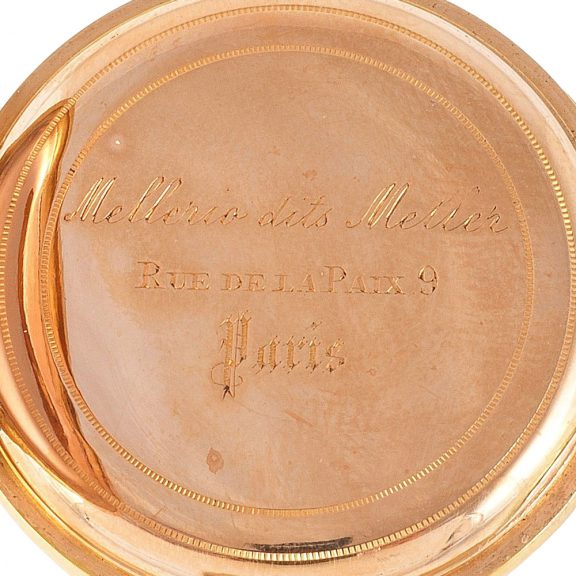
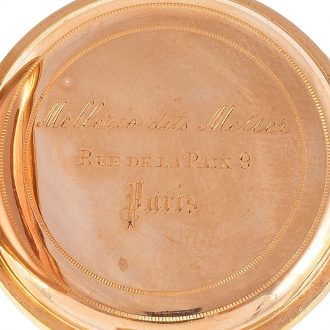
Signed: Mellerio dits Meller Rue de la Paix Paris
–
Mellerio dits Meller, a dynasty of French jewellers of Italian origin, from a small mountain village in northern Italy, Craveggia in the Val Vigezzo. In 1515, the Mellerio family, along with other families from their valley, decided to move to France. They settled in Paris, on Rue des Lombards. In 1613, Queen Marie de Medicis granted the family privileges as a reward for foiling a plot against her young son Louis XIII. This decree authorised them to practice in France without having to submit to the administrative restrictions generally applied. All the kings of France up to Louis XVI renewed this exceptional privilege.
–
Between 1780 and 1799, Marie-Antoinette opened the gates to Versailles for the Mellerios to become the Court’s supplier. It was during the reign of Louis XVI that the House began to occupy a significant place in French jewellery. It specialized above all in the luxury products that Marie-Antoinette liked to give to her close friends. This recognition enabled them to open a boutique at 20 Rue Vivienne, under the sign ‘Mellerio – Meller à la couronne de fer’. Empress Josephine authorised them to visit the Tuileries whenever they had something new to see. She subsequently introduced them to her entire entourage, including the Bonaparte family.
–
In 1815, François Mellerio set up his shop on Rue de la Paix. In 1830, when Marie-Amélie and Louis-Philippe d’Orléans acceded to the French throne, Mellerio was appointed official supplier to Her Royal Highness, the Queen of the French.
–
The revolution of 1848 caused a serious economic crisis in France. The Mellerio family was looking for a new market and decided to set up in Madrid, Spain, where they opened a shop under the sign ‘Mellerio-Hermanos’ in 1850. The company quickly took on numerous orders from Queen Isabel II and the Spanish high nobility. When Countess Eugénie de Montijo became Empress of the French, she showed her confidence in the House by becoming the most important customer in its history.
–
At the end of the 19th century, the Dutch Court ordered a crown, necklace and earrings composed of 36 exceptional rubies for the coronation of Queen Emma in 1879, which are often worn today by Queen Maxima of the Netherlands. The foreign clientele grew considerably and included members of almost all the European nobility.
–
Their clientele further included the Maharaja of Kapurthala, who visited their store in October 1905.
–
In 1984, several points of sale were opened in Japan, where Empress Masako Owada loves her Mellerio watch, always wearing it during public events.
–
At the beginning of the 20th century, society began to lose interest in Art Nouveau jewellery. Mellerio was sensitive to changes in fashion and always took advantage of new trends. Collaborating with leading couturiers and creating some of the finest sports awards.
–
In the 1980s, a period when most of the jewellery houses at the Place Vendôme were joining large groups, Mellerio decided to remain an independent, family owned House. Today, it is the oldest and last family owned jewellery House in France.
–
Mellerio dits Meller, a dynasty of French jewellers of Italian origin, from a small mountain village in northern Italy, Craveggia in the Val Vigezzo. In 1515, the Mellerio family, along with other families from their valley, decided to move to France. They settled in Paris, on Rue des Lombards. In 1613, Queen Marie de Medicis granted the family privileges as a reward for foiling a plot against her young son Louis XIII. This decree authorised them to practice in France without having to submit to the administrative restrictions generally applied. All the kings of France up to Louis XVI renewed this exceptional privilege.
–
Between 1780 and 1799, Marie-Antoinette opened the gates to Versailles for the Mellerios to become the Court’s supplier. It was during the reign of Louis XVI that the House began to occupy a significant place in French jewellery. It specialized above all in the luxury products that Marie-Antoinette liked to give to her close friends. This recognition enabled them to open a boutique at 20 Rue Vivienne, under the sign ‘Mellerio – Meller à la couronne de fer’. Empress Josephine authorised them to visit the Tuileries whenever they had something new to see. She subsequently introduced them to her entire entourage, including the Bonaparte family.
–
In 1815, François Mellerio set up his shop on Rue de la Paix. In 1830, when Marie-Amélie and Louis-Philippe d’Orléans acceded to the French throne, Mellerio was appointed official supplier to Her Royal Highness, the Queen of the French.
–
The revolution of 1848 caused a serious economic crisis in France. The Mellerio family was looking for a new market and decided to set up in Madrid, Spain, where they opened a shop under the sign ‘Mellerio-Hermanos’ in 1850. The company quickly took on numerous orders from Queen Isabel II and the Spanish high nobility. When Countess Eugénie de Montijo became Empress of the French, she showed her confidence in the House by becoming the most important customer in its history.
–
At the end of the 19th century, the Dutch Court ordered a crown, necklace and earrings composed of 36 exceptional rubies for the coronation of Queen Emma in 1879, which are often worn today by Queen Maxima of the Netherlands. The foreign clientele grew considerably and included members of almost all the European nobility.
–
Their clientele further included the Maharaja of Kapurthala, who visited their store in October 1905.
–
In 1984, several points of sale were opened in Japan, where Empress Masako Owada loves her Mellerio watch, always wearing it during public events.
–
At the beginning of the 20th century, society began to lose interest in Art Nouveau jewellery. Mellerio was sensitive to changes in fashion and always took advantage of new trends. Collaborating with leading couturiers and creating some of the finest sports awards.
–
In the 1980s, a period when most of the jewellery houses at the Place Vendôme were joining large groups, Mellerio decided to remain an independent, family owned House. Today, it is the oldest and last family owned jewellery House in France.
Signed: Mellerio dits Meller Rue de la Paix Paris
Share this page: