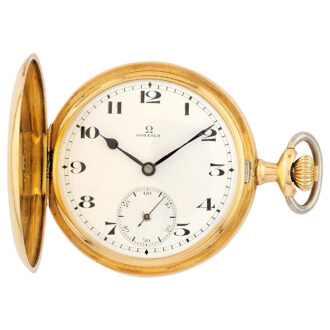
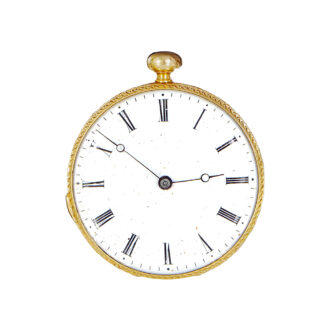
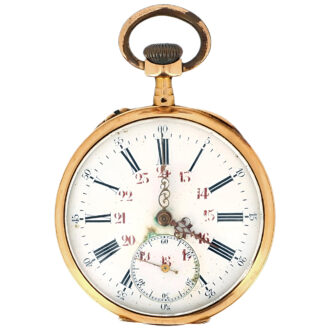
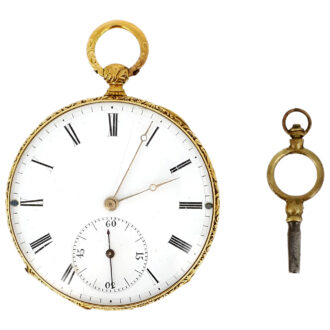
Fine English 18k gold complicated lever clockwatch Circa 1900
- Kenmerk
- BB0824
- Diameter
- 61 mm
- Estimate
- € 30.000 - 60.000
- Price sold
- € 30.300
Gold hunting cased complicated watch by Baume & Co
–
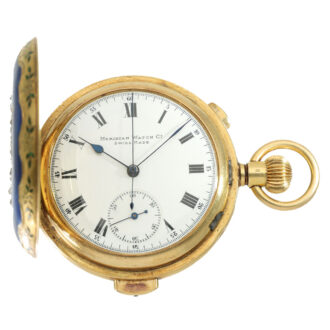
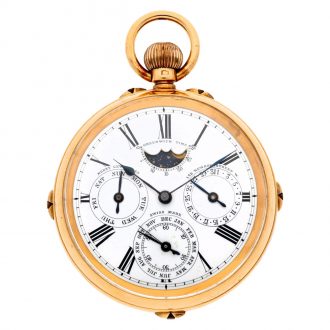
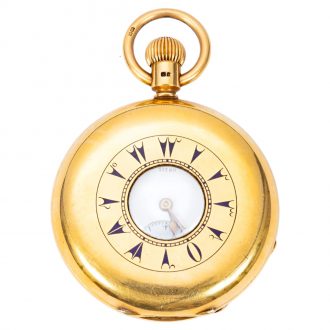
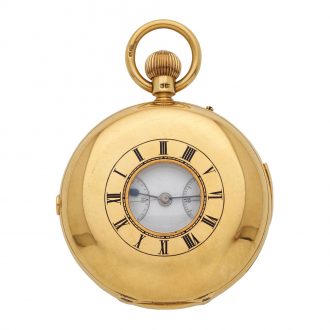
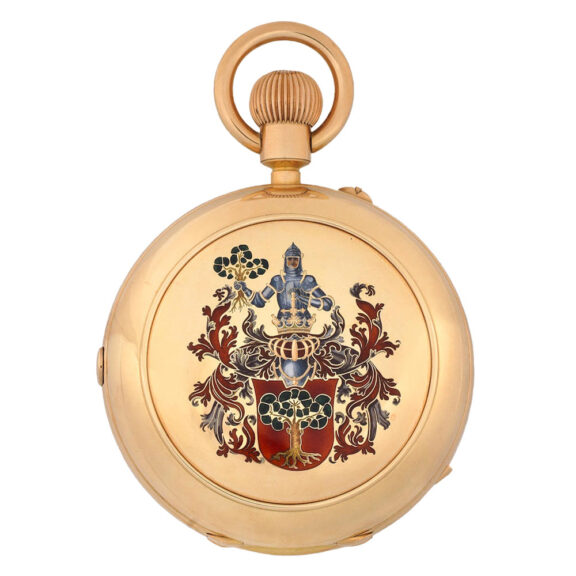
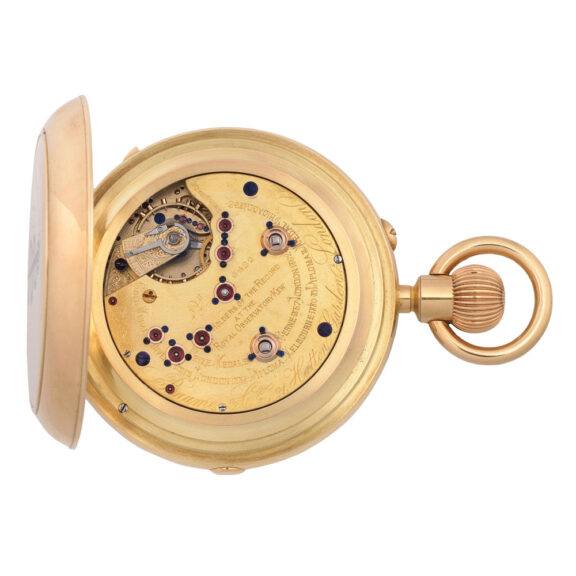
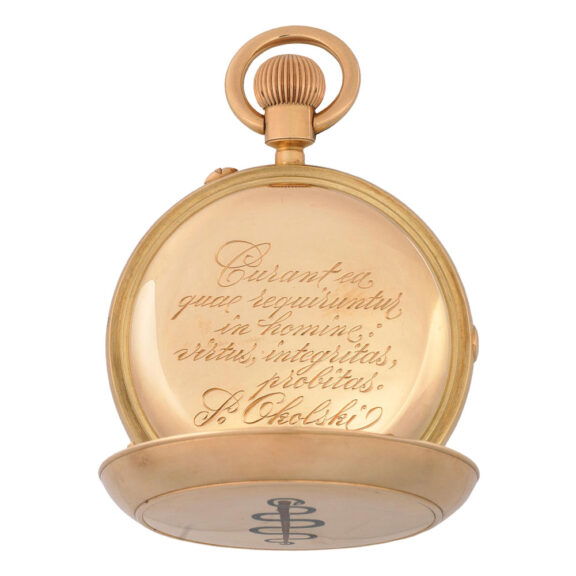
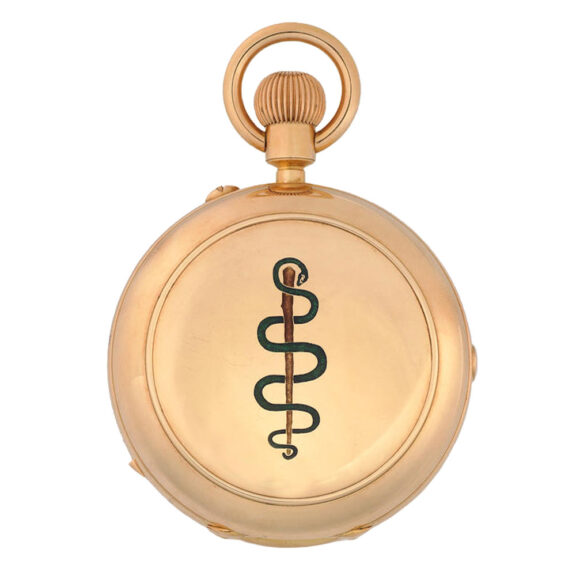
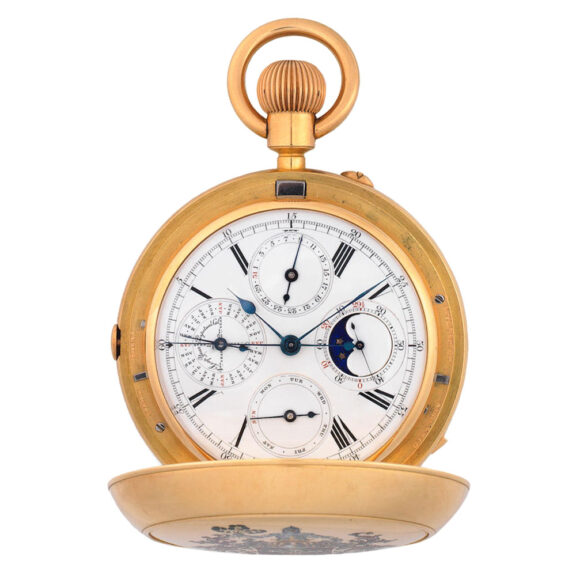
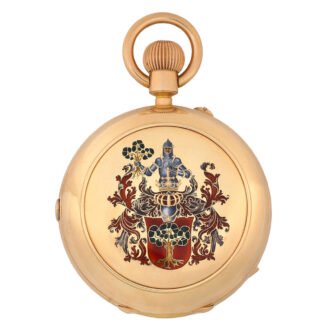
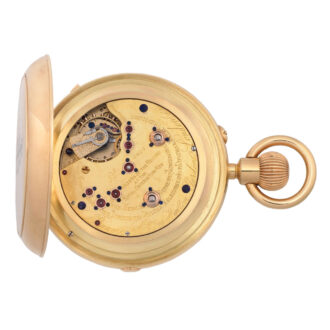
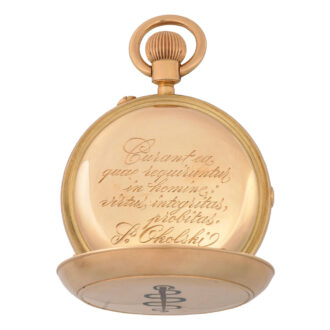
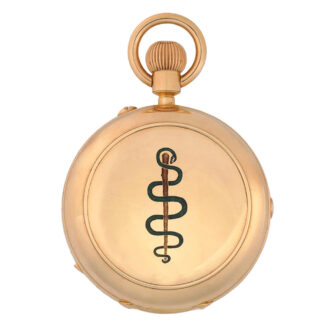
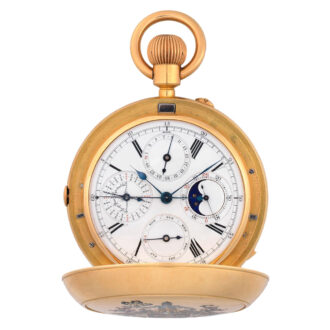
A very fine English 18 carat gold hunting cased keyless wind perpetual calendar trip minute repeating Grande Sonnerie clockwatch with chronograph, strike silent and moon phase, circa 1900 and later. Gilt 3/4 plate fire gilt English lever movement, cut and compensated bimetallic balance, gold compensation screws, blued steel Breguet overcoil balance spring, screwed gold chaton jewels throughout, bi-directional winding for going and striking, diamond end stone. White enamel dial with black Roman numerals, black outer minute and 1/5th second divisions, subsidiary dials at 3, 6, 9 and 12 for seconds combined with moon phase, day, date and month combined with leap year, blued steel spade hands. Later polished round hinged case, enamel decoration to the front depicting a European family crest, enamel decoration to the reverse depicting the Rod of Asclepius, chronograph button at 12, strike/silent indication on bezel between 11 and 12, quarters only, hours and quarters indication on bezel between 6 and 7, repeat button at 7, thief proof bow. Latin engraving to cuvette reads ‘Curant ea quae requiruntur in homine: virtus, integritas, probitas. S.(Simon) Okolski 1641. Movement signed and numbered, case numbered. Accompanied by fitted wooden box and three spare 18 carat gold case back panels.
–
Diameter: 61 mm
–
Signed: Baume & Co Hatton Garden London
–
This piece is deriving from the private collection of a German Professor of Medicine. The Professor had a great love of travelling and collecting which took him, alongside his career, to many of the annual auctions in London and Geneva with certain of his pieces being exhibited in Germany. This watch is an excellent representation of what can be achieved through passion, appreciation and an eye for quality. Privately commissioned, the watch case features beautifully enamelled panels to the fore and reverse whilst the Baume & Co movement is a skilfully executed piece of horological craftmanship from the turn of the century.
–
Applied to the case are two handsomely finished pieces of enamel work. The front depicts the Professors family crest which hails back to Prussia in the 1840s. The lore of the family is that during battle a Knight pulled a small oak tree from the ground before proceeding to save the life of one of the kings involved in the skirmish. In gratitude, the King made the Knight a Baron and named the land after him which can now be found in modern day Poland.
–
To the reverse of the case is the more familiar Rod of Asclepius. Not to be confused with the Caduceus borne by Hermes, the rod is represented by a single serpent wrapped around a staff and is commonly associated with healing and medicine. Asclepius was the son of Apollo and Coronis, a mortal, and was taught the art of healing by the centaur Chiron. His renown for healing steadily grew but it was not until after his death when he was smote down on Zeus’s orders that his cult established fully. As such it is believed that it is in this process that the staff and serpent merge to form one icon as they originally were seen as separate symbols.
–
The desire to ensure the watch represented something personal and of high quality by the Professor is furthered by the engraved inscription on the cuvette by Simon or Szymon Okolski, a celebrated heraldry specialist and historian. Roughly translated, the Latin inscription is a reminder of what as human beings we need in order to live a wholesome and rewarding life – virtue, integrity and honesty.
Signed: Baume & Co Hatton Garden London
Share this page: