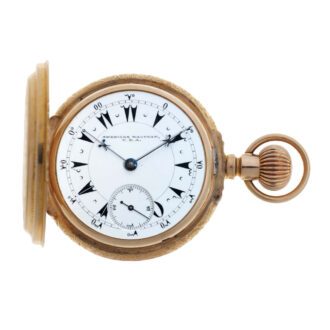
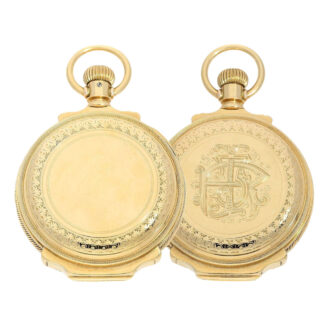
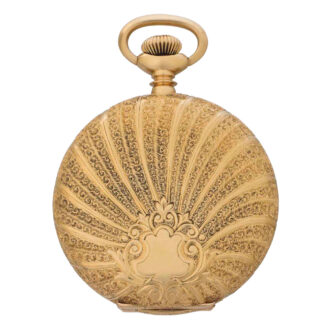
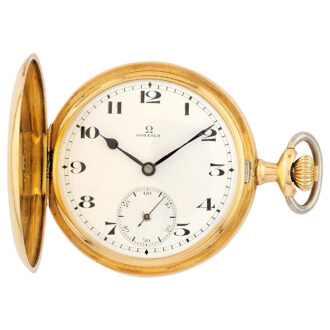
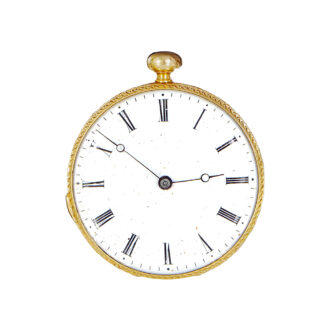
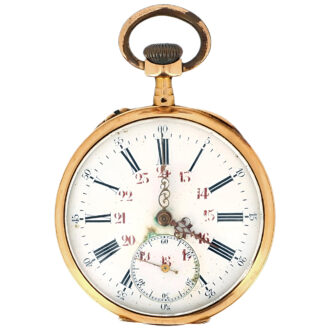
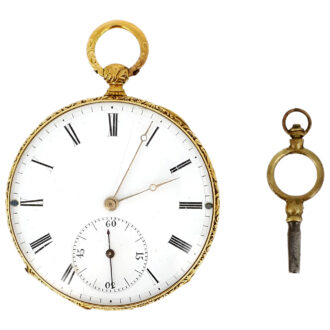
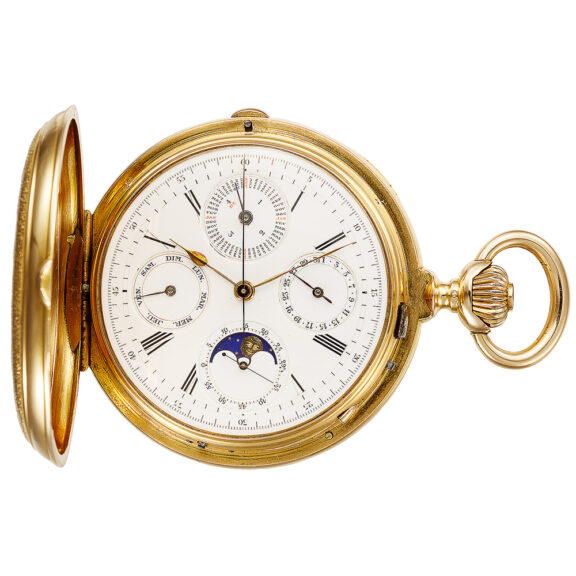
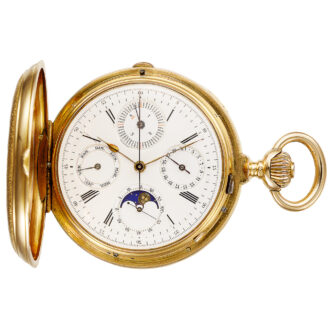
American repeating chronograph with calendar Circa 1887-1895
- Kenmerk
- AA0162
- Diameter
- 58 mm
- Estimate
- € 15.000 - 25.000
- Price sold
- -
Pocket watch with eight complications by Non magnetic Watch Co. of America
–
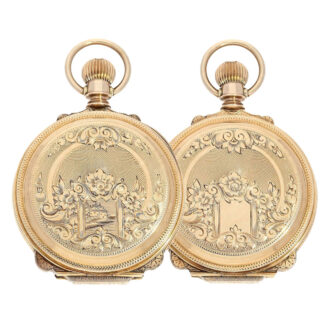
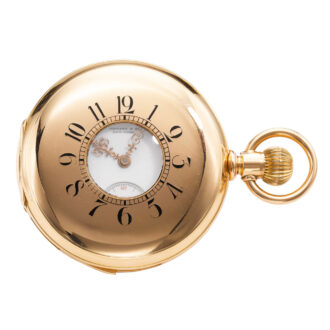
A fine, keyless winding, hunting cased, minute repeating pocket watch with chronograph, perpetual calendar, and moon phase, circa 1887-1895.
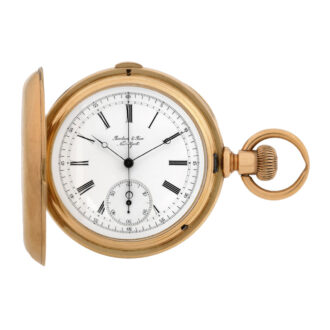
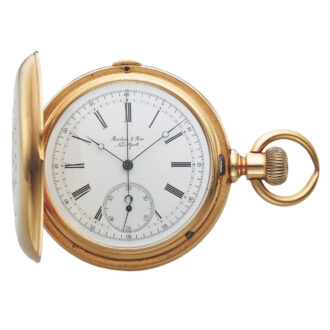
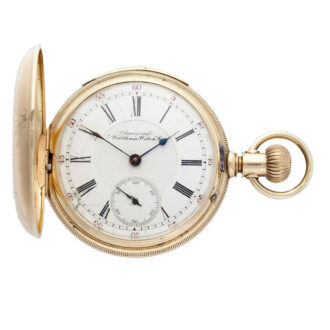
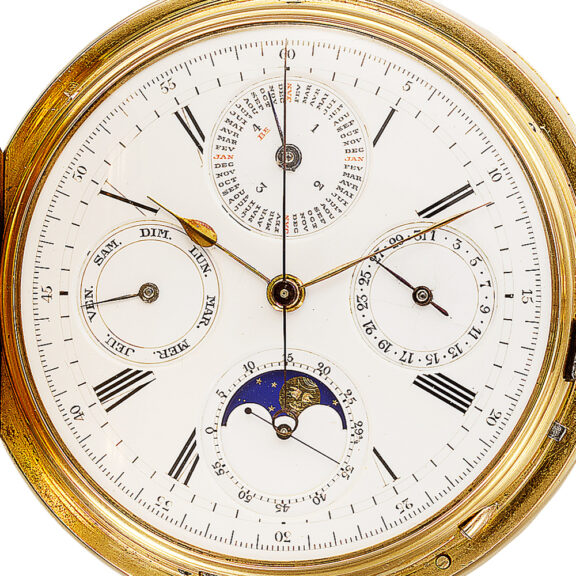
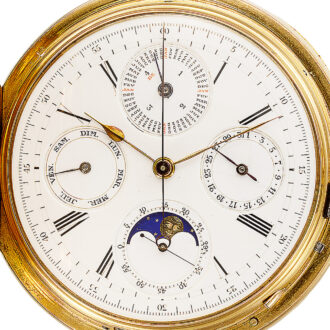
This watch has eight horological complications: Minute repeater on two steel gongs (activated by the slide at 6 o’clock) – 1/5 second chronograph (activated by the rectangular push piece located on the case band at 12 o’clock) – Instantaneous perpetual calendar – Date of the month (subsidiary dial at 3 o’clock) – Day of the week (subsidiary dial at 9 o’clock; indications given in English) – Month of the year (subsidiary dial at 12 o’clock; indications given in English) – Age and phases of the moon (subsidiary dial, graduated from 0 to 29 1/2, and aperture at 6 o’clock) – Four year cycle of leap years (subsidiary dial at 12 o’clock).
–
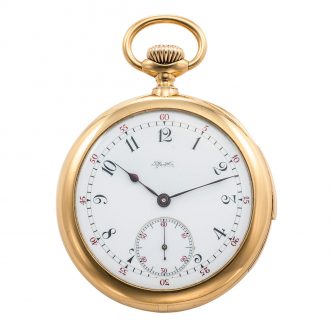
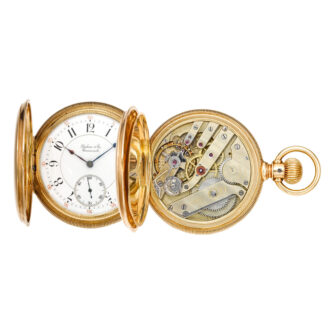
The round shaped case has a hinged case back and cover and is made of 18 Carat yellow gold. The enamel dial has Roman radial hours, outer minutes/seconds track with Arabic five minutes/seconds numerals, spade hands, and subsidiary dials for the seconds, perpetual calendar, date of the month, day of the week, the month of the year, age and phases of the moon, and the four year cycle of leap years. The movement is (ébauche possibly from Patek, Philippe & Co., Geneva) rhodium plated with going barrel, gold non magnetic straight line equilibrated lever escapement, compensated balance and blued steel hairspring with a terminal curve, index regulator with swan neck spring and micrometric screw. And the case and movement are signed.
–
Diameter: 58 mm
–
Signed: Non Magnetic Watch Co. of America
–
Non magnetic Watch Co. of America, American watch manufacture
The Non magnetic Watch Co. of America existed from 1887 to 1905. She sold complete series of watches with movements from size 16 with seven jewels to size 18 with 24 jewels. Works from Switzerland, Louis Bornand, and later Jean Jaques Badollet & Cie and Aeby & Landry were used. American results from Elgin, Illinois and Peoria firms were also used. All movements were equipped with an antimagnetic hairspring made of a palladium alloy; Charles Auguste Paillard invented this hairspring.
–
Ébauche (loanword from French, meaning blank, outline or sketch) is a term used in art to denote the first preliminary underpainting or quick sketch in oils for an oil painting. Horology, clockmaking and watchmaking appropriated the term ébauche to refer to an incomplete or unassembled watch movement and its associated components. The French term is regularly used by English-speaking artists and art historians, as well as horologists and hobbyists.
Signed: Nonmagnetic Watch Co. of America
Share this page: