English 18k gold split-seconds chronograph Circa 1859-1860
- Kenmerk
- BA1523
- Diameter
- 47 mm
- Estimate
- € 2.500 - 4.000
- Price sold
- € 700
Gold lever chronograph made for the American market
–
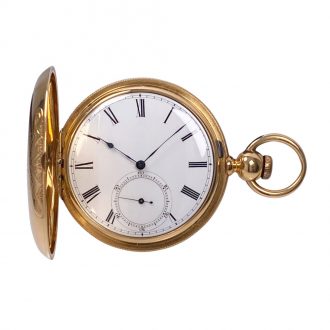
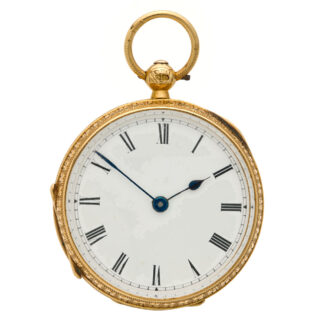
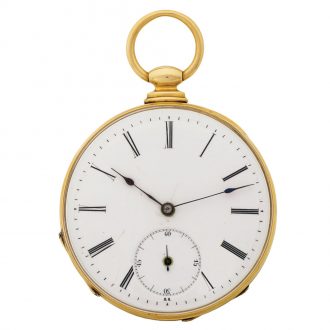
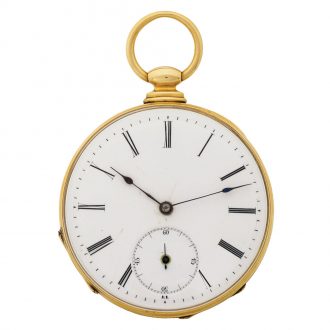
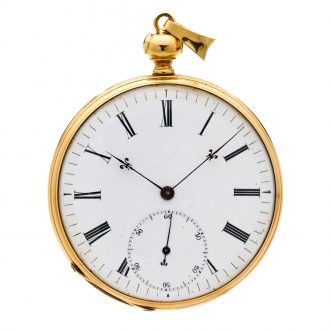
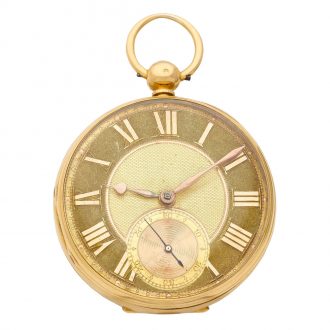
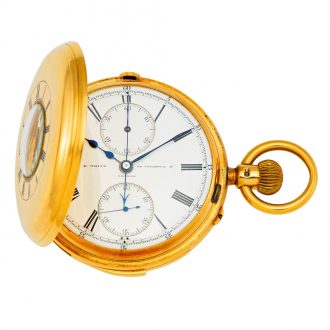
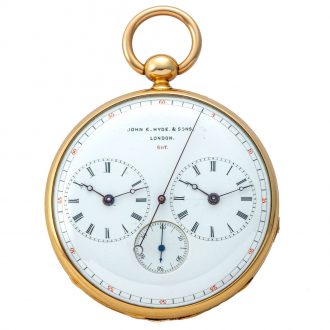
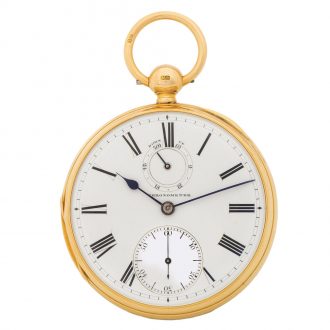
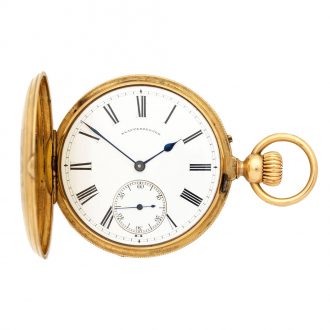
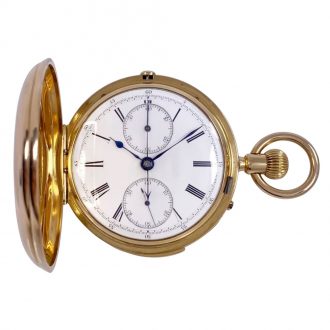
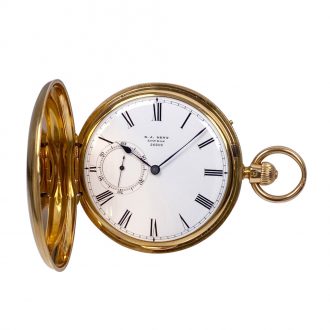
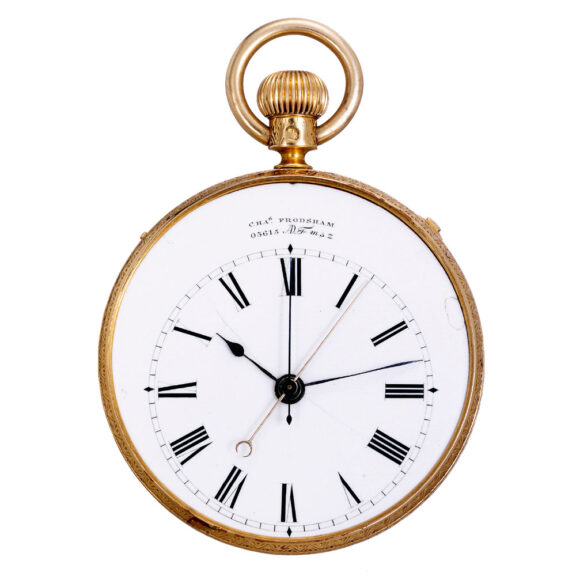
A fine, extremely rare English 18-carat gold open-faced keyless very early split-seconds chronograph lever pocket watch with stop feature made for the American market, Hallmarked London 1859-1860. 3/4 Plate movement, gilt brass, Nicole Nielsen keyless winding, lateral English-type lever escapement with lift on the pallets, cut bimetallic compensation balance, Breguet balance spring, jeweled to the third wheel, split-seconds mechanism with heart-piece mounted under the dial, the split returning lever made of gold. White enamel dial, eccentric with Roman numerals, outer minute/seconds track, and original blued steel spade hands. The back engraved with the American eagle, perched on two crossed American flags, each of which features thirteen stars representative of the 13 founding states, the motto E Pluribus Unum (Out of Many, One) below, bezels and band engraved in a repeated pattern, bolt at 1 o’clock for the stop feature, master mark AN.
Signed on the dial and on the movement, Patent, No. 23140 and pillar plate punched 3361.
–
Diameter: 47 mm
–
Signed: Charles Frodsham Ad. FMSZ
–
In addition to being an interesting example of ‘Americana’, this watch is noteworthy from a horological point of view in that it features a curious combination of Dent’s and Frodsham’s signatures, two watchmakers who were not partners. It would seem that Dent ordered the ebauche from Nicole Nielsen, and that it was subsequently bought or finished by Frodsham. This watch could be termed experimental because Nielson’s invention of the heart piece (1862), allowing the chronograph to return-to-zero, was still unknown. In this particular case, the heart piece is not used for return-to-zero but is employed in the split-seconds mechanism, allowing the split-seconds hand to rejoin the center-seconds/chronograph hand, making the watch rather advanced for its time. While still in partnership with Arnold, Frodsham employed a split-seconds mechanism with a duration of less than a minute that was controlled by a spring similar to a balance spring. The one in this watch is one of the earliest types that is found later in most of the complicated Swiss watches.
Signed: Charles Frodsham Ad. FMSZ – J.E. Dent Watchmaker to the Queen
Share this page: