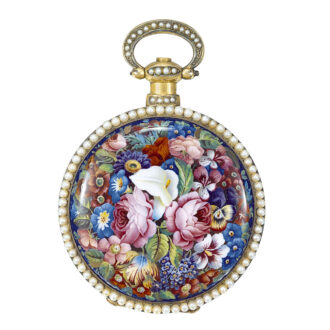
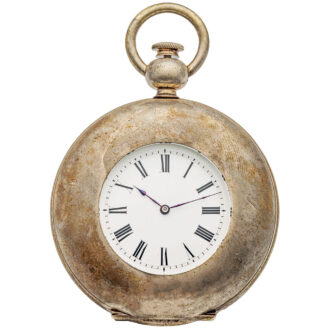
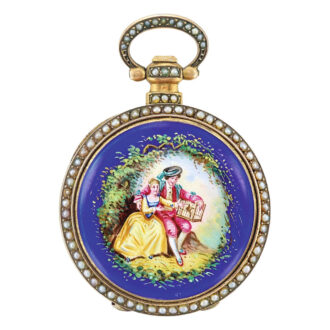
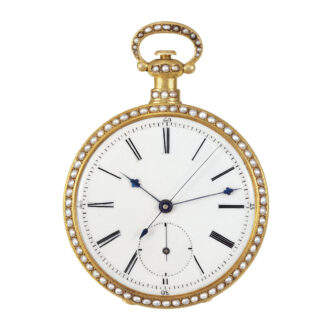
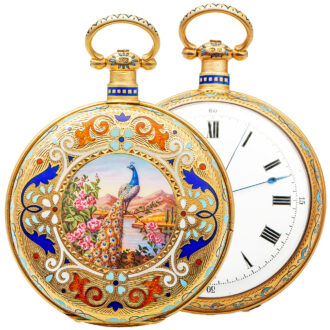
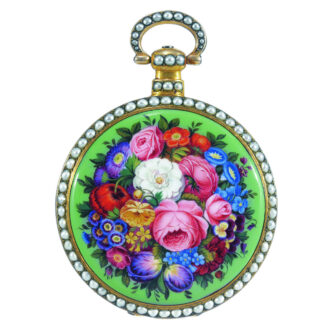
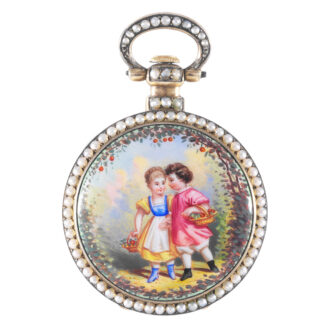
Swiss gilt duplex made for the Chinese market Circa 1870
- Kenmerk
- BA0493
- Diameter
- 62 mm
- Estimate
- € 20.000 - 35.000
- Price sold
- € 20.150
Decorated center seconds duplex attributed to P. Amédée Champod
–
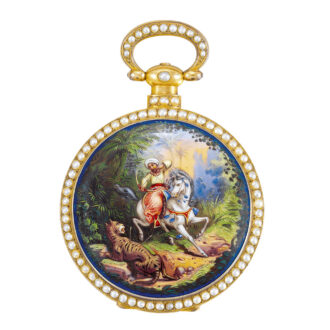
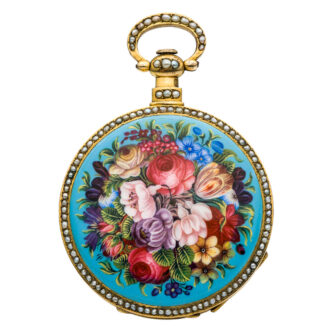
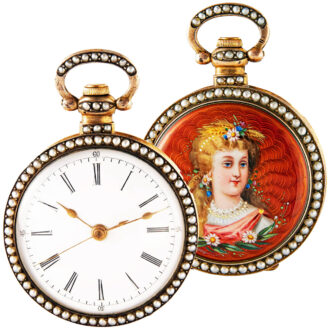
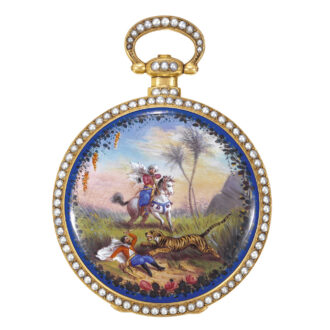
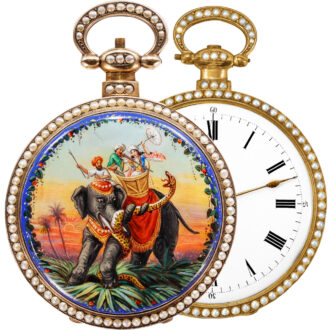
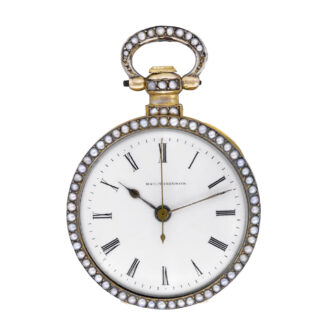
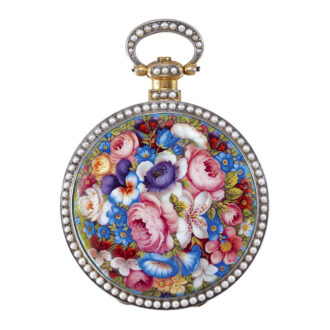
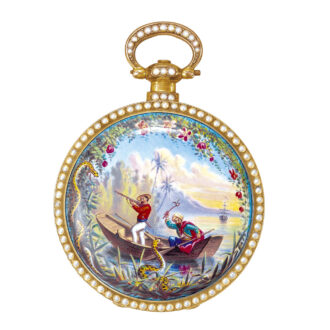
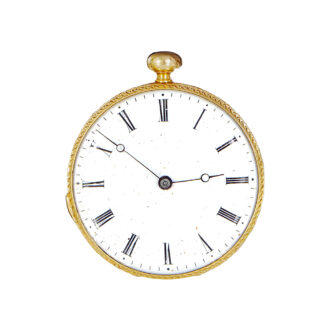
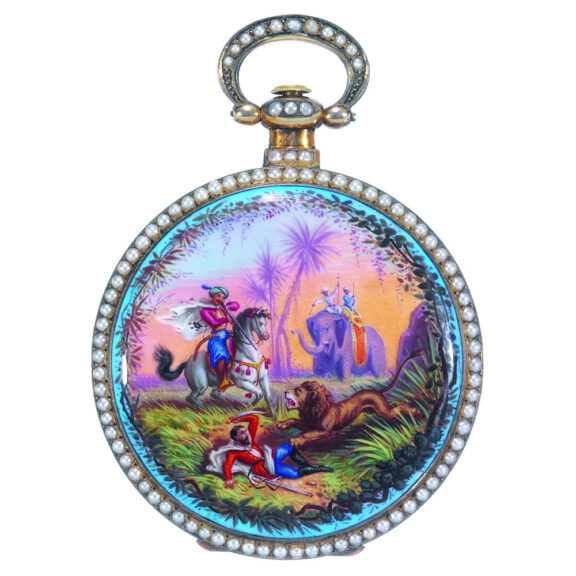
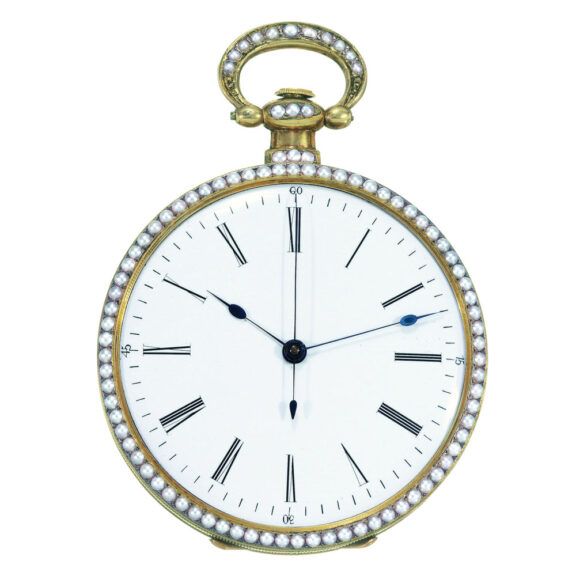
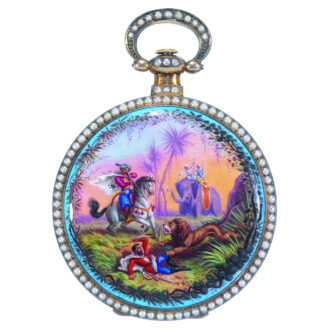
A fine, large Swiss silver gilt, enamel and pearl set open faced center seconds pocket watch with Jacot duplex escapement made for the Chinese market, circa 1870. Fully engraved gilt movement, Chinese caliber, free standing barrel, Jacot duplex escapement, three armed steel balance with blued steel ‘wing’, blued steel flat balance spring, index regulator. Spring loaded glazed gilt rimmed cuvette. White enamel dial with narrow Roman numerals, outer minute divisions, Arabic 15 minute numerals, and original blued steel ovoid hands. Case and movement signed Bovet in Chinese characters. The case back is painted on enamel with a lion attacking a hunter, another on a white horse shooting at the attacking lion in a landscape, an elephant with further hunters in the background, pearl set bezels, a pendant and bow. Accompanied by a Bovet key.
–
Diameter: 62 mm
–
Signed: Bovet Fleurier
–
This watch is a fine example of the Indian hunting scenes painted with vigour by P. Amédée Champod. This particular scene is unusual in the genre because it depicts a lion instead of the more commonly seen tiger.
–
Along with John Graff, Champod was one of the most celebrated enamel painters of the late 19th and early 20th centuries, specializing in hunting scenes. In his autobiography, which his descendants have preserved, he writes that he wanted to be a painter of large format scenes but that economic realities led him to paint on enamel. He studied with Huguenin, Sauerländer and Charles Glardon, who had the strongest impact on his future style. Champod dropped out of school at eleven and, at sixteen, began working. At the Paris Exhibition of 1900, Champod received a silver medal. His technique was outstanding and the sense of dynamics in his compositions was unrivalled.
–
Bovet, a watchmaking dynasty founded by Edouard, Frédéric, Alphonse, Gustave, Charles-Henri and Caroline Bovet of Fleurier. In 1822, a partnership was founded for the Chinese watch trade in Canton. In 1840, Bovet Frères et Cie was established in Fleurier and in 1864, the factory was sold to Bovet’s inspectors in Fleurier, Jules Jéquier and Ernest Bobillier, soon joined by Ami Leuba. In 1888, Bovet Frères was founded under the direction of Alexis Landry, who had been an apprentice in Fritz Bovet’s Fleurier workshop, producing ebauches for Chinese watches and silver cases. Alexis Landry partnered with Albert and Jean Bovet, specializing in complicated watches and chronographs. In 1901, the Bovet trademark was acquired by César and Charles Leuba, sons of Ami Leuba. In 1918, Jacques Ullmann & Co. of La Chaux-de-Fonds bought the Bovet brand, and in 1948, Favre-Leuba took over the company and acquired the first production plant. In 1966 Favre-Leuba sold the Fleurier plant, and in 1989 Parmigiani acquired the Bovet name. A limited company registered as Bovet Fleurier S.A. was formed in 1990 using the Bovet trademark. In 1994, Roger Guye and a partner bought Bovet Fleurier S.A. and opened a branch in Geneva. Pascal Raffy became the majority shareholder and President in 2001. Today, Bovet timepieces are widely available the world over. Eager to maintain its historical roots in the Far East, the company has subsidiaries in Hong Kong and Japan and delivers to select distributors in Singapore, Taiwan, the Middle East, Turkey, Russia, the United States, London and Geneva.
Signed: Bovet Fleurier
Share this page: