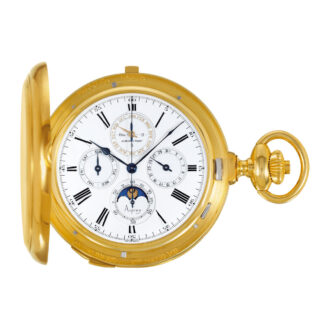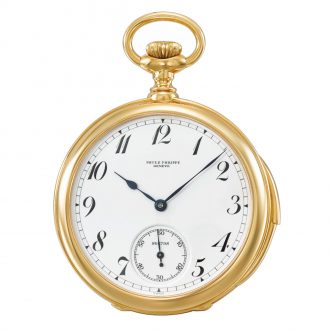
Spectacular Swiss gold complicated lever watch Circa 1989
- Kenmerk
- BA1670
- Diameter
- 89 mm
- Estimate
- € 4.000.000 - 10.000.000
- Price sold
- € 3.391.000
With 33 complications it is one the most complicated watch in the world
–
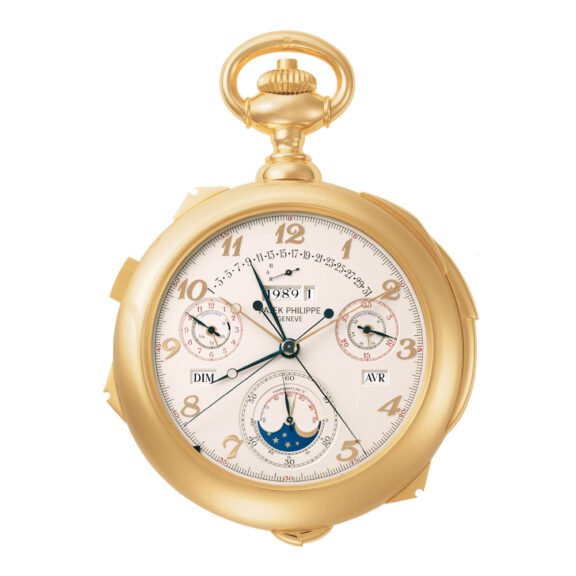
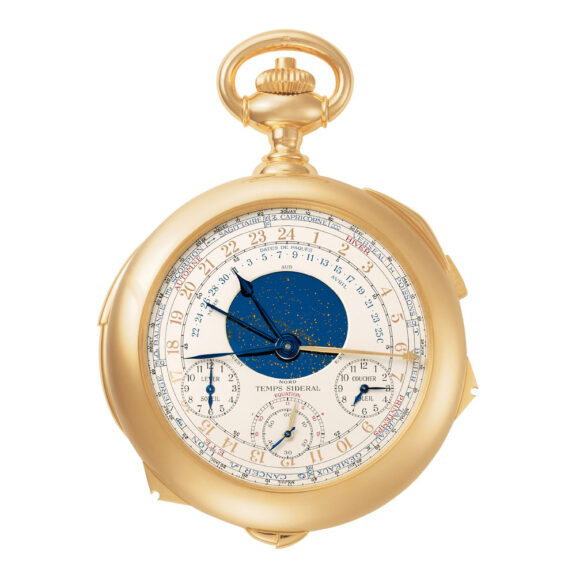
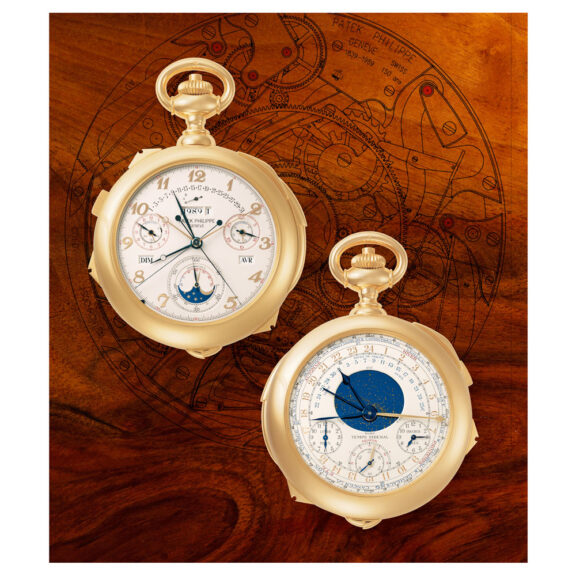
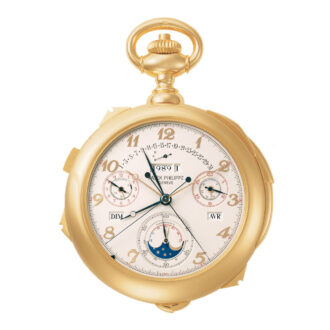
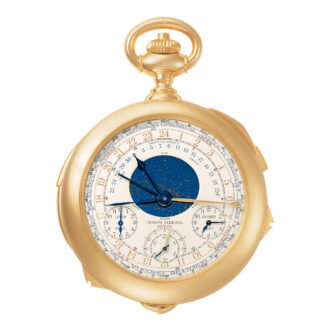
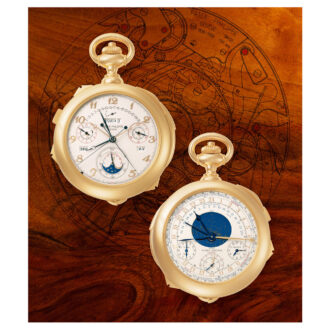
This is a spectacular and unique Swiss 18-carat gold open-faced pocket watch with two dials. It has three barrels and is both astronomical and astrological. It is a keyless lever watch with sidereal time, a second time zone, time of sunrise and sunset, equation of time, perpetual calendar, century leap year correction, century, decade and year indication, four-year cycle indication, season, equinox, solstice and Zodiac indication, star chart, phases and age of the moon, date of Easter indication, split-seconds chronograph, hour and minute recorders, Westminster chime on four gongs, grande and petite sonnerie, alarm, up/down indicators for the going and striking train, three-way setting indicator, winding crown position indicator, thermometer, and tourbillon regulator. It dates to circa 1989.
–
The movement is nickel-silver with three barrels on four levels. It weighs 600 grams and has Geneva striping decoration, 126 jewels, 1,728 parts, a straight-line lever escapement, a Gyromax balance, a blued steel Breguet balance spring, adjustment to heat, cold, isochronism and five positions, and a tourbillon regulator.
The dial-side main plate contains the mechanisms for the chime, alarm, 12-hour recorder and the power reserve indicators for the chime and movement. The reverse main plate contains the mechanisms for the meantime, the chronograph, the 30-minute recorder and the tourbillon regulator. Plate 2 contains the mechanisms for sidereal time, the season, solstices, equinoxes and solstice, the times of sunrise and sunset, the equation of time, the date of Easter and the star chart. Plate 3 contains the mechanisms for the secular perpetual calendar, the second time zone, the phases and age of the moon and the thermometer.
–
The front dial is cream with applied gold Breguet numerals. It has a retrograde date sector, hour and minute recording dials combined with the power reserve sectors for the going and striking trains, moon phase, year, month, day and four-year cycle apertures, second-time zone, thermometer, winding crown position indicator, alarm indicator, an outer 1/5th seconds scale with five minute/seconds red Arabic markers, subsidiary constant seconds, and original blued steel and yellow gold hands. The back dial is silvered with hours of sidereal time, date of Easter sector, sunrise and sunset dials, subsidiary sidereal seconds, equation of time sector, sun hand and aperture for the star chart, and original blued steel and gold hands.
–
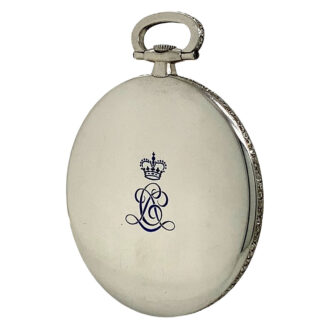
The case is polished. The dial, case and movement are signed. The watch comes with an Extract from the Archives and a fitted hardwood box
From the Matsuda Collection
This watch comes from the Matsuda Collection, one of the world’s finest private collections of Patek Philippe watches and Ferrari cars.
–
Yoshiho Matsuda was born in Tokyo and graduated in economics from the renowned Keio University. While living in the United States he came to know Western culture, and there he discovered the world of collecting art, paintings and watches.
–
He was one of the first to open car museums in Hakone, starting with a Porsche museum in 1981. When it closed, he opened the Art City Museum of Art in 1996, showing glass art and works by Warhol, Lichtenstein and others. In 1998 it became the Ferrari Museum of Art, where part of his collection of art, Ferraris and watches is on display. Few people have done as much as Mr Matsuda to spread knowledge of classic European cars and Swiss watches in Japan.
–
The Calibre 89
The Calibre 89 is an open-faced astronomical clock watch with two main dials. Patek Philippe built it in Geneva to celebrate the firm’s 150th anniversary. It is generally accepted to have 33 complications, in five groups: timekeeping, calendar, chronograph, chiming and operating functions.
–
The first calculations and designs date from 1980. A working prototype was ready in July 1988, and the watch was completed in April 1989. It meets the standards of the Geneva Seal. This hallmark is reserved for watches made in Geneva that meet the manufacturing standards in the Geneva watch-inspection law of 6 November 1886, as amended on 23 October 1959.
–
Four unique examples
Only four Calibre 89 watches were made, each unique:
- yellow gold: this watch, the very first Calibre 89
- pink gold
- white gold
- platinum
All four were bought by a single royal family. The collection was broken up in the early 2000s:
- The yellow gold watch went to an important collector, who kept it in his private museum.
- The pink gold watch was bought by an important Italian collector.
- The platinum watch went to a Middle Eastern royal family for their private museum.
- The white gold watch was the last to be sold, at Antiquorum’s 30th-anniversary auction on 24 and 25 April 2004.
–
The case
The open-faced case is made from three pieces of 18K yellow gold, in the Geneva bassine style. A central band holds the movement, and two bezels hold the glasses. The pendant and winding stem are at 12 o’clock, a layout named after the French watchmaker Jean-Antoine Lépine. The neck of the pendant is part of the case band itself.
–
The glasses are sapphire crystal (corundum), domed like a circle cut from a hollow sphere. They resist scratches from almost every material except diamond. The watch is operated and set by 12 external slides, pushers and winders.
- diameter: 88.2 mm
- thickness: 36.55 mm without glasses, 41.07 mm with glasses
- weight of the case: 500 g (16.075 troy oz)
- total weight of the watch: 1,100 g (35.365 troy oz)
–
The dials
The two main dials are 14K gold discs with condensed silver vapour on the surface, which gives them an opalescent finish. They are mounted directly on the second and third plates of the movement.
–
Indications on the mean time dial and the sidereal time dial
- day of the month
- hours of mean time
- 12-hour recorder
- power reserve (up-down) for the chime
- day of the week
- hour in a second time zone
- chronograph
- seconds of mean time
- moon phases
- winding crown position indicator
- century, decade and year
- year in the four-year leap cycle
- minutes of mean time
- 30-minute recorder
- power reserve (up-down) for the movement
- month
- split seconds
- thermometer
- hours of sidereal time
- date of Easter
- minutes of sidereal time
- time of sunrise
- equation of time
- seconds of sidereal time
- star chart
- sun hand
- time of sunset
The movement
The movement is built on four levels across three plates of nickel silver, also called German silver. One mainspring barrel drives the watch, which is regulated by a tourbillon. Two more barrels power the chime and the alarm.
- width: 71.5 mm including the plate mountings
- thickness: 28.05 mm
- weight: 600 g (19.29 troy oz)
- 1,278 parts, including 332 screws, 184 wheels, 61 bridges, 68 springs, 126 jewels, 24 hands, 8 discs, 2 main dials and 429 composite mechanical parts
–
Levels 1 and 2: the main plate. One side of the main plate carries the chime, the alarm, the 12-hour recorder and the power reserve indicators for the chime and the movement. The other side holds mean time, the chronograph with its 30-minute recorder, and the tourbillon, visible on the left at about 8 o’clock.
–
Level 3: the second plate. This plate carries the sidereal dial mechanisms: sidereal time, the seasons, solstices, equinoxes and signs of the zodiac, sunrise and sunset, the equation of time, the date of Easter and the star chart. The notched cam for the date of Easter, with its snail cam on top, is visible just below the engraved bridge at the top.
–
Level 4: the third plate. Facing the mean time dial, this plate holds the secular perpetual calendar, the second time zone, the moon phases and the thermometer. The calendar mechanism sits under the disc with the month names, on the right of the movement. The century wheel and its satellite, which turns once every 400 years, are hidden under the bridge at 3 o’clock.
–
The tourbillon
Abraham-Louis Breguet (1747–1823) invented the tourbillon to cancel the timing errors that gravity causes when a watch is held in different positions. The balance and escapement sit in a rotating cage, usually turning once a minute. This spreads the load evenly over every bearing, whatever the position of the watch.
–
Patek Philippe improved on Breguet’s idea. In a normal tourbillon the cage sits on the fourth wheel of the going train. In the Calibre 89, the fourth wheel instead drives the toothed rim of the cage. That same wheel also drives the seconds hand, the chronograph and the 32-wheel sidereal time train.
- main cage parts in titanium
- cage and escapement: 54 parts, weighing 0.73 g
- one rotation every two minutes
- straight-line Swiss lever escapement with a 20-tooth escape wheel
–
The Gyromax balance
The balance is a Gyromax with variable inertia, cut from 14K gold together with its inertia blocks. It beats 18,000 times an hour, or five times a second.
–
The Gyromax is a monometallic balance with slotted gold weights mounted on pins around its rim. Turning these weights changes the effective radius of the balance at chosen points. This makes the watch far easier and more precise to regulate than a conventional index regulator. The hairspring is free-sprung with a Breguet overcoil. The complete balance assembly has 19 parts and weighs 0.98 g. Patek Philippe invented the Gyromax and protected it with Swiss patents No. 261431 (15 May 1949) and No. 280067 (31 December 1951).
–
Second time zone
A gold Breguet hand shows the hour in a second time zone on the main scale of the solar dial. It sits on the canon pinion of the hour wheel, and each press of the pusher at 11 o’clock moves it forward one hour. Travellers can set local time without touching the minute hand. The mechanism is based on Patek Philippe’s Swiss patent No. 340191 of 31 July 1959.
–
Equation of time
A blued steel hand shows the equation of time on a horseshoe-shaped scale at 12 o’clock on the sidereal dial, from −17 to +17 minutes. The hand is moved by a cam driven by the sidereal train, so it always matches the season shown by the sun hand.
–
The equation of time is the difference between mean time and apparent solar time. It reaches about 14 minutes in mid-February and about 16 minutes in early November, with opposite signs. It is zero around 15 April, 14 June, 1 September and 25 December. Navigators need it when they measure the height of the true sun against the time on a mean-time watch.
–
Sidereal time
Sidereal time is shown on a 24-hour scale by blued steel Breguet hands, with sidereal seconds on a small dial at 12 o’clock. The 32-wheel sidereal train is driven by the fourth wheel of the main movement. A reduction train makes one sidereal second equal to 0.9972677 of a mean second. This is a fraction shorter than the true value of 0.9972696. Sidereal time gains 3.94512 minutes a day on mean time, a full 24 hours over a year.
–
To set sidereal time, pull the crown to position B, move the slide to CS, and turn the crown anti-clockwise. The sun hand and star chart move along in proportion.
–
The unit is the sidereal day: the time between two passes of the vernal equinox, or first point of Aries, across the observer’s meridian. Because this imaginary point is infinitely far away, it gives a more regular measure of time than the sun. Navigators use sidereal time to find the hour angle of a star.
–
Sunrise and sunset
Two small dials on the sidereal side show the times of sunrise (at 16:00) and sunset (at 08:00) in Geneva (latitude 46° 11′ 59″ N), matched to the time of year shown by the sun hand. Each is driven by a cam, and the cams can be replaced for other latitudes.
–
The times are accurate to within five minutes of true sunrise and sunset, when the upper edge of the sun touches the true horizon for an observer at sea level. True sunrise and sunset are normally corrected for atmospheric refraction.
Signed: Patek Philippe Genève
Share this page: