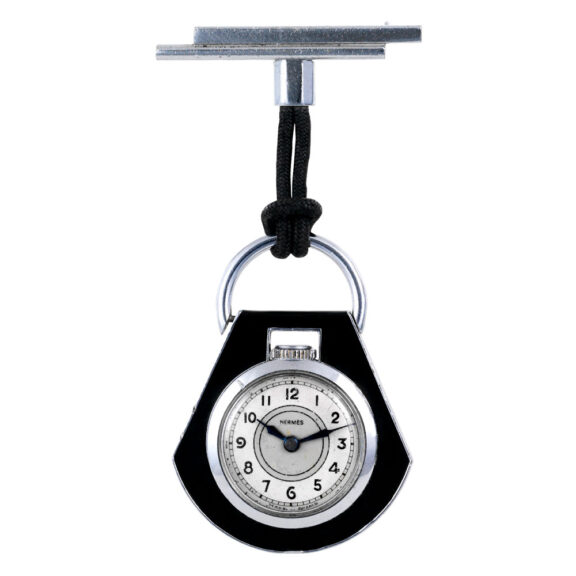
French chromed, black-lacquered padlock-form lapel watch Circa 1935
- Kenmerk
- BA2495
- Diameter
- -
- Estimate
- € 500 - 1.000
- Price sold
- € 600
Padlock-form keyless lapel watch by Hermès
–
A fine French chromed and black-lacquered padlock-form keyless lapel watch, made in the 1930s. Rhodium-plated movement, 15 jewels, monometallic balance, self-compensating flat balance spring, index regulator. Two-tone silvered dial with painted Arabic numerals, outer minute track and original blued steel hands. Polished case, the front and back overlaid with black lacquer, inclined bezels, hinged bow with cord and chromed brooch attachment, transparent back. Dial signed.
–
Dimensions excluding bow: 32 x 31.5 mm
–
Signed: Hermès made France
–
The Horology Of Hermès. The celebrated Paris firm was founded in 1837 by Thierry Hermès, a German immigrant from Krefeld, whose French Protestant family had fled temporarily to Germany. He opened a shop near the Madeleine in Paris, where he offered harnesses and other items for horses and horse-drawn carriages. After Thierry’s death in 1878, his descendants took over the family business, extending the firm’s expertise in leather to the creation of belts, clothing, and handbags. Hermès soon acquired a reputation for excellence and became famous for luxury goods crafted in fine materials. In the 1920s Hermès began making watch straps, which naturally led to the creation of watches in their entirety. In 1928 Hermès offered its first watches in its famous store at 24, rue du Faubourg Saint Honoré. Perhaps the best known of these was the Ermeto, a pocket or purse watch that was automatically wound when its sliding covers were opened to reveal the time, and when they were closed. This timepiece, made in conjunction with Movado, was elegantly covered in fine leather by Hermès. The company’s timekeepers were appreciated by celebrities and royalty. In 1935 the Romanian king Carol II ordered a rose gold and steel watch with the family arms engraved on its case, and in 1945 a belt watch was made for king Umberto II of Italy. Over the next fifty years, Hermès created many fine timepieces in collaboration with several renowned watch brands including Jaeger- LeCoultre, Vacheron Constantin, Universal Genève, Mido, Tavannès, and Movado, but it was not until 1978 that the firm opened its own horological workshop in Biel, La Montre Hermès SA. The wide variety of timekeepers created by Hermès include desk clocks, travel clocks, mantel clocks, sporting watches, chronographs, brooch watches, belt buckle watches, and elegant timepieces for evening wear. Certain clocks and watches highlighted Hermès’ traditional area of expertise: timepieces clad in fine leather, and the stirrup-shaped ‘Etrier’ desk clock, for example. One of the most influential designers of Hermès timepieces was Paul Dupré-Lafon (1900-1971). Born in Marseille, France, Dupré-Lafon studied at the Ecole des Beaux Arts in his hometown and graduated in 1923 with a double diploma in both architecture and interior design. Quickly gaining a reputation as an architect and designer, Dupré-Lafon decorated the Paris apartments of many discerning collectors. His long and fruitful partnership with Hermès began in 1929. While Dupré-Lafon was an innovator, he shunned the merely trendy. His sober and elegant style, influenced by Art Deco and the streamlined ‘paquebot’ style, emphasizes functionality and comfort. The understated opulence of his pieces comes from their sharp yet fluid lines, their palette of nature tones, and the use of the finest materials: exotic woods, leather, lacquer, and metal. One of the few designers of the 30s to have remained active long past mid-century. In the words of critic Michel Dufet, his work represents the profound ‘essence of luxury’. Each of his creations is imprinted with a lucid serenity that one cannot help but admire.
Signed: Hermès made France
Share this page: