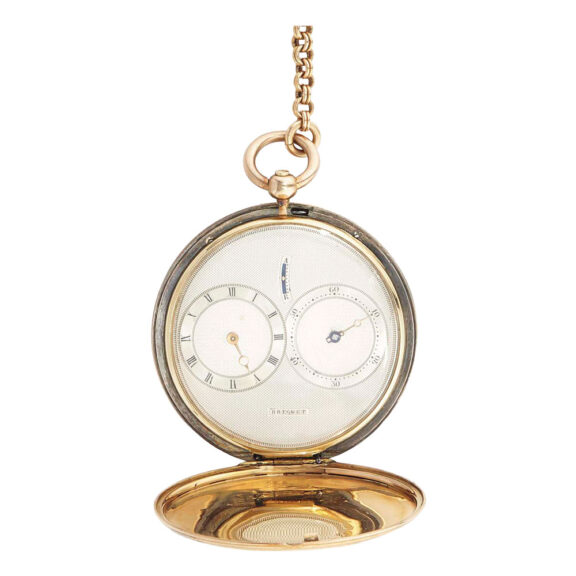
Historically important French gold silver cylinder Circa 1825
- Kenmerk
- CH1367
- Diameter
- 41 mm
- Estimate
- € 200.000 - 400.000
- Price sold
- € 237.350
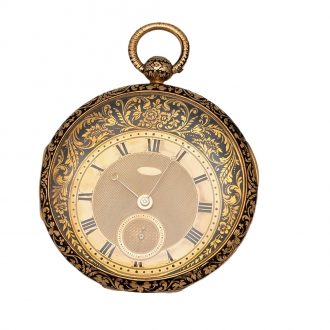
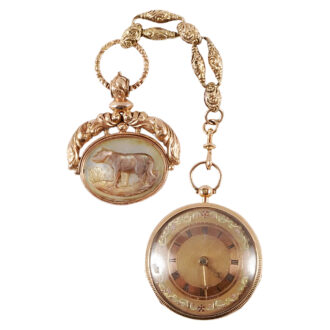
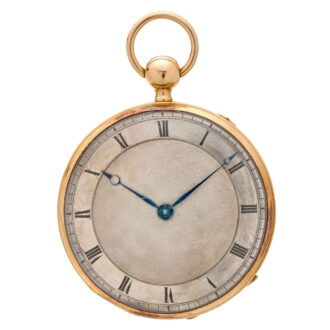
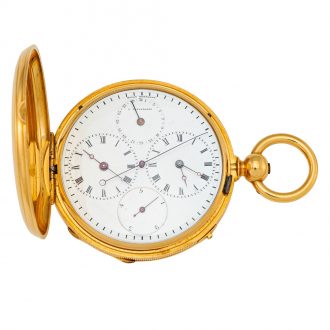
Very fine full hunter cased cylinder watch by Breguet
–
Breguet gold and silver hunter-case watch with off-centre dials, sold to King George IV, circa 1825
–
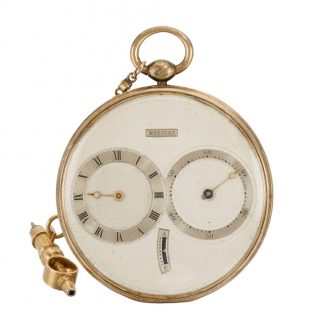
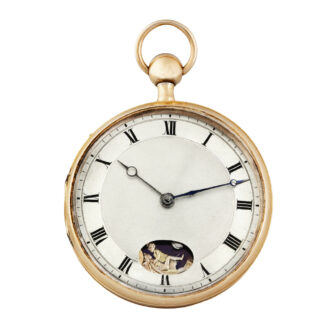
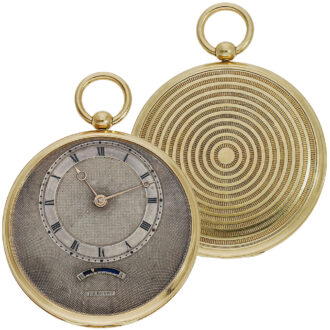
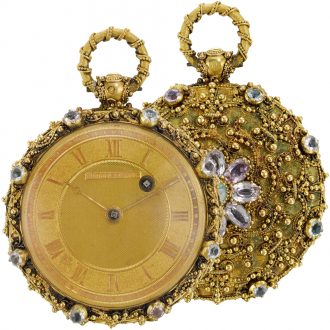
This is a very fine, rare and historically important French watch in 18-carat gold and silver. It has a full hunter case and separate off-centre dials for the hours and the minutes.
–
Provenance
The Breguet records describe it as a “Montre simple plate à deux cadrans excentriques d’heures et minutes.” It was sold on October 3, 1825, to His Majesty King George IV of Great Britain for 2,900 francs.
–
Case
The case has a silver band and engine-turned gold covers. The back rotates on a bayonet catch: turning it opens or closes the winding hole. To open the back fully, a small screw under the bezel is removed. The case is no. 4052, from the workshop of Pierre-Benjamin Tavernier. It bears the later master’s mark “MAB” in a diamond, used after 1820.
–
Dial:
- Engine-turned silver dial, signed Breguet
- Two off-centre dials, one for the hours and one for the minutes, with Roman numerals
- Gold Breguet hands
- Fast/slow regulator slide above the dials
–
Movement:
- Gilt-brass movement with a ruby cylinder escapement
- Plain three-arm brass balance with “parachute” shock protection on the top pivot
- Flat blued steel balance spring
–
Accessories:
- Short gold chain with a gold ratchet key. One end winds the watch, the other sets the hands.
- Original fitted box in red Morocco leather
–
Diameter: 41 mm
–
Signed: Breguet
–
This watch appears on the list of the most important watches and clocks that Breguet sold to George, Prince of Wales, who later became Prince Regent and finally King George IV of Great Britain. It is watch no. 4420, described as a “Montre très plate à deux cadrans” in gold. It was sold to King George IV on October 3, 1825, for 2,900 francs (certificate no. 2580).
———————————
George IV, King of Great Britain and Ireland 1762–1830
George Augustus Frederick became King of Great Britain and Ireland, and King of Hanover, when his father George III died on January 29, 1820. He reigned until his own death ten years later. Before that, from 1811, he had ruled as Prince Regent. A man of exceptional taste and style, he is best remembered as a generous patron of the arts.
–
Early life
George was born at St James’s Palace in London on August 12, 1762. As the eldest son of the king, he became Duke of Cornwall and Duke of Rothesay at birth, and was made Prince of Wales and Earl of Chester shortly afterwards. On September 18 of that year he was baptised by Thomas Secker, Archbishop of Canterbury. His godparents were his uncle the Duke of Mecklenburg-Strelitz (represented by the Duke of Devonshire, the Lord Chamberlain), his great-uncle the Duke of Cumberland and his grandmother, the Dowager Princess of Wales.
–
George was a gifted student. Besides English, he quickly learned French, German and Italian. He had a strong feeling for music and the arts and was known for his good looks.
–
Patron of the arts
George lived a lavish life that helped shape the fashions of the Regency era, and he championed new forms of leisure, style and taste. He asked the famous architect John Nash to remodel Buckingham Palace, and Sir Jeffry Wyattville to rebuild Windsor Castle. In Brighton, he turned the Royal Pavilion into a fantastical seaside palace. Nash redesigned it in an “Indian Gothic” style loosely inspired by the Taj Mahal, with extravagant Indian and Chinese interiors.
–
George also played a key role in founding the National Gallery and King’s College London. His charm and culture earned him the name “the first gentleman of England.”
–
Marriage and death
On April 8, 1795, he married his cousin, Princess Caroline of Brunswick, at the Chapel Royal in St James’s Palace. The couple formally separated after the birth of their only child, Princess Charlotte, in 1796.
–
George IV died at Windsor Castle on the morning of June 26, 1830, and was buried in St George’s Chapel, Windsor, on July 15. His brother Prince William, Duke of Clarence, succeeded him as William IV.
—————————————-
A masterpiece from the Breguet workshop
Abraham-Louis Breguet (1747–1823) was known as “watchmaker of kings and king of watchmakers.” He and his descendants, Antoine-Louis and Louis-Clément, lived through often turbulent historical and political times. The technical, innovative and decorative qualities of this watch show Breguet’s genius in every area of fine watchmaking.
–
Abraham-Louis Breguet
Breguet is widely recognised as the watchmaker who set the standard by which all fine watchmaking has been judged ever since. He was born in Neuchâtel, Switzerland, but spent most of his working life in Paris. He studied every aspect of watchmaking, and his inventions were as varied as they were fundamental.
–
His career began with a series of breakthroughs: the successful self-winding “perpétuelle” watch, the use of gongs in repeating watches, and the first shock protection for the balance pivots.
–
Louis XVI and his Queen, Marie-Antoinette, were early enthusiasts of Breguet’s watchmaking. Each watch from his workshops demonstrated the latest horological improvements in an original movement, mostly fitted with lever or ruby cylinder escapements that he perfected. Breguet took refuge in Switzerland from the excesses of the French Revolution. He returned to Paris overflowing with the ideas that produced the Breguet balance spring, his first carriage clock (sold to Bonaparte), the ‘sympathique’ clock and its dependent watch, the tact watch and finally the tourbillon, patented in 1801.
–
Breguet became the indispensable watchmaker to the scientific, military, financial and diplomatic elites of the age. His timepieces ruled the courts of Europe. For his most celebrated clients, Breguet designed exceptional timepieces. For Caroline Murat, Queen of Naples, he conceived in 1810 the world’s very first wristwatch. Honours saluted his enormous contribution to horology. Appointed to the Board of Longitude and as chronometer maker to the navy, he entered the Academy of Sciences and received the Legion of Honour from the hands of Louis XVIII.
–
When he died in 1823, all mourned the architect of the greatest revolution in the science and art of time-keeping.
–
Antoine-Louis Breguet 1776–1858
When Abraham-Louis died in 1823, his only son, Antoine-Louis, took over the firm as his natural successor. He had trained with his father in Paris, with John Arnold in London and with several Swiss watchmakers around Le Locle. From about 1790 he had helped run the firm and had taken part in all its innovations. Customers knew and respected him, and his one wish was to continue his father’s work.
–
Under his leadership, the firm made more marine chronometers and more complicated watches. He was a worthy successor who kept pushing the limits of what was possible and gave free rein to his strong artistic sense. Some of his pieces were more elegant and refined than anything the firm had made before. Breaking with house tradition, he designed off-centre dials of striking boldness. At the national exhibition of 1827 he won gold medals for his marine chronometers and his complicated watches.
–
Although he was a highly gifted watchmaker, Antoine-Louis lacked his father’s people and business skills. As sales declined, he handed the business to his son Louis-Clément, and on May 20, 1833, the firm became Breguet, Neveu et Compagnie.
–
Louis-Clément Breguet 1804–1883
Like his father and grandfather, Louis François Clément Breguet was a trained watchmaker. He was also a physicist and a prolific inventor. After taking over in 1833, he led the renamed firm in a new direction.
–
Between 1835 and 1840 he standardised most of the firm’s production, which then stood at 350 watches a year. At the same time, he kept a traditional workshop for one-off pieces made “à l’ancienne,” in the old style. He also branched out into scientific instruments and electrical devices, including recording instruments, an electric thermometer, telegraph equipment and electrically synchronised clocks.
–
In 1842, together with Alphonse Foy, he developed an electric needle telegraph to replace the optical telegraph then in use. He built the rotating-mirror apparatus that Léon Foucault and Hippolyte Fizeau used to measure the speed of light in 1850. In 1856 he designed a public network of synchronised electric clocks for the centre of Lyon. In 1866 he patented an electric clock controlled by a 100 Hz tuning fork.
–
In terms of honors, in 1843 he was appointed to the Bureau of Longitudes. In 1845 Breguet was awarded the Legion d’Honneur. He was made a member of the French Academy of Sciences in 1874 and was elevated to Officer of the Legion d’Honneur in 1877. He is one of the 72 French scientists whose names are written around the base of the Eiffel Tower.
–
Breguet was married and had one son Antoine 1851-1882 who also joined the family electrical business. Father and son met Alexander Graham Bell and obtained a license to manufacture Bell telephones for the French market. Antoine’s son was Louis Charles Breguet, aviation pioneer and aircraft manufacturer. In 1870, both Louis-Clément and his son Antoine had lost interest in traditional watchmaking. The branch was separated from the rest of the firm and handed over to Edward Brown who had been working at Breguet since 1845. Breguet then focused entirely on the telegraph and the nascent field of telecommunications. He collaborated in the development of an induction coil, later improved by Heinrich Ruhmkorff. He died in 1883, a little over a year after the sudden death of his son Antoine.
Signed: Breguet
Share this page: