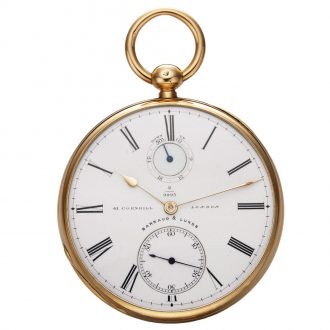
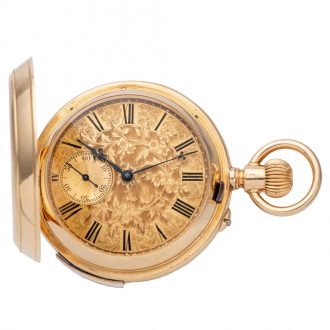
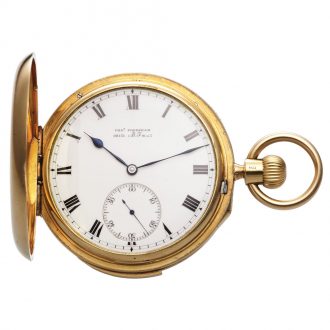
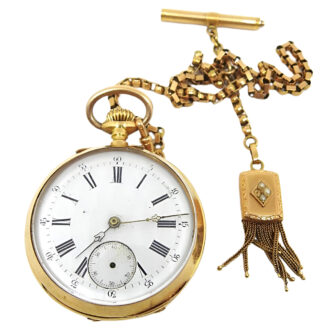
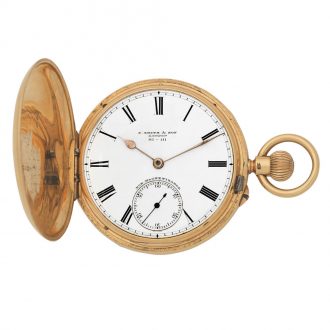
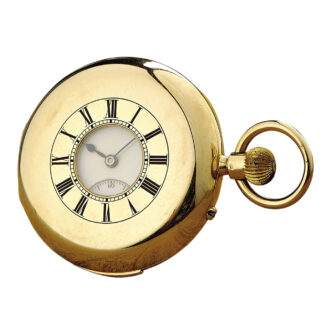
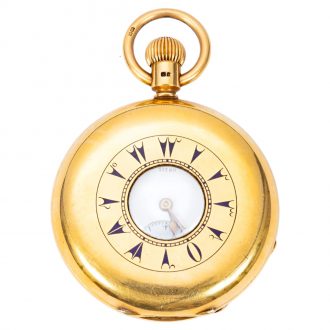
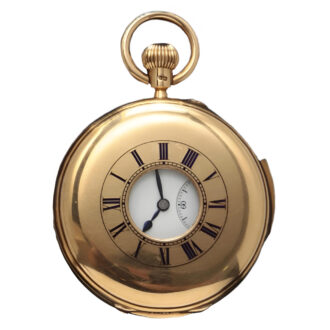
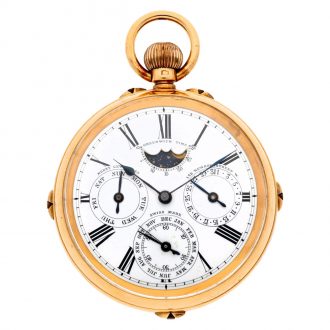
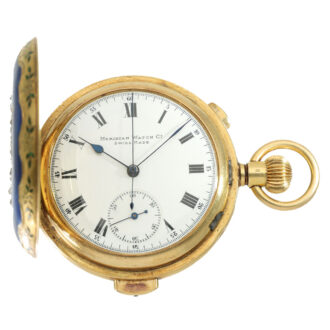
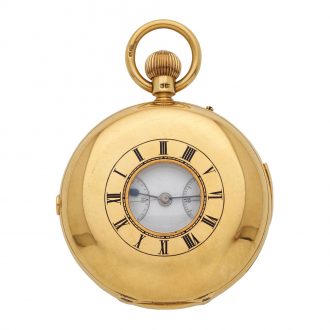
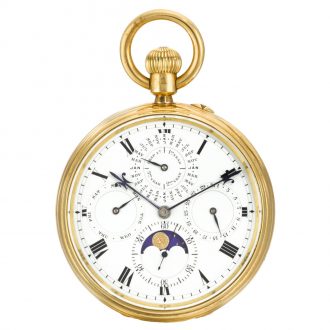
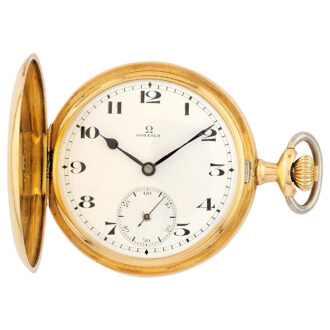
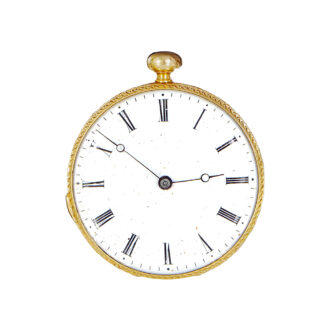
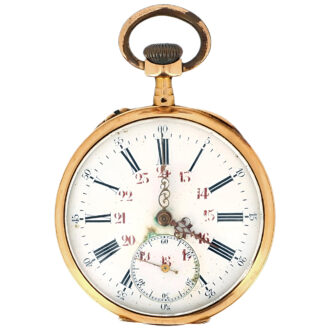
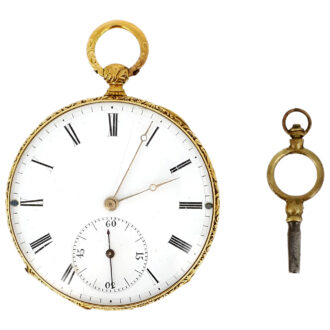
English gold watch with power reserve indicator Circa 1900
- Kenmerk
- TA4190
- Diameter
- 52 mm
- Estimate
- € 3.250 - 5.000
- Price sold
- € 1.400
Gold open faced lever
–
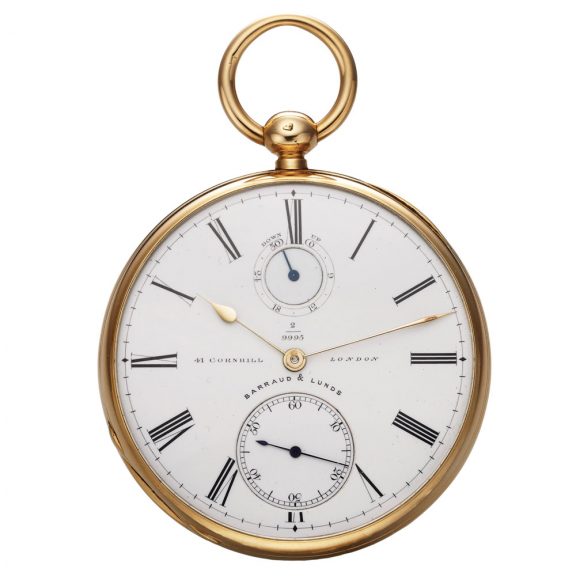
A rare English 18 carat gold pocket watch with power reserve indicator, circa 1900. Accompanied by a key. A solid, polished case with a hinged gold cuvette, winding and setting apertures. White enamel dial with radial Roman numerals, outer minute track, sunk subsidiary second dial, power reserve indicator at 12 and gold spade hands. Gilt brass, three-quarter plate movement, nine jewels, pointed tooth lateral lever escapement, cut bimetallic balance with gold timing screws, Breguet balance spring. Dial and movement signed, numbered on the case.
–
Diameter: 52 mm
–
Signed: Barraud & Lunds London
–
The Barrauds, a family of watchmakers. Paul Philip Barraud was a prominent English watchmaker who lived and worked in London, specifically in Cornhill. He became well-known for the construction of chronometers. He was born on December 5th, 1752 in Soho, London to Francis Gabriel Barraud and Magdalen Bennin Crespin, the daughter of a well-known Huguenot silversmith named Paul Crespin.
–
In 1796, he became a member of the Clockmakers’ Company and a master from 1810 to 1811. Paul Philip formed a partnership with George Jamison and William Howells. He married Marriet Chapman and they had seven children together. Three of their sons, Frederick Joseph, John and James also learned the watchmaking trade. He further taught other watchmakers, including Thomas Robison from December 1st, 1800, to December 7th, 1812, and William Turpin from June 5th or June 6th, 1809. After a long and painful illness, Paul Philip died on August 26th, 1820 in Croydon, Surrey and Frederick Joseph assumed management of the firm under the name Barraud & Son, Barraud & Sons and Barrauds.
–
Frederick Joseph was free of the Clockmakers’ Company in 1806. He took his son Frederick Philip and the son of his brother John, Hilton Paul, as his apprentices. John himself had only a minor role in the business and the youngest brother James did not follow the trade at all. The company manufactured over 1.000 chronometers between 1796 and 1820. In 1838, Frederick Philip joined in partnership with John Richard Lund, a horological inventor, they renamed the firm Barrauds & Lund. In 1846 Hilton Paul replaced his uncle, Frederick Joseph in the firm. Frederick Joseph died on September 4th, 1859.
–
Paul Philippe Barraud was also the great-grandfather of William Barraud (1810-1850) and Henry Barraud (1811-1874), who were well-known animal painters. Henry Barraud’s son was painter Francis Barraud (1856–1924), who became known for creating the iconic “His Master’s Voice” logo of a dog named Nipper next to a gramophone.
Signed: Barraud & Lunds London
Share this page: