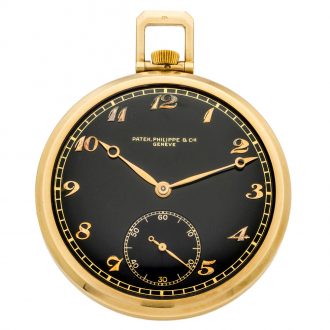
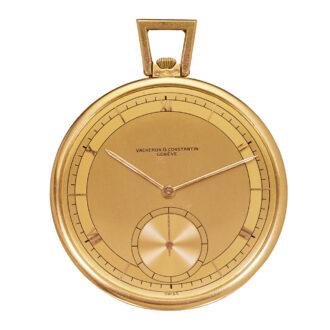
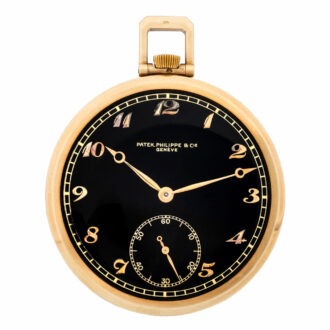
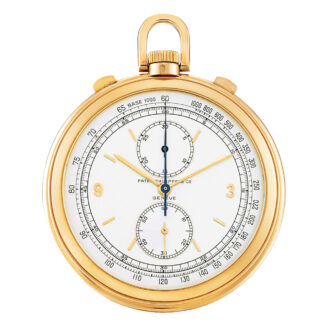
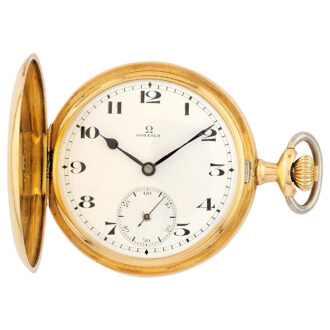
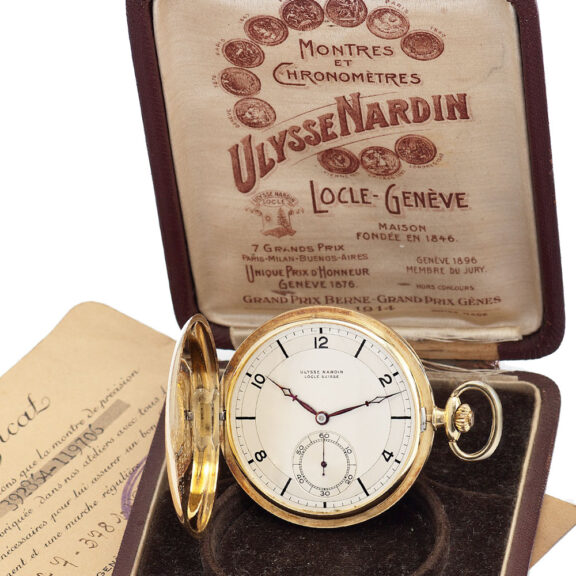
Swiss gold hunting cased key less lever pocket watch Circa 1944
- Kenmerk
- TA3589
- Diameter
- 47 mm
- Estimate
- € 2.000 - 3.500
- Price sold
- € 1.900
Gold watch with a two tone silver dial
–
A fine and elegant Swiss 18 carat yellow gold hunting cased keyless pocket watch, circa 1944. Sold on July 4th, 1944 in Buenos Aires. Accompanied by the original fitted box and certificate. A polished and engine turned case, the front cover engraved with a monogram, the interior with a dedication and a hinged gold cuvette. Two tone silver dial with radial Arabic numerals and baton indexes, outer minute track, subsidiary seconds dial and blued steel cathedral hands. Movement with 15 jewels, straight line lever escapement, cut bi metallic compensation balance with gold temperature adjustment screws, blued steel Breguet balance spring and a swan neck micrometre regulator.
Dial, case and movement signed.
–
Diameter: 47 mm
–
Signed: Ulysse Nardin Locle
–
The case and movement are slightly scratched.
–
Ulysse Nardin SA is a Swiss luxury watchmaking company. Founded in 1846 in Le Locle, Switzerland bearing the name of its founder Ulysse Nardin. It has remained in continuous production since. The company became best known for manufacturing highly accurate marine chronometers (of which the anchor in the company logo is a reminder nowadays) used by over 50 of the world’s navies from the end of the 19th century till 1950. Furthermore, pocket watches with complications such as moon phases, a perpetual calendar, repetition and an alarm function were produced. According to the last official report of Neuchâtel Observatory in Switzerland, Ulysse Nardin had won numerous awards and honours for its marine chronometers from 1846 to 1975, including 4324 certificates, 2411 special prizes and 18 gold medals at International exhibitions. Ulysse was born in 1823 in Le Locle, Switzerland. He first trained as an apprentice horologist under his father, Léonard-Fédéric Nardin and
by which time they were employing over two hundred specialist craftsmen including goldsmiths, enamellers, engravers, lapidaries, diamond polishers and watchmakers. By employing these artists directly, rather than contracting out the work, Verger Frères were able to keep tight control of the quality of their work. Consequently, they became renowned for the outstanding quality and consistency of their pieces. The firm remained in the Verger family during the 1940s and 1950s, but eventually, the business was bought by Georges Lenfant and more recently it was acquired by Atelier Bouder who have dedicatedly reconstructed the company’s heritage through the extensive archives of drawings and models.
Signed: Ulysse Nardin Locle
Share this page: