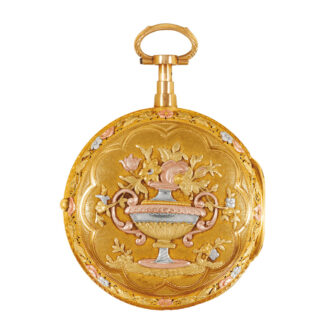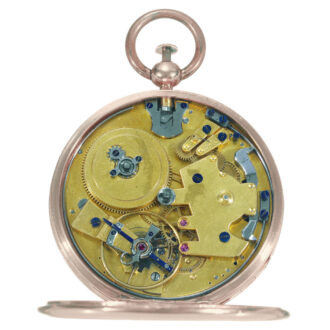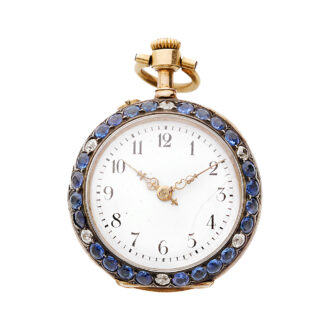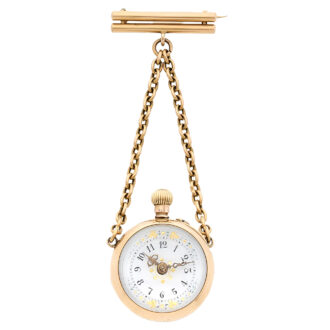
English gold duplex watch made for Chinese market Circa 1815
- Kenmerk
- TA1570
- Diameter
- 60 mm
- Estimate
- € 100.000 - 200.000
- Price sold
- € 249.400
Gold, enamel and pearl-set pocket watch
–
English gold, enamel and pearl-set pocket watch for the Chinese market, circa 1815
–
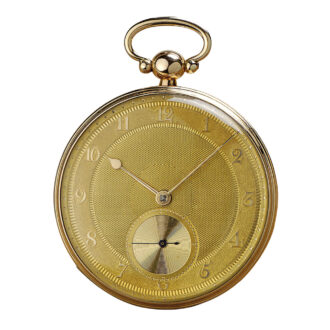
This is a very fine and rare English pocket watch in 18-carat gold, made for the Chinese market. It is set with pearls, has a centre seconds hand and a duplex escapement.
–
Case
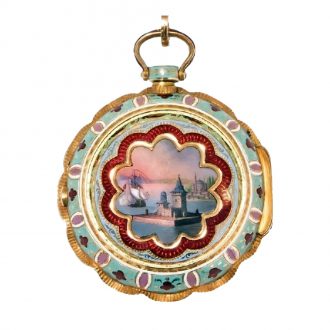
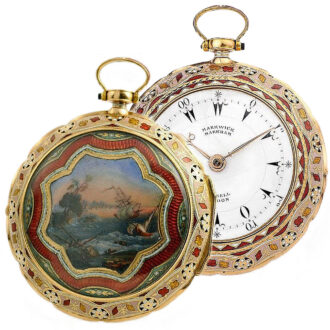
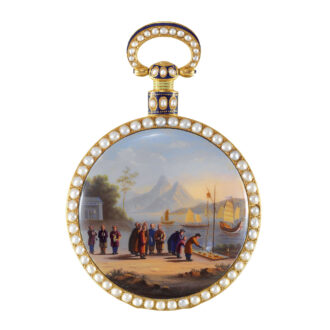
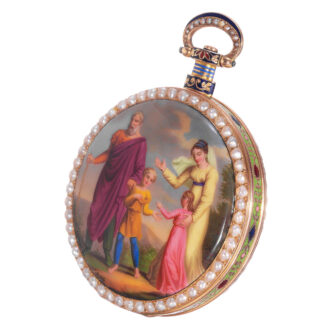
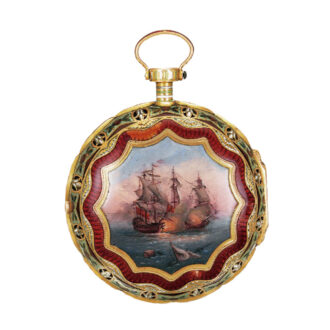
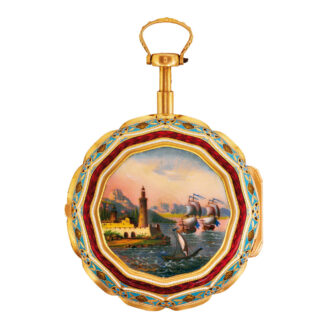
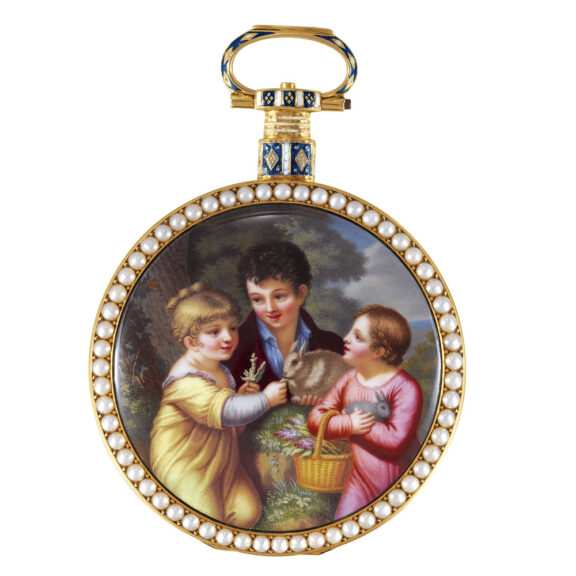
The back shows a finely painted enamel scene, “Feeding the Rabbits,” attributed to Jean-François-Victor Dupont. Three children are feeding a rabbit in a wooded landscape, and one of them holds a baby rabbit in their arms. The case band, pendant and bow are decorated with champlevé enamel in royal blue, pale blue and white. The bezels are set with split pearls.
–
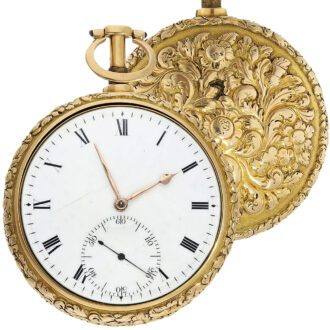
Inside, a hinged gold dust cover (cuvette) is engraved with scrolls and a central rosette.
–
Dial:
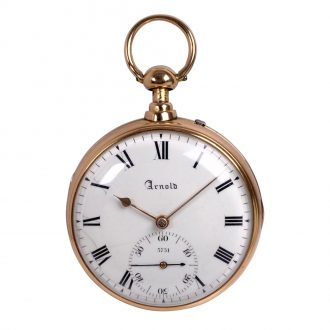
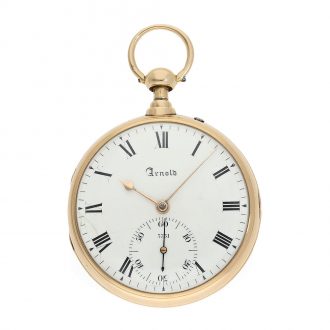
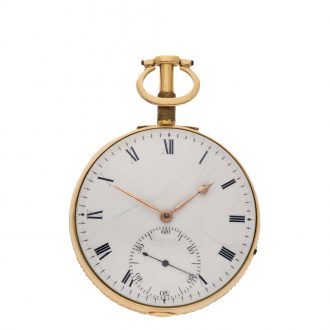
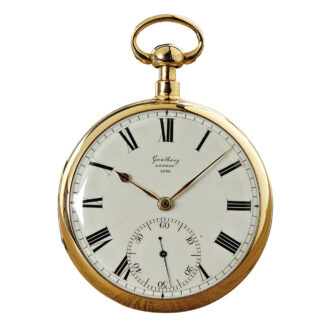
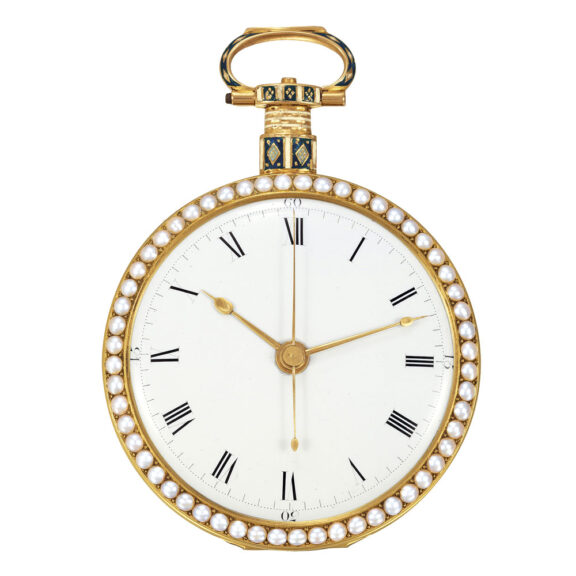
White enamel dial with Roman numerals set around the dial
Outer track for minutes and seconds, with Arabic numerals at the quarter hours
Gold oval hands
–
Movement:
Gilt-brass Chinese-calibre movement, engraved all over with flowers, signed
Standing barrel
Single-wheel duplex escapement
Plain polished steel balance with five arms and a flat balance spring
Diamond endstone
Index regulator
–
Diameter: 60 mm
–
Signed: Ilbery London
–
The scene
The painting on this watch is a charming example of a theme that was very popular in the early 19th century: children with their pets. Many of these images were based on English engravings and prints of the time, by artists such as Francis Wheatley, William Hamilton and George Morland.
–
William Ilbery (circa 1760–1839)
Ilbery worked in London from 1780, first in Goswell Street and then, towards the end of the 18th century, in Duncan Terrace. Following James Cox in London and Jaquet Droz in Switzerland, he specialised in luxury watches for the Chinese market.
–
His early watches were very English in style, with a full-plate movement and an English single-wheel duplex escapement. For his finest pieces he used a spring detent escapement instead. His later movements took their inspiration from the Lépine calibre, with a free-standing barrel. Jaquet Droz’s Swiss watches signed “London” and the work of the London maker William Anthony followed the same approach.
–
The best enamellers in Geneva decorated his cases. They included Jean-François-Victor Dupont, who usually signed his work, and Jean-Louis Richter, who rarely did. Ilbery also organised the production of richly engraved movements for the Asian market in Switzerland, mainly in Fleurier. Other makers in Fleurier (Val de Travers), such as Bovet and Juvet, later did the same.
–
For all these reasons, Ilbery is regarded as one of the most typical makers of “Chinese” watches. He also seems to have had close links with the trade on the Continent: a watch signed “Ilbery Paris” is known, and the firm Ilbery & Son is recorded in London, Fleurier and Canton.
–
Jean-François-Victor Dupont (1785–1863)
Dupont was probably the finest enamel painter working in Geneva in his time. He painted portraits of distinguished figures such as King George IV and Henry VI. He also decorated boxes and, above all, watches made for the Chinese market. For these he often worked with Ilbery and with Piguet & Meylan.
–
He was especially good at painting a group of figures side by side without the scene looking crowded. His distinctive colours may come from the fact that he mixed his own paints.
Signed: Ilbery London
Share this page: