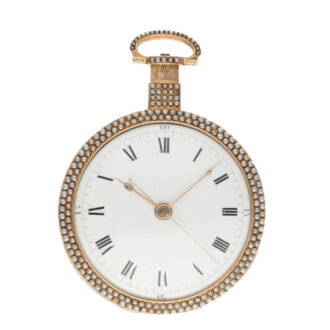
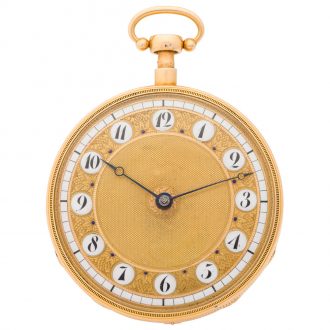
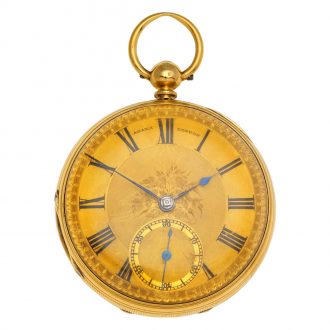
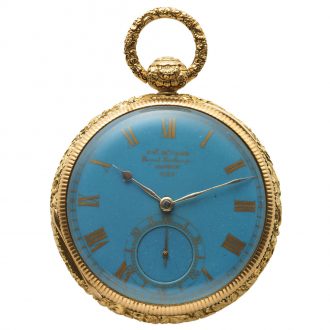
English gold duplex made for the Chinese market Circa 1820
- Kenmerk
- AD1137
- Diameter
- 60 mm
- Estimate
- € 80.000 - 140.000
- Price sold
- € 106.250
Gold enamel and split pearl set watch by William Ilbery
–
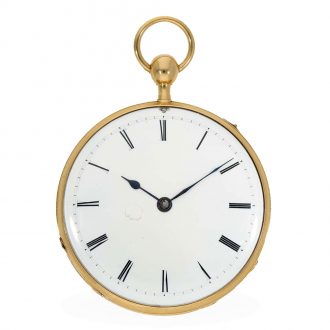
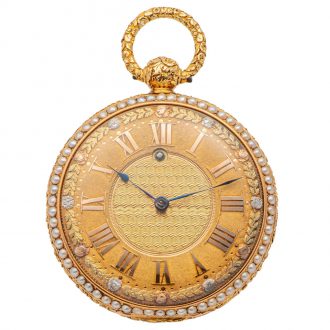
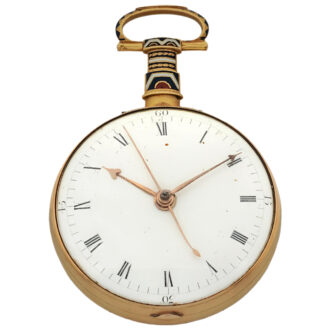
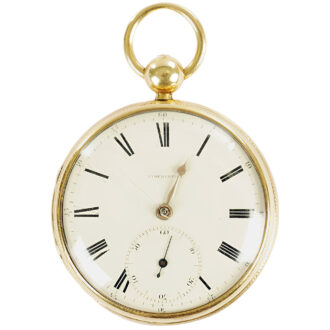
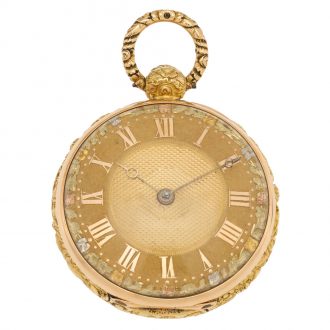
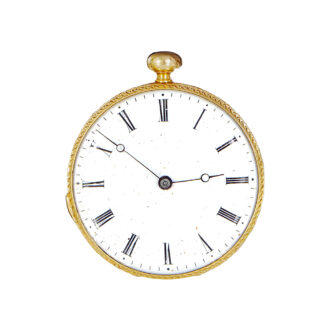
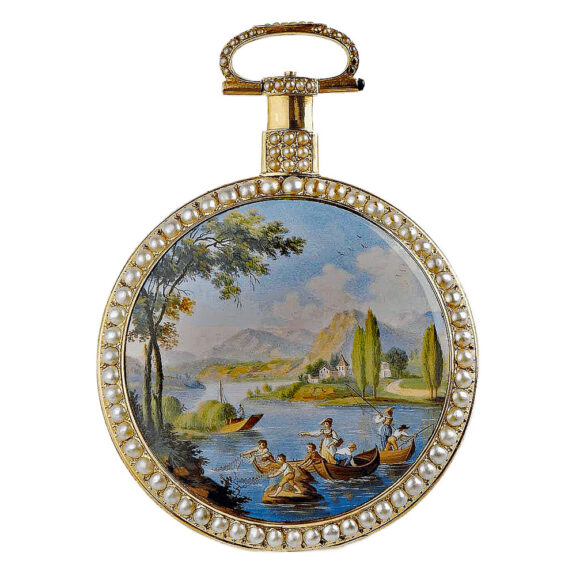
A very fine English 18 Carat gold, enamel and pearl set open faced duplex pocket watch in museum like quality made for the Chinese market, Gathering in the Fishing Nets, circa 1820. Lavishly florally engraved gilt bridge movement according to Lépine, keywind, florally engraved going barrel, duplex escapement, five arm steel balance, blued balance spring, fine florally engraved and pierced balance cock, chatoned diamond end stone on balance, signed.
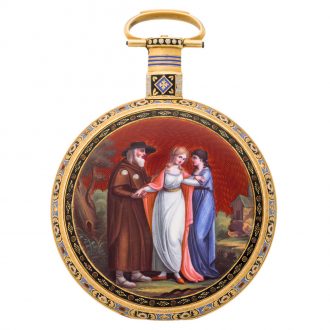
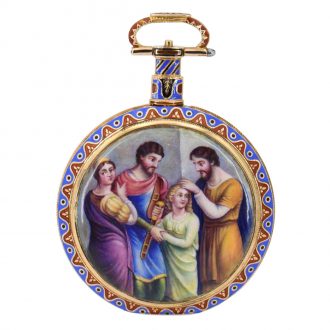
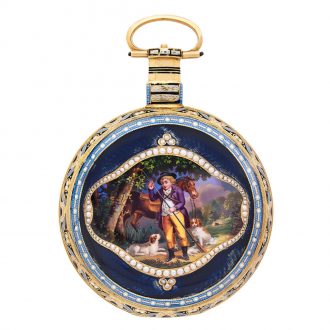
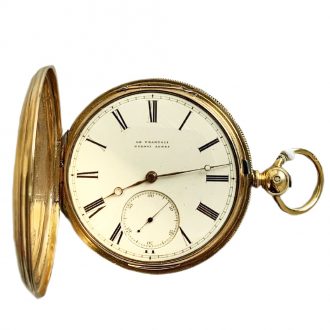
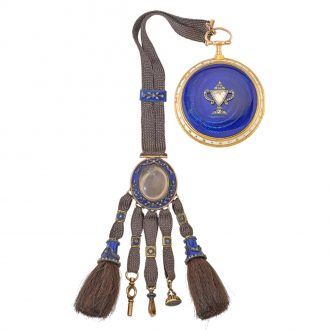
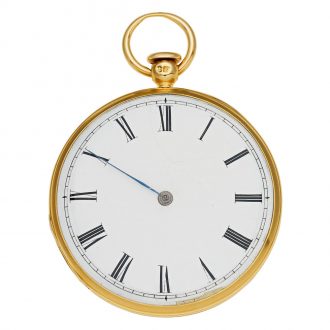
Bezels, pendant and bow set with split pearls set, the reverse with a polychrome enamel miniature painting of an alpine lake view with three fisher boats in the foreground and a small village in the back, the enamelling attributed to Jean-Louis Richter. Lavishly florally engraved gold dome. White enamel dial with radial Roman numerals, auxiliary seconds and filigree gold hands.
–
Diameter: 60 mm
–
Weight: 149 g
–
Signed: Ilbery London
–
William Ilbery, circa 1760-1839, was active in London from 1780 in Goswell Street, he moved to Duncan Terrace towards the end of the 18th century. After James Cox in London and Jaquet Droz in Switzerland, he also specialized in producing luxury watches for the Chinese market. His early production was very much in the English style, featuring a full plate movement and an English type single wheel duplex escapement. However, for his highest quality watches, he incorporated a spring detent escapement. Later, the watch movements he produced were much inspired by the Lépine calibre with a free standing barrel, as were Jaquet Droz’s Swiss production signed in London and that of William Anthony, who worked in London. The cases of his watches were sumptuously decorated by the best Genevan enamellers, such as Jean-Francois-Victor Dupont, who usually signed his work, and Jean-Louis Richter, who signed rarely. He organized the production in Switzerland, mainly in Fleurier, of profusely engraved movements for the Asian market. He was followed in this by makers such as Bovet and Juvet who also worked in Fleurier (Val de Travers). Ilbery can therefore be considered one of the most representative makers of ‘Chinese’ watches. He seems to have maintained close contacts with the continental trade since a watch signed ‘Ilbery Paris’ is known while Ilbery & Son are recorded in London and Fleurier, as well as in Canton.
–
Jean-Louis Richter, 1766-1841, learned his art under David-Etienne-Roux and Philippe-Samuel-Théodore Roux. He specialized in landscapes, lake side scenes and marine scapes, often representing ships in a harbour or battles with Men of War, but also portraits and hunting scenes. Richter did not often sign his work, but the style and quality of his paintings make them clearly recognizable as being of his hand. He applied his art principally to watch cases and snuff boxes which were largely destined for the Chinese, Turkish, British and Italian markets.
Signed: Ilbery London
Share this page: