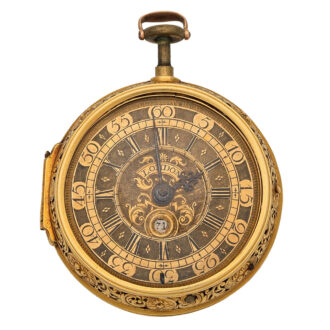
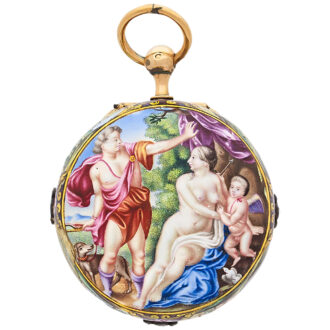
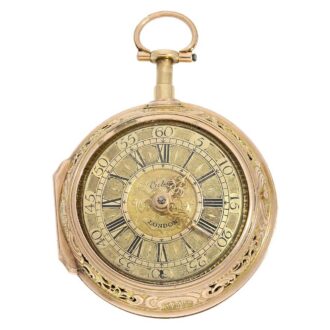
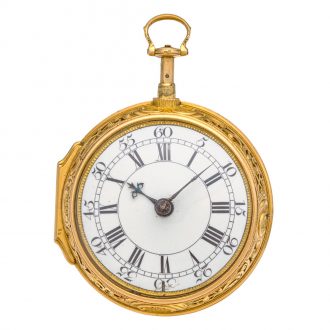
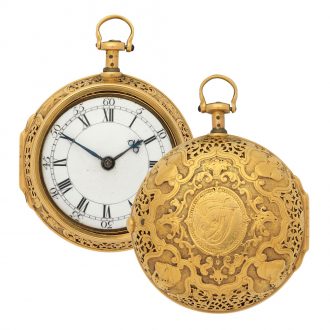
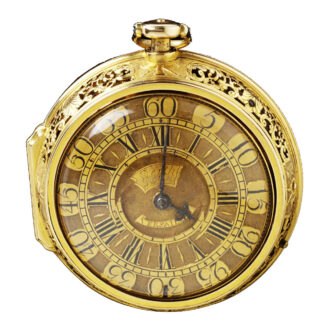
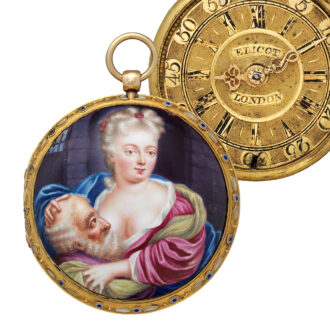
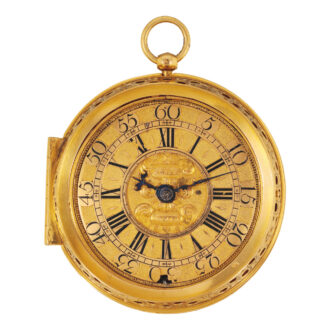
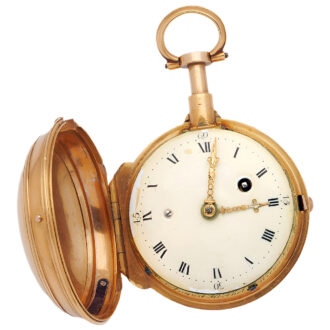
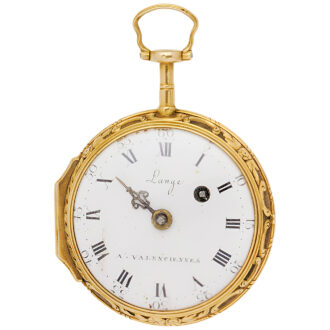
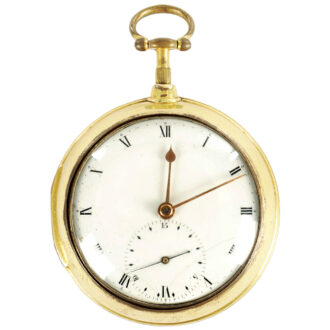
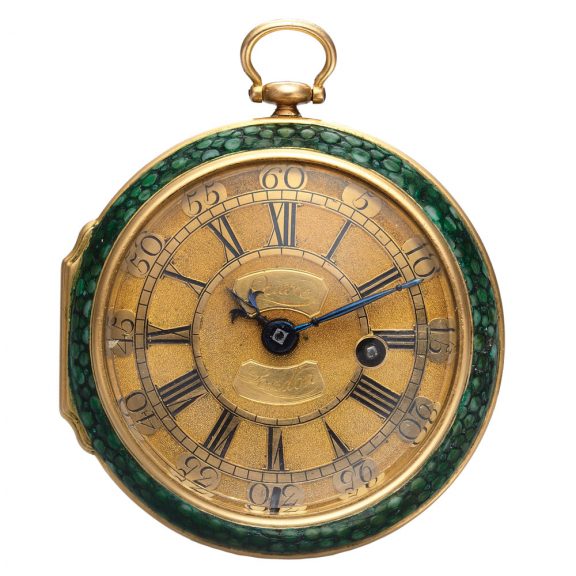
Fine English gold and shagreen pocket watch Circa 1710
- Kenmerk
- TA4237
- Diameter
- 53 mm
- Estimate
- € 4.000 - 8.000
- Price sold
- € 2.350
Gold verge accompanied by a key
–
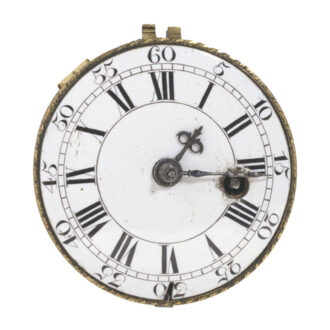
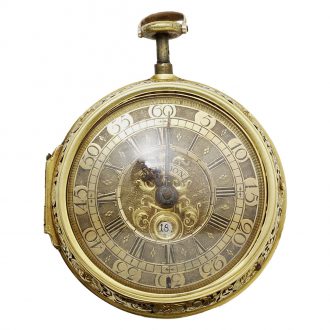
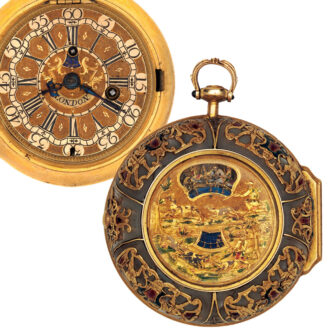
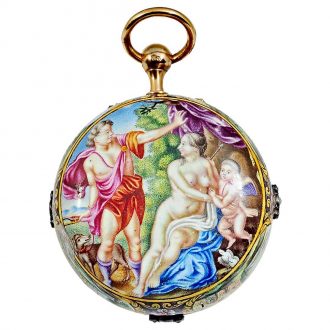
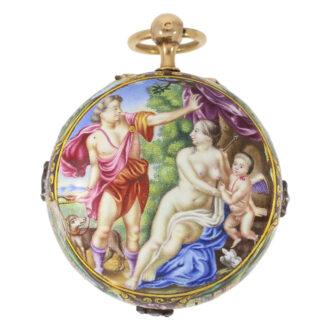
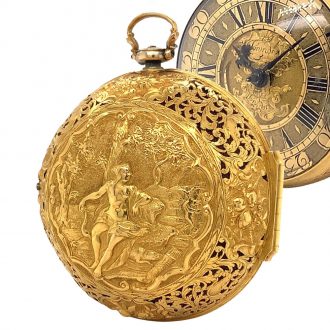
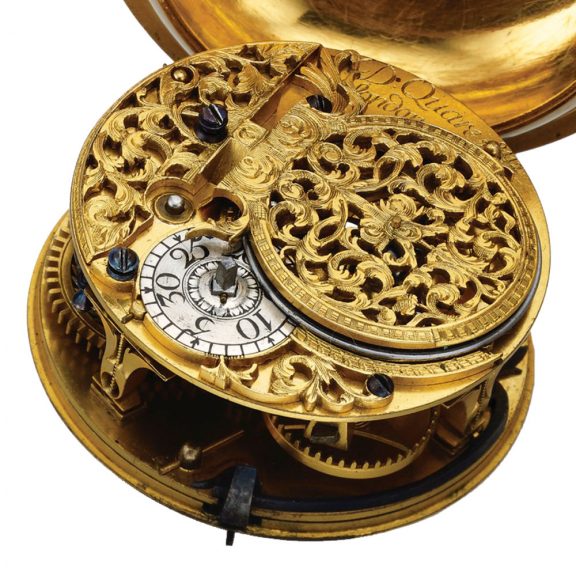
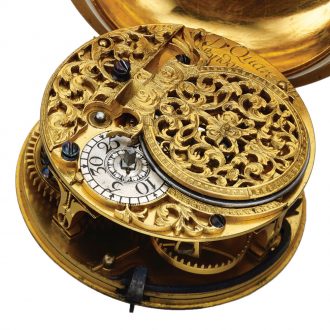
A fine English gold and shagreen pocket watch, circa 1710. The case with a deep back, polished, shagreen back and bezel. Gold dial with radial Roman numerals, outer minute track and outermost Arabic five-minute markers and blued steel Beetle and Poker hands. Hinged gilt brass, full plate movement, Egyptian pillars, fusee with chain, verge escapement, plain steel three-arm balance, flat balance spring, gilt brass English clock with streamers, pierced and engraved with a mask and foliage. Dial and movement signed.
–
Diameter: 53 mm
–
Signed: Daniel Quare London
–
Accompanied by a key
–
Daniel Quare was a highly esteemed English watchmaker. Born circa 1647 in Somerset and died August 1724. He was admitted to the Clockmakers’ Company in 1671, becoming a master in 1708. Quare established himself as an important horological innovator by inventing a type of repeating work around 1680. Whilst he was developing his repeating mechanism, his rival, Edward Barlow, was developing his own version. Barlow had invented the rack form of striking in 1676 and, in 1685, Thomas Tompion made a watch for Barlow that incorporated the latter’s repeating system. Three years later, in 1688, Quare and Barlow presented their different forms of repeating watches to King James II so that he might declare which he regarded the superior. The King favoured Quare’s form, noting that Barlow’s required two pushers, one for the hour strike and one for the quarters, whilst Quare’s single push-piece activated both the hours and quarters.
Signed: Daniel Quare London
Share this page: