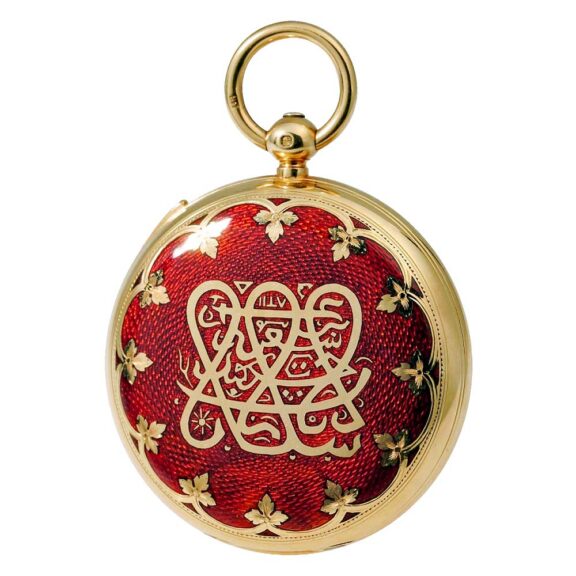
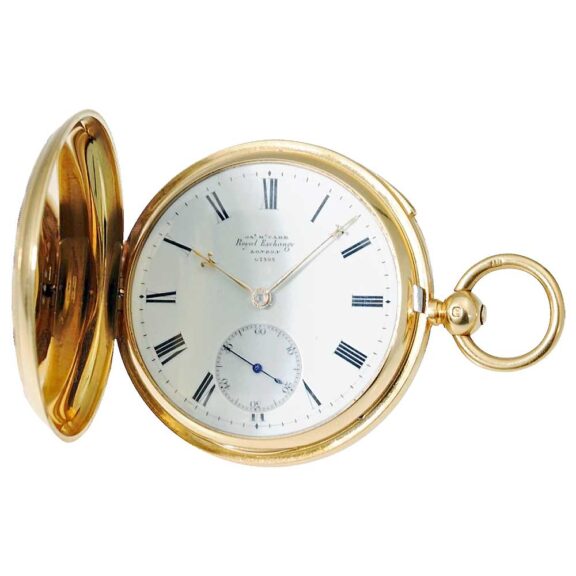
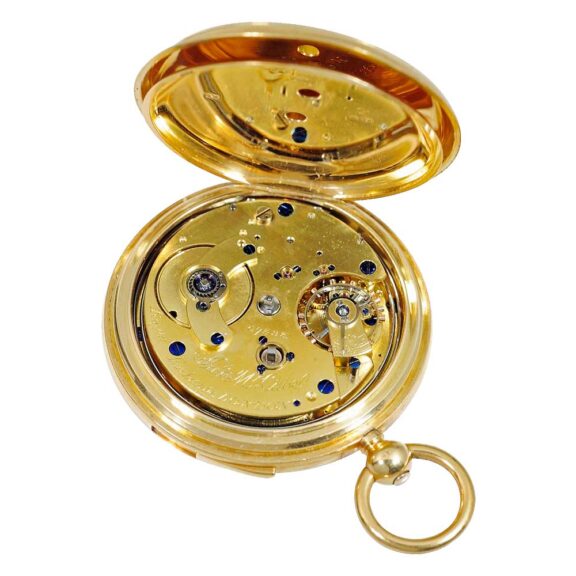
English gold historically interesting repeating watch Circa 1872
- Kenmerk
- AD2074
- Diameter
- 51 mm
- Estimate
- € 12.500 - 25.000
- Price sold
- € 24.400
Gold hunting cased duplex watch
–
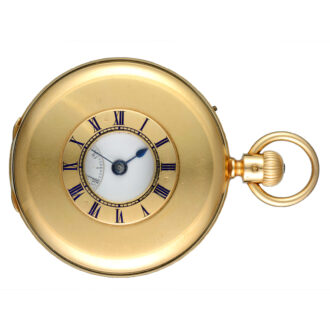
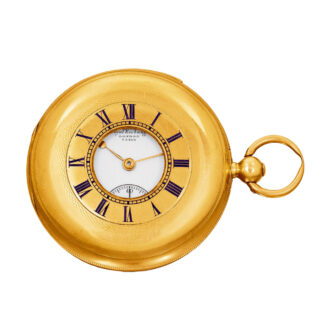
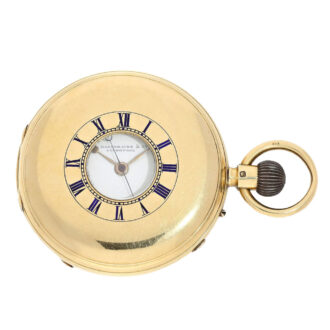
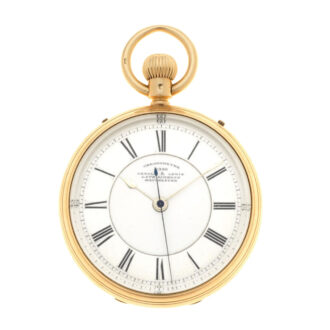
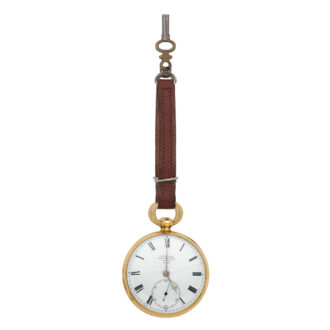
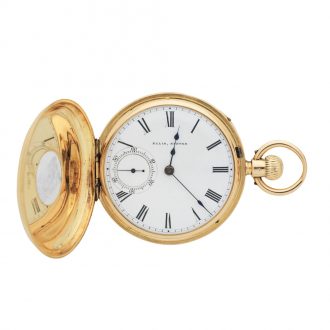
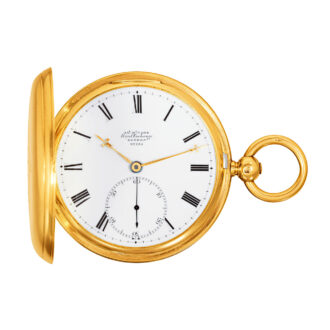
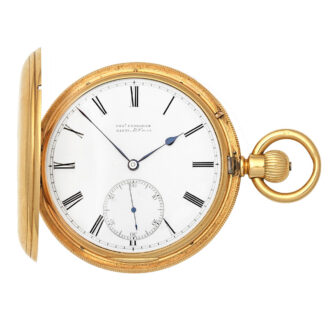
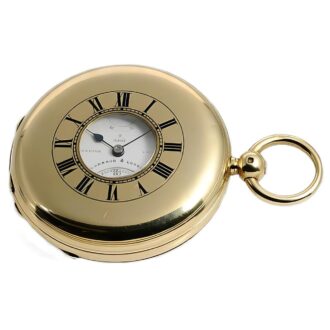
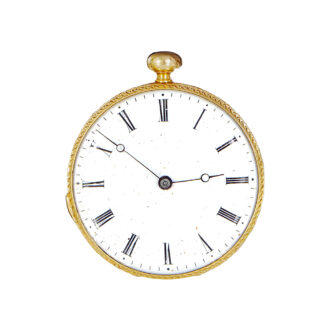
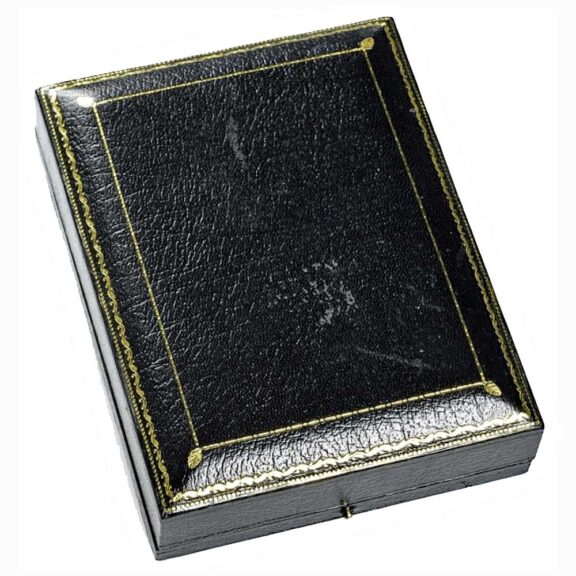
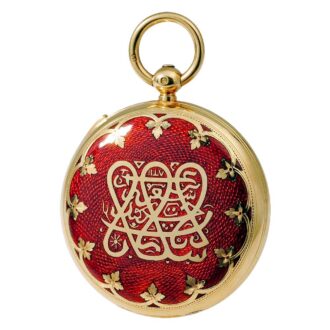
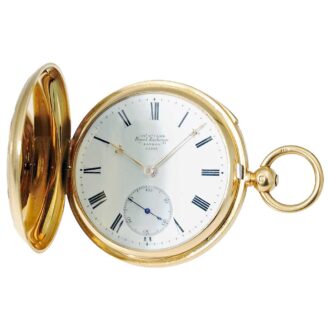
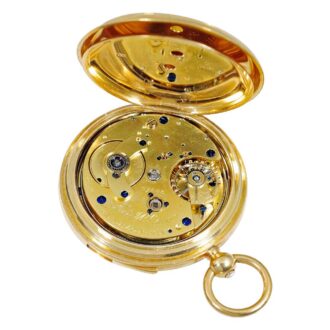
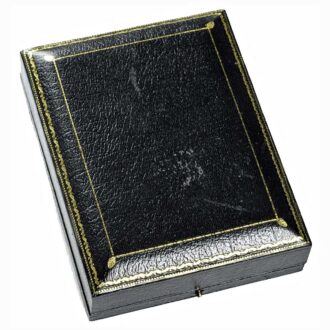
A historically interesting English 18 carat gold hunting cased minute repeating pocket watch made by James McCabe in London, circa 1872. Presented to Sayyid Barghash bin Said Al-Busaid, the Sultan of Zanzibar, by expeditioner and diplomat Sir John Kirk. The watch comes with the original morocco leather presentation box and a watch chain. The front and back lid of the case are decorated with translucent red enamel over an engine turned ground and inscribed with a dedication in gold: presented to Sayyid Barghash bin Said Al-Busaid, a gold cuvette with the engraving: Sir John Kirk G.C.M.G K.C.B. and maker’s punch mark AS for Alfred Stram. Signed off white enamel dial with Roman hour numerals, an outer minute track, subsidiary dial for the seconds at 6 o’clock and gold Fleur de Lys hands. A 4/5 plate movement with a duplex escapement, two hammers, two gongs, chain and fusee, and gold screw compensation balance.
–
Diameter: 51 mm
–
Weight: 142 g
–
Signed: James McCabe Royal Exchange London
–
Sir John Kirk was a Scottish physician, naturalist, companion to explorer Dr David Livingstone and British administrator in Zanzibar, where he was instrumental in ending the slave trade. He was born on December 19th, 1832 in Barry, Angus near Arbroath, Scotland. Krik received his medical degree from the University of Edinburgh and was Fellow of the Royal Society (FRS), Knight Commander of the Bath (KCB) and granted the Grand Cross of the Order of St Michael and St George (GCMG).
From 1858 to 1864 Kirk accompanied explorer Dr David Livingstone on the Second Zambezi Expedition as a botanist and experienced his work to end the East African slave trade. He thought Livingstone an inept leader and in 1862 he wrote “I can come to no other conclusion than that Dr Livingstone is out of his mind and a most unsafe leader.” In 1866, Livingstone began his next and final expedition to find the source of the Nile from Zanzibar. From Livingstone’s subsequent correspondence during the expedition it seems that Kirk remained in Zanzibar and did not continue with the rest of the party. After Livingstone’s death in 1873, Kirk pledged to continue his work to end the East African slave trade.
From his appointment, in 1865, as the British Consul in Zanzibar, Henry Adrian Churchill worked on the abolition of the slave trade on the island, however his heavy workload and the adverse climate took a toll on his health and, in 1869, Kirk, who was his physician and Vice Consul, advised him to leave for London. Churchill left in December 1870, leaving Kirk to undertake his duties as acting Consul. Kirk continued Churchill’s work on the slave trade and in June 1873, he received simultaneous contradictory instructions from London, one to issue an ultimatum to Sultan Barghash, under threat of blockade that the slave trade should be stopped and the slave market closed, and the other not to enforce a blockade which might be taken as an act of war pushing Zanzibar towards French protection. Kirk only showed the first instruction to Barghash, who capitulated within two weeks. In August 1873, he was appointed British Consul in Zanzibar, in 1875, Consul from the Comoro Islands and in 1881, he became Consul General in Zanzibar. For years he negotiated with Sultan Barghash, gaining his confidence and promising to help enrich the East African domain through legitimate commerce. By 1885, the region was larger and more profitable.
Sir John Kirk died, age 89, on January 15th, 1922, and was buried in St. Nicholas’ churchyard in Sevenoaks, Kent, England.
–
Sayyid Barghash bin Said Al-Busaidi (1837-1888) was the Sultan of Zanzibar, who ruled over the Sultanate of Zanzibar and its East African territories from 1866 or 1870 until his death in 1888. In 1883, the Sultan was appointed Knight Grand Cross of the Order of St Michael and St George. He was responsible for building the infrastructure of Stone Town in Zanzibar City and for abolishing the slave trade in Zanzibar. It is also said that Barghash recognized the advantages of a Western education and supported the European explorers on the mainland while at the same time strengthening his influence on the East African territories by allowing the slave traders access to these areas.
–
The name James McCabe and the House of McCabe are part of a watchmaking dynasty that lasted for over a century. It was renowned for the enormous variety of its designs, and the creativity and prestige of its manufacture. James and his descendants would become one of Britain’s most prolific watchmakers with over 50.000 watches, 7000 clocks and 500 marine chronometers produced in the company’s 100 year history.
–
James McCabe was born in 1748 in the town of Lurgan, County Armagh, Ireland, into a family of watchmakers. His grandfather and father, Patrick McCabe, were both skilled horologists.
–
Moving to Belfast, James apprenticed under his brother, Thomas, before setting up a workshop in London in 1775, in the Bells Building on Fleet Street, and subsequently, Cheapside and 97 Royal Exchange. His reputation quickly grew, he gained recognition as one of the leading watch and chronometer makers of his era. His timepieces were admired for their elegance, mechanical precision and durability, earning him prestigious commissions from royalty, nobility and prominent merchants. Among notable owners of his timepieces were Lord Horatio Nelson and the first President of the United States, George Washington. McCabe further became a respected member of the Clockmakers’ Company.
–
After James’ passing in 1811, his sons continued the business, maintaining the company’s reputation for high quality horology throughout the 19th century.
Signed: James McCabe London
Share this page: