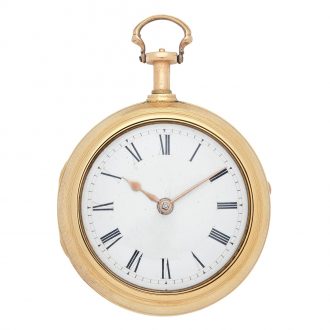
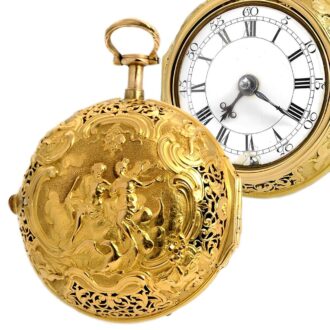
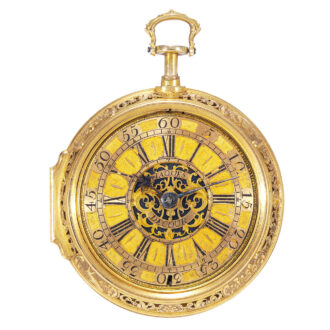
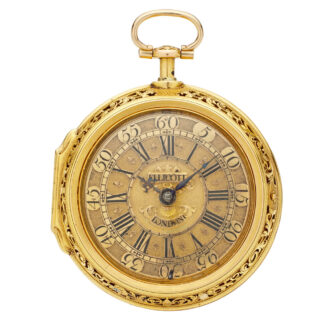
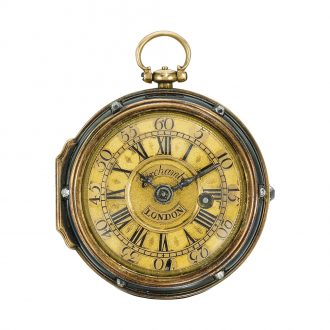
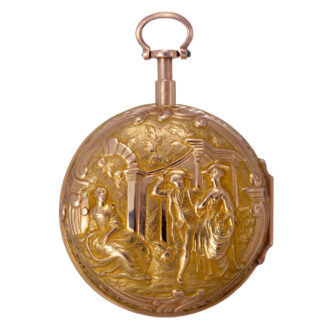
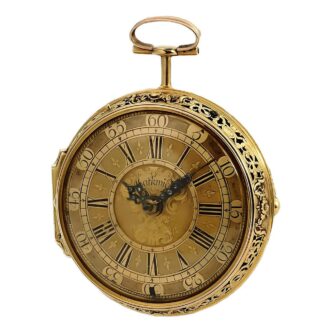
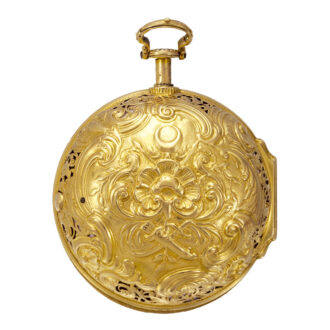
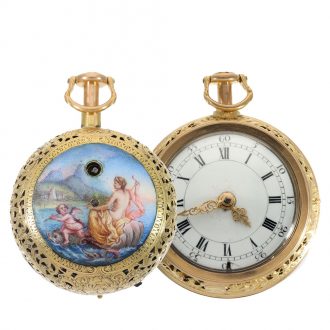
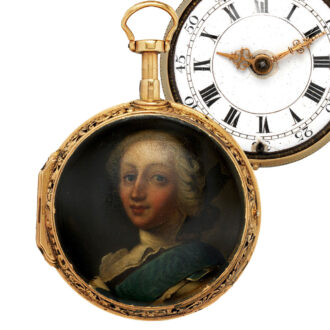
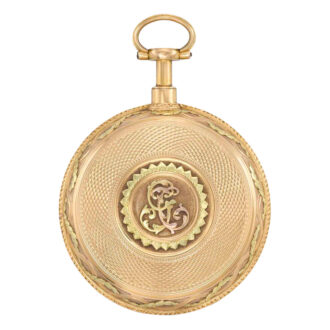
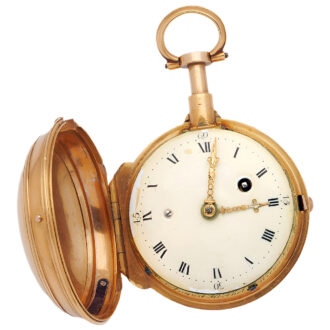
English repeating pocket watch with repoussé decoration Circa 1740
- Kenmerk
- AS2041
- Diameter
- 48 mm
- Estimate
- € 3.500 - 7.000
- Price sold
- € 3.300
Gold pair cased verge pocket watch by Charles Cabrier
–
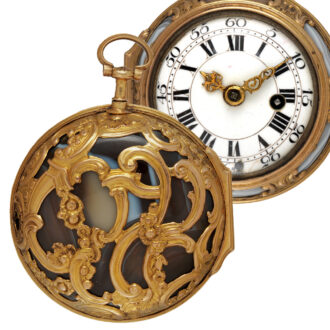
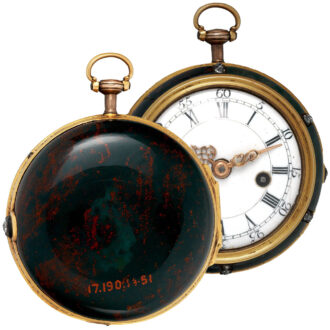
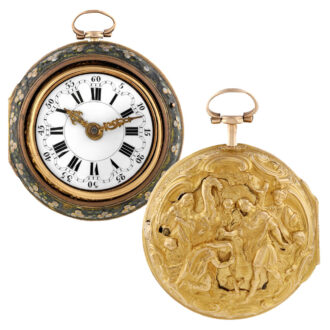
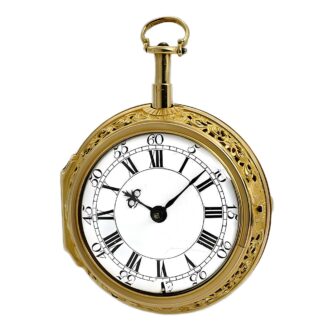
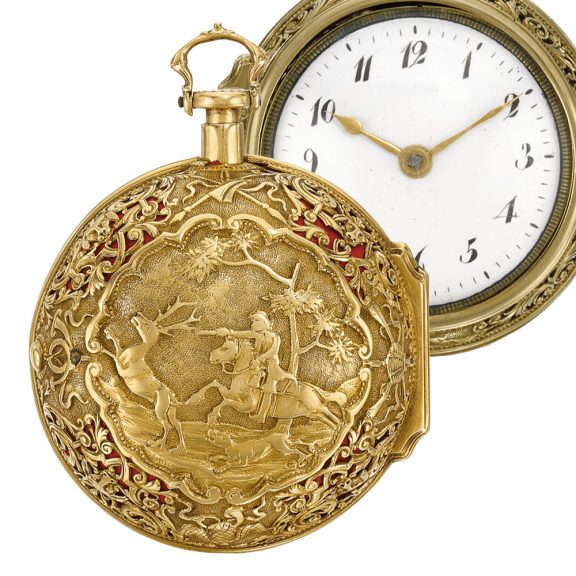
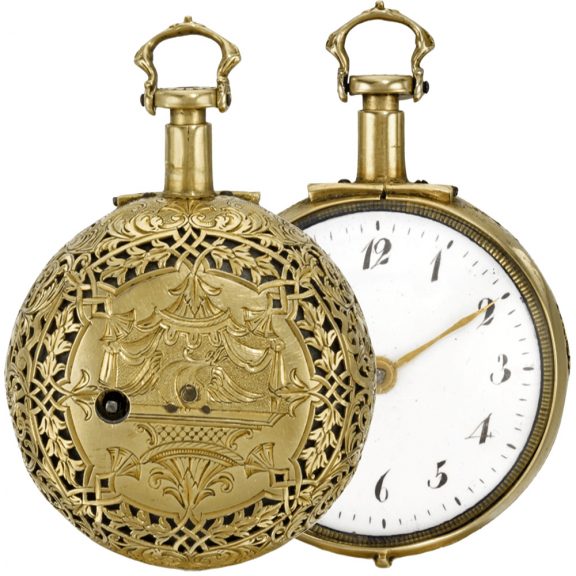
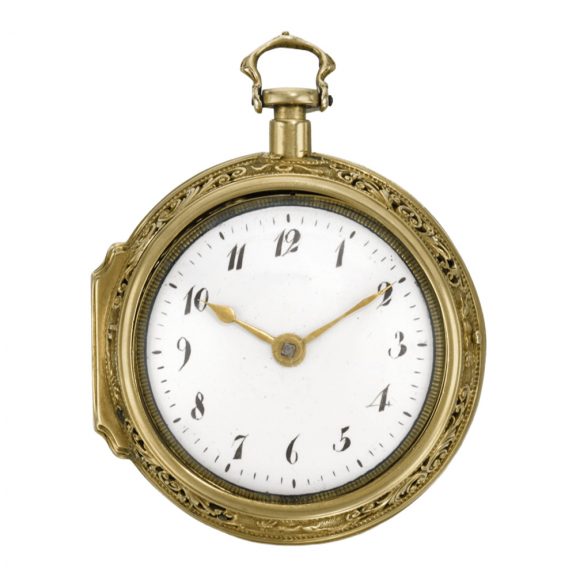
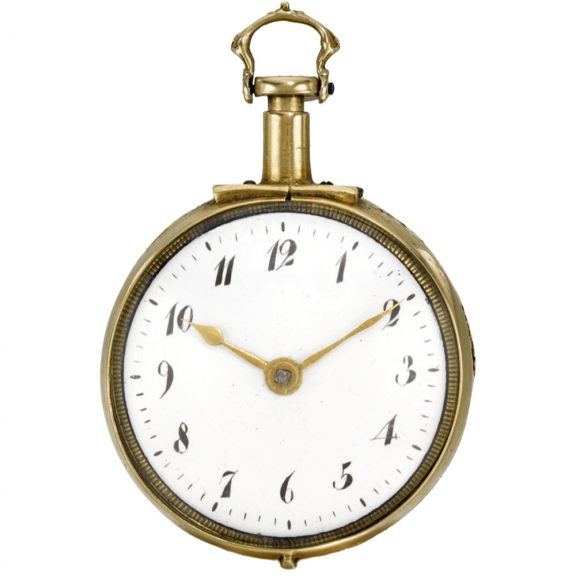
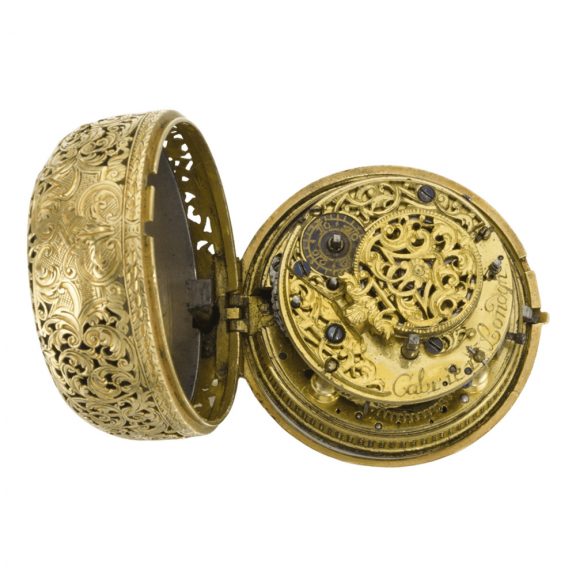
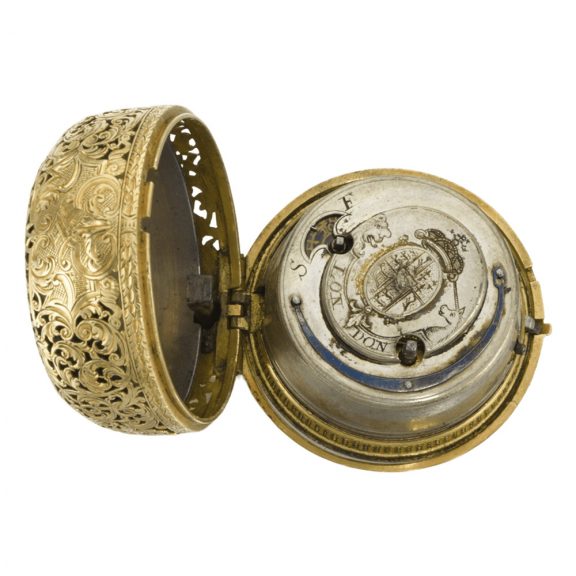
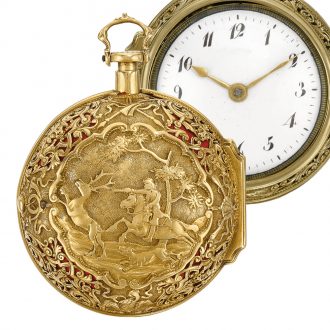
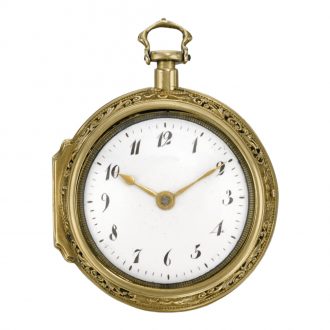
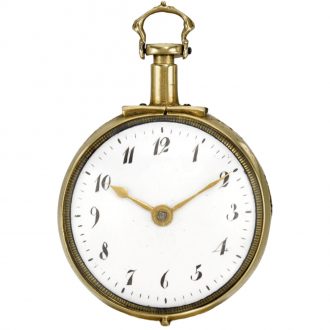
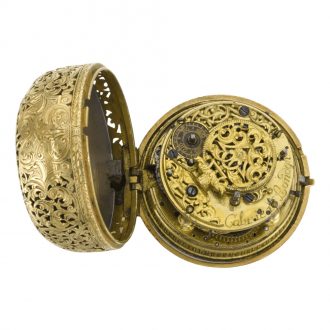
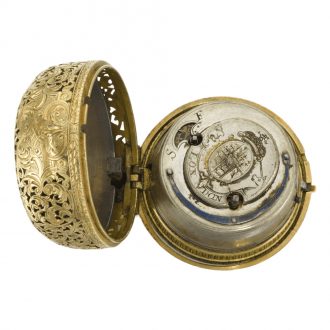
An English pair cased quarter repeating verge pocket watch with repoussé decoration, circa 1740. This watch features a gilded full plate movement, signed Cabrier London, with a verge escapement, a pierced and engraved balance cock, a fusee and chain, and baluster pillars. It has a silver dust cap adorned with the British Royal Arms and a repeating mechanism that chimes on a bell on the inside back. The later white enamel dial displays Arabic numerals, an outer minute ring, and gold spade hands.
–
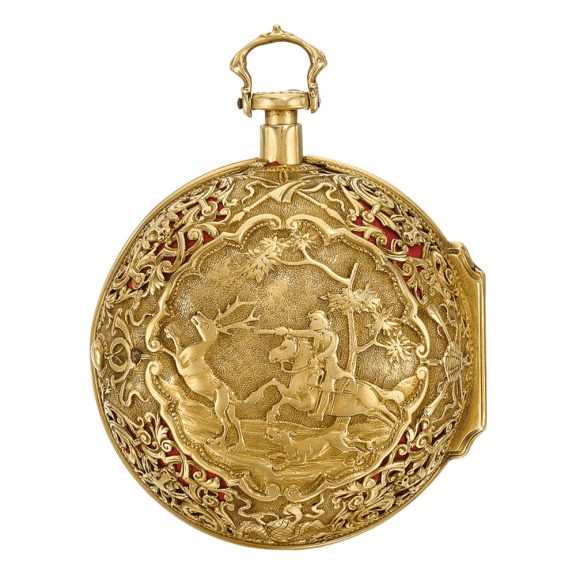
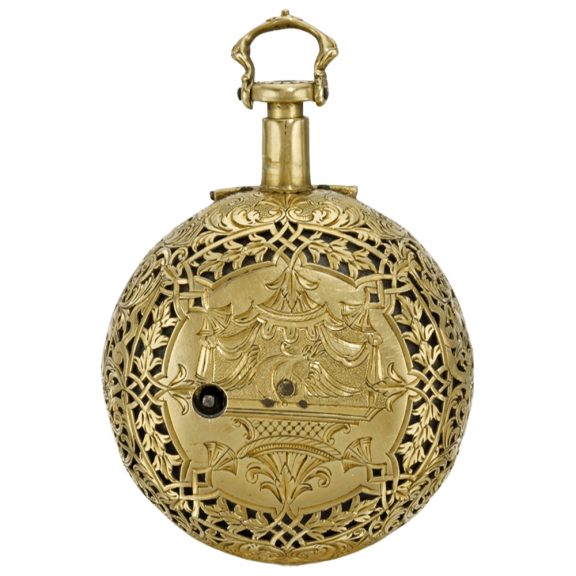
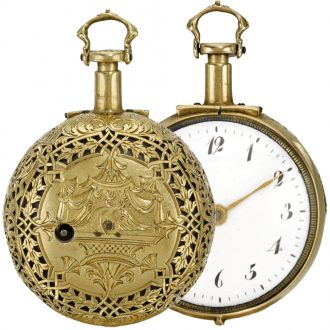
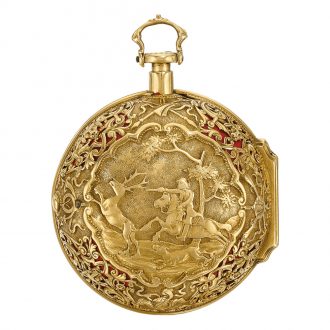
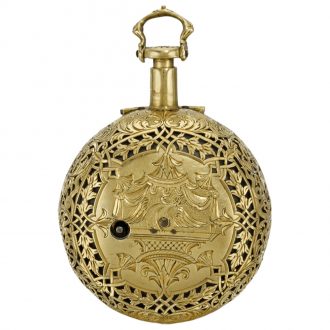
The watch has two cases: a gold inner case that is decoratively pierced and engraved with foliate scrolls, birds, and serpents, with an engraved bird at the centre of the back; and a repoussé case that is finely chased and engraved with a hunting scene. Additionally, the band of the repoussé case is decoratively pierced, showcasing animal masks, and divided into four panels that depict hunting accoutrements. The marker’s mark is possibly AR.
–
Diameter outer case: 48 mm
–
Diameter inner case: 39 mm
–
Signed: Cabrier, London
–
The enamel dial is in good condition. The inner case has scuffs throughout, while the outer repousse is quite worn, with the hunting scene significantly rubbed. There is damage to the pierced band. The movement is not running or striking, although the balance rotates freely when power is applied to the train.
–
Charles Cabrier II is the second of three generations of London based clockmakers all named Charles Cabrier. Charles is an unusual given name for a Huguenot family (Old Testament names were preferred to avoid Catholic saints’ names) but was chosen for the first Charles Cabrier, born in 1670 in Lyons, after his great uncle and godfather, Dr. Charles Spon, a distinguished 17th century Doctor of Medicine. Charles Cabrier II was apprenticed to his father, Charles Cabrier I, through the London Clockmakers’ Company in 1719, made free in 1726, and served as assistant to the master from 1750 and master of that guild from 1757 to 1772. Until 1759 he had a workshop at 79 Broad Street, near Finsbury Circus; he then moved to Pig Street (which does not exist anymore) near Threadneedle Street. He married Rebecca Stone in April 1725 at St. Bride’s Fleet Street. Charles and Rebecca’s first son Charles died in infancy, but their second Charles, born in 1729, later became the third reputed clockmaker, Charles Cabrier III.
Signed: Cabrier, London
Share this page: