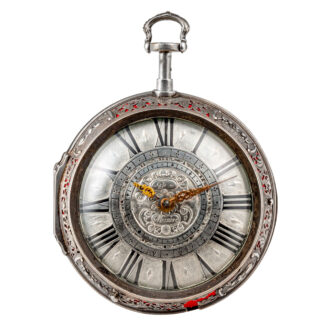
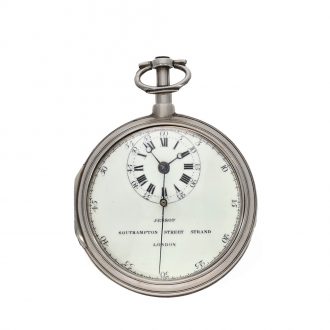
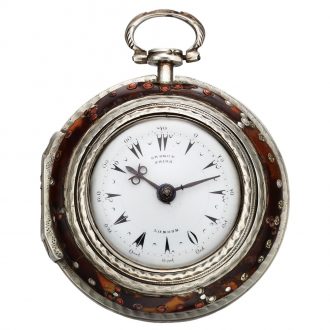
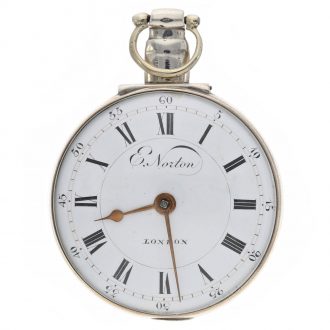
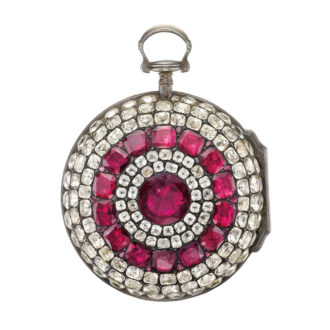
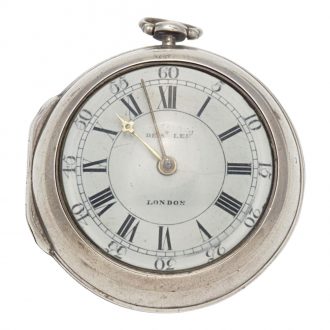
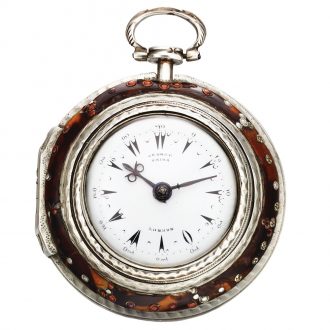
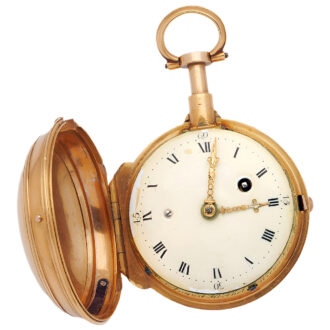
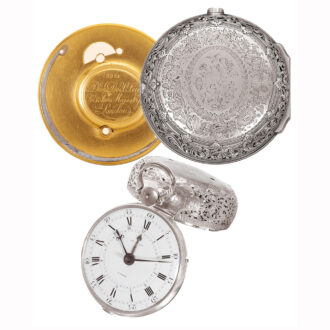
English silver hour striking coach watch with alarm Circa 1780
- Kenmerk
- FA0137
- Diameter
- 116 mm
- Estimate
- € 12.000 - 16.000
- Price sold
- € 15.100
Silver coach watch by Daniel De St. Leu, Servant to Her Majesty, London
–
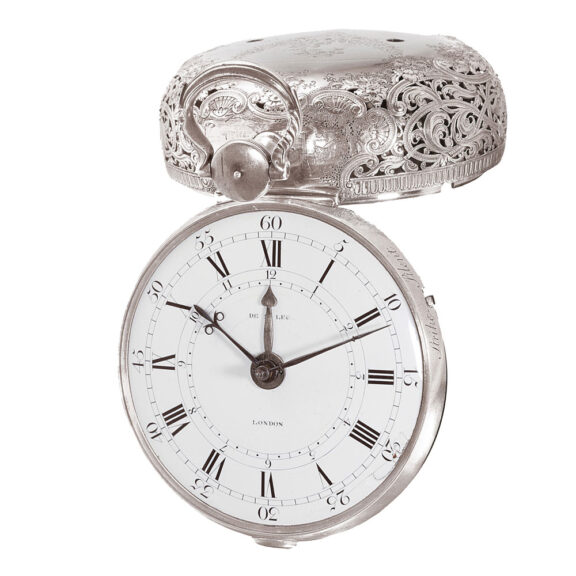
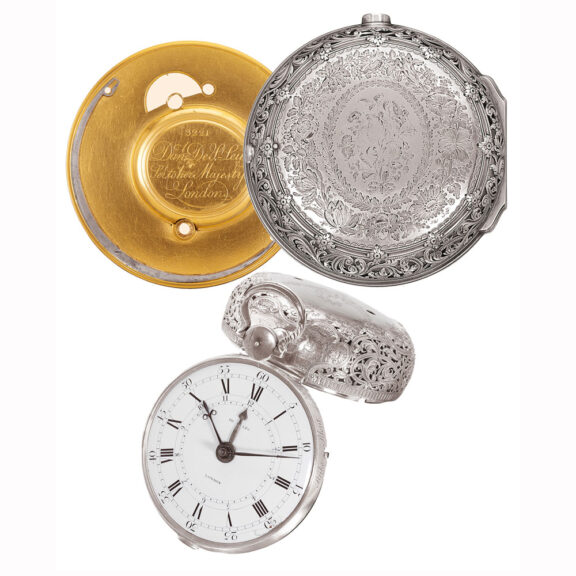
Extremely fine and rare, Swiss pair cased silver hour striking coach watch with alarm, circa 1780. Gilt movement with turned pillars, fusee with chain, spring barrels for striking and alarm trains, steel hammers, verge escapement, three arm polished steel balance, blued steel flat balance spring, finely pierced, chased and engraved back plate furniture, calibrated silvered regulator disc, gilt dust cover.
–
Extremely fine and rare, Swiss pair cased silver hour striking coach watch with alarm, circa 1780. Gilt movement with turned pillars, fusee with chain, spring barrels for striking and alarm trains, steel hammers, verge escapement, three arm polished steel balance, blued steel flat balance spring, finely pierced, chased and engraved back plate furniture, calibrated silvered regulator disc, gilt dust cover.
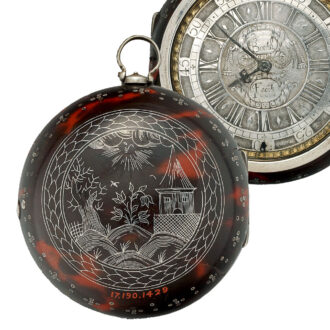
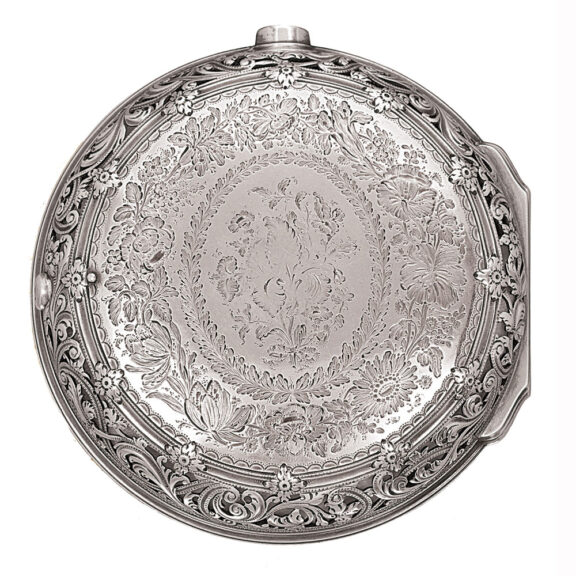
Outer case by John Terrill Pain (ITP), very finely pierced, chased and engraved with scrolls and flowers, the center engraved with an iris in a bouquet within a laurel-leaf oval border. Inner case by John Terrill Pain (ITP), polished bezel,very finely pierced, chased and engraved with inhabited foliage, floralswags and a bust portrait of an old man in Tudor dress,strike/silent lever in the bezel.
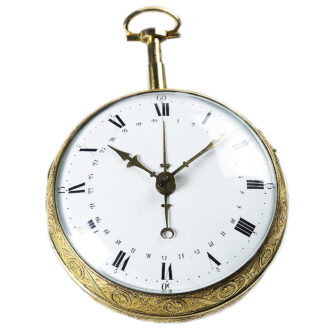
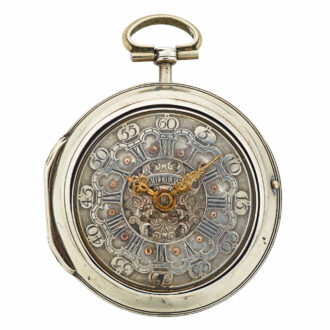
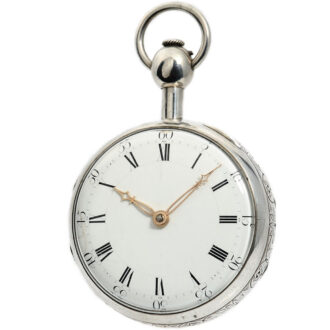
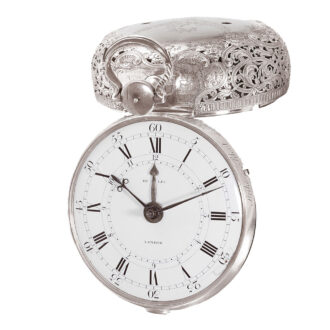
White enamel with radial Roman numerals, outer minute track and Arabic five minute numerals, inner alarm ring with Arabic numerals and half and quarter hour markers. Blued steel beetle and poker hands, polished steel alarm hand. Movement and dust cover signed Daniel De St. Leu, Servant to Her Majesty, London. Dial signed De St Leu London.
–
Diameter: 116 mm
–
Signed: De St Leu London
–
Daniel de St. Leu originally came from Geneva and worked from 1753 to 1797; he created some of the most beautiful and intricate watches of the eighteenth century. In 1765 he was appointed watchmaker to Queen Charlotte, wife of King George III – the fact that all of de St. Leu’s watches after this year are either signed ‘Sevt. to her Majesty’, or ‘Watch Maker to her Majesty’ is proof that he held this title for the rest of his life.
–
De St. Leu was specialized in the production of watches for the wealthy Ottoman market, where the clientele wanted their watches to be pieces of jewellery, often in lavish gold cases with elaborate decoration and set with precious stones. In the 18th century, English watches were very much in demand on the Ottoman market and exported in great numbers from England. R. Rolt states in ‘A New Dictionary of Trade and Commerce’, 1756, that “Great quantities of watches are exported to Asia, particularly to Turkey; where they serve more for ornaments like pictures in rooms, than for use in pockets.” Daniel de St. Leu created movements of superior quality and put them in extravagant cases – the perfect timepieces for the Ottoman market.
White enamel with radial Roman numerals, outer minute track and Arabic five minute numerals, inner alarm ring with Arabic numerals and half and quarter hour markers. Blued steel beetle and poker hands, polished steel alarm hand. Movement and dust cover signed Daniel De St. Leu, Servant to Her Majesty, London. Dial signed De St Leu London.
–
Diameter: 116 mm
–
Signed: De St Leu London
–
Daniel de St. Leu originally came from Geneva and worked from 1753 to 1797; he created some of the most beautiful and intricate watches of the eighteenth century. In 1765 he was appointed watchmaker to Queen Charlotte, wife of King George III – the fact that all of de St. Leu’s watches after this year are either signed ‘Sevt. to her Majesty’, or ‘Watch Maker to her Majesty’ is proof that he held this title for the rest of his life.
–
De St. Leu was specialized in the production of watches for the wealthy Ottoman market, where the clientele wanted their watches to be pieces of jewellery, often in lavish gold cases with elaborate decoration and set with precious stones. In the 18th century, English watches were very much in demand on the Ottoman market and exported in great numbers from England. R. Rolt states in ‘A New Dictionary of Trade and Commerce’, 1756, that “Great quantities of watches are exported to Asia, particularly to Turkey; where they serve more for ornaments like pictures in rooms, than for use in pockets.” Daniel de St. Leu created movements of superior quality and put them in extravagant cases – the perfect timepieces for the Ottoman market.
Signed: De St Leu London
Share this page: