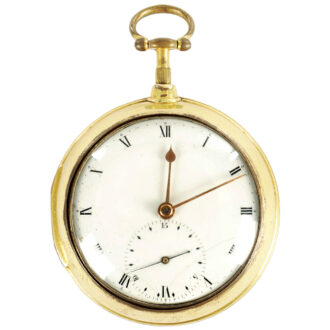
Gold English pair cased half quarter repeater Circa 1730
- Kenmerk
- SA0329
- Diameter
- 50 mm
- Estimate
- € 7.500 - 15.000
- Price sold
- € 12.500
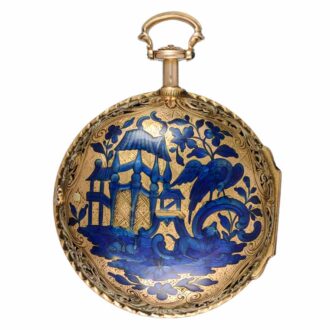
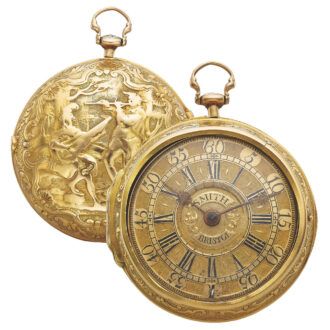
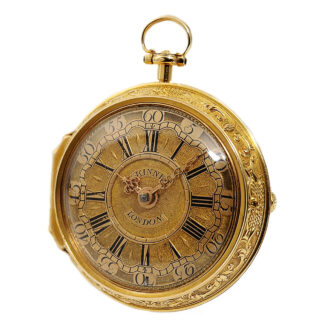
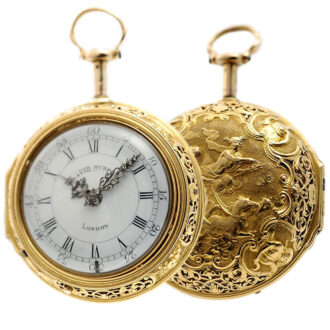
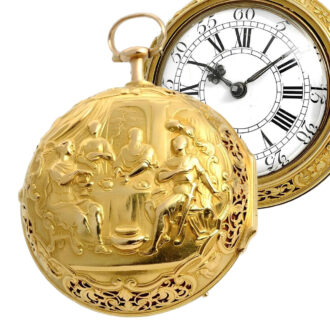
Gold half quarter repeating verge watch with repousse scene
–
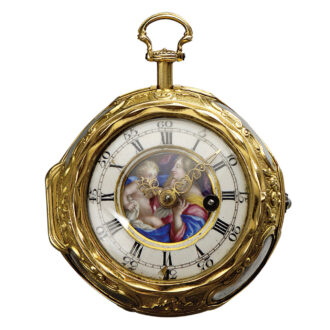
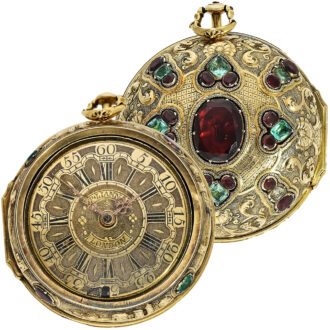
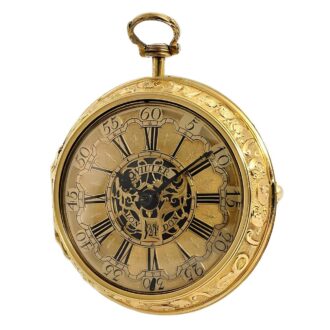
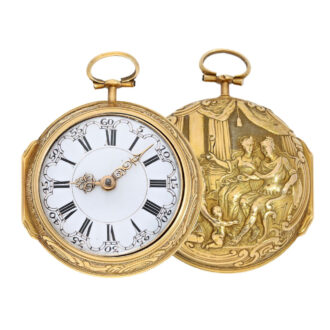
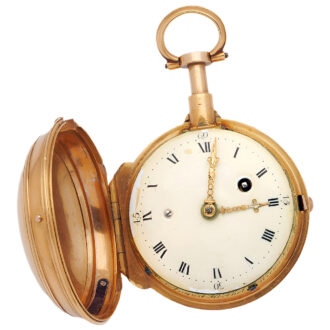
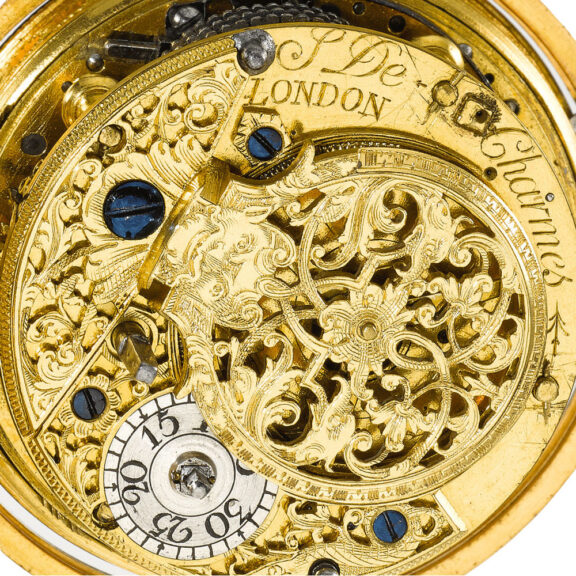
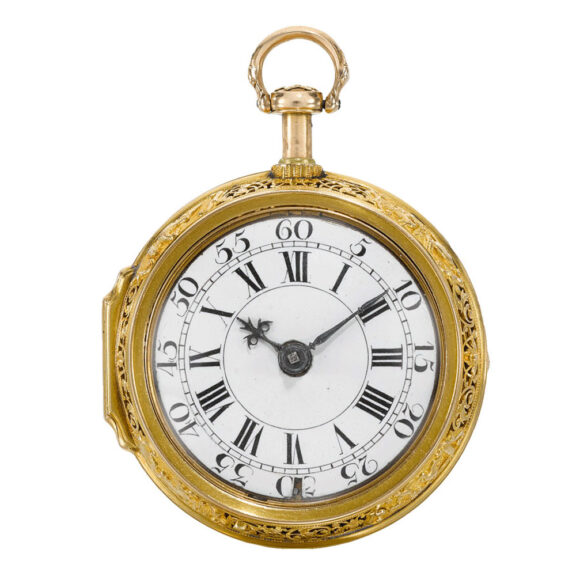
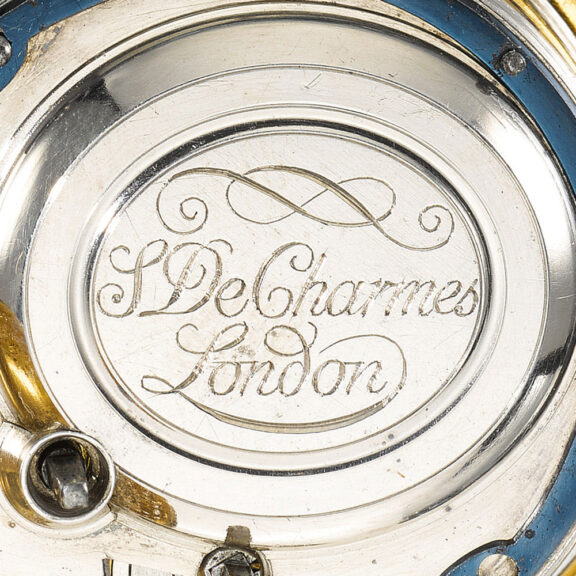
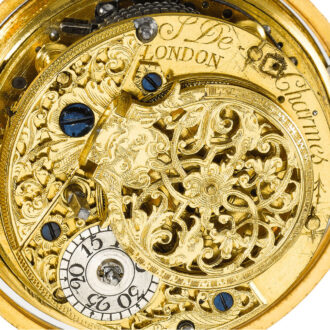
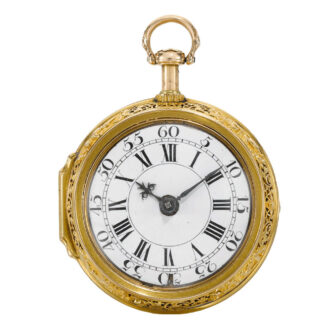
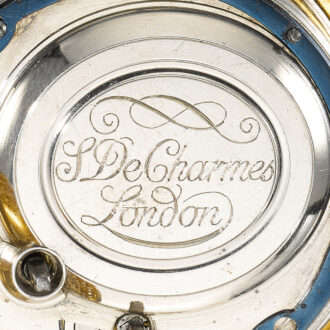
A fine gold English pair cased half quarter repeating verge watch with repousse scene by John Valentine Haidt, circa 1730, gilded full plate movement, verge escapement, pierced and engraved masked balance cock with foliate scrolls inhabited by two dolphins’ heads, plain flat balance, repeating on a bell to the inside case back, rounded baluster pillars, silver dust cap, movement and dust cap signed S De Charmes, London, bell scratch signed Drury.Later white enamel dial, Roman numerals, outer Arabic minute ring, blued steel beetle and poker hands.
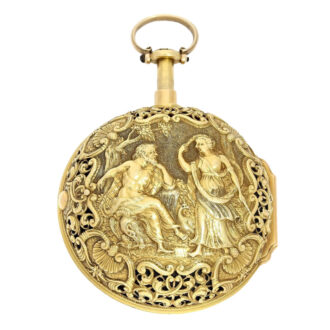
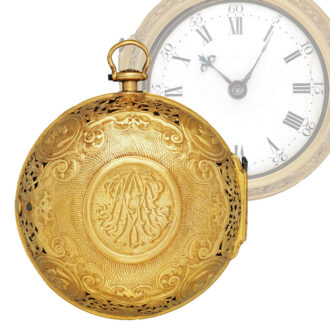
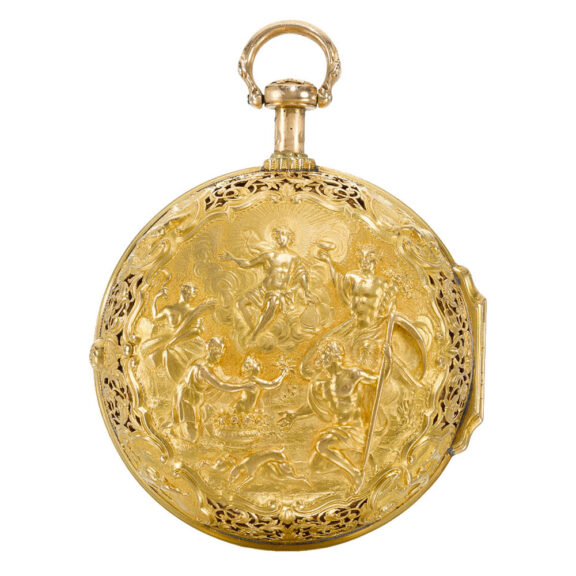
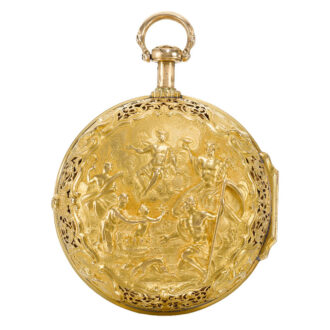
Gold inner case with band pierced and engraved with scrolls of foliage inhabited by birds, grotesque mask to the base, townscape beneath the pendant, the center of the back with an engraved flower and aperture for winding, maker’s mark IL for John Lee, outer case with repoussé scene depicting Apollo, the sun god and the four seasons: Flora with an infant for Spring; Ceres, Summer; Bacchus, Autumn; and Saturn as Winter within a symmetric cartouche, four subsidiary scenes outside the central cartouche depict putti and alternate with pierced panels with scrolling foliage, shells and dolphins’ heads, the bezel with alternating scenes of birds and rabbits and with pierced foliate scrolls, maker’s mark SG beneath a fish incuse for Stephen Goujon, repoussé signed J.V. Haidt at the base of the scene.
–
Diameter: 50 mm
–
Signed: S De Charmes London
–
Simon de Charmes became a Free Brother of the Clockmakers’ Company in 1691 and it is thought that he remained an active watchmaker until about 1730, the approximate date of this watch. The repoussé case was made by John Valentine Haidt (1700-1780), whose signature appears on the step below the scavenging dog. Haidt was originally from Augsburg and studied at the Royal Academy of Arts in Berlin. It was John Valentine’s father who encouraged him to become a goldsmith. Haidt lived in many different cities around Europe, working in Augsburg, Rome, Venice and Paris before moving to London where he married, in 1725, Catherine Compigné, the daughter of a clock or watchmaker. The famed goldsmith and painter George Michael Moser is understood to have worked for Haidt in the early 1730s. In 1754, Haidt left Europe for America and became the official painter to the Moravian community in Bethlehem, Pennsylvania, where he died in 1780.
Signed: S De Charmes London
Share this page: