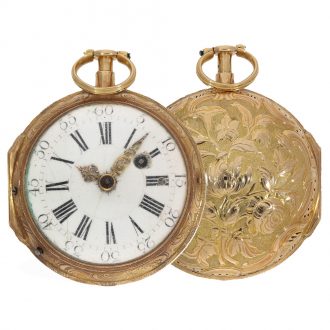
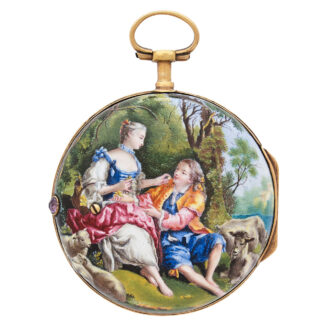
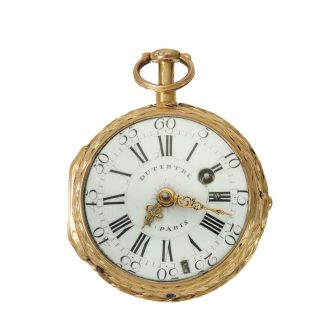
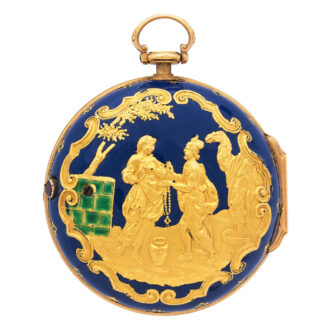
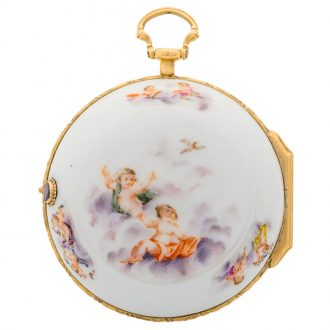
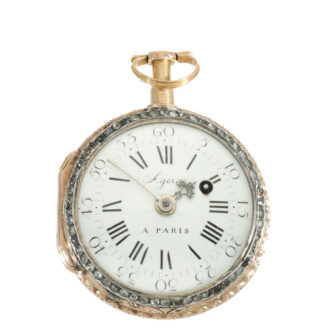
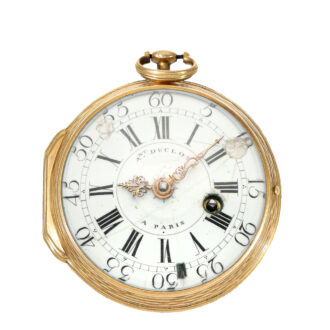
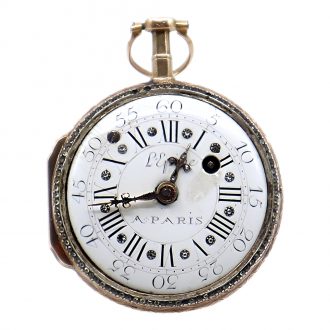
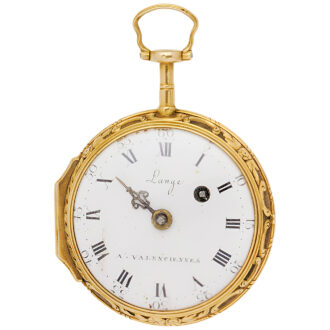
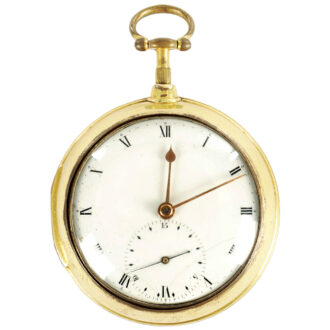
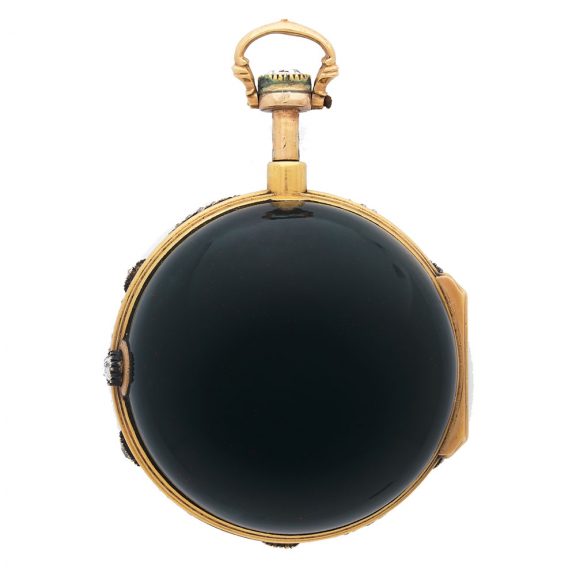
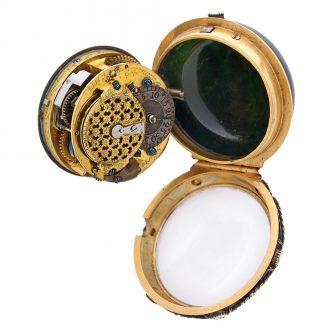
French gold quarter repeating watch in bloodstone Circa 1750
- Kenmerk
- FF0038
- Diameter
- 42 mm
- Estimate
- € 7.000 - 12.500
- Price sold
- -
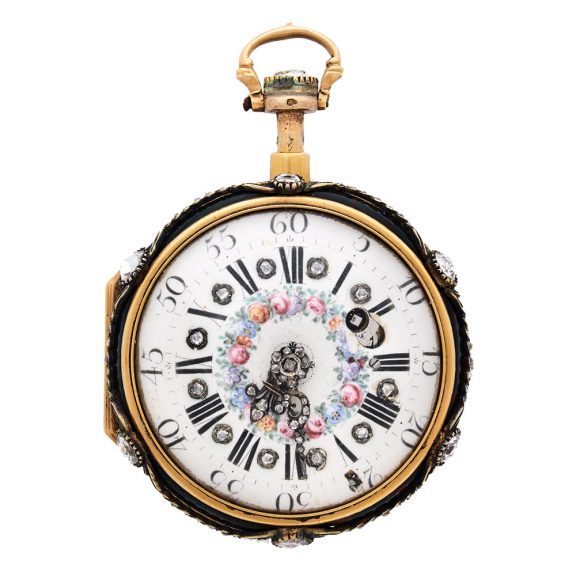
Pocket watch in gold and bloodstone
–
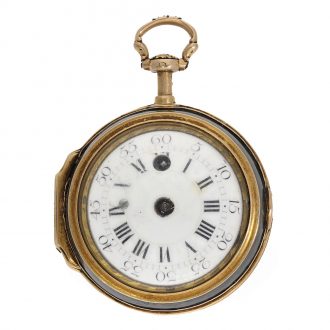
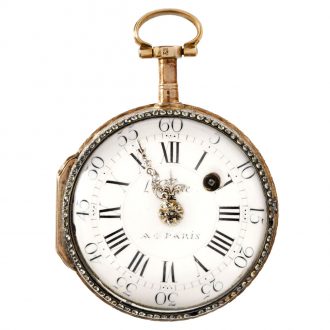
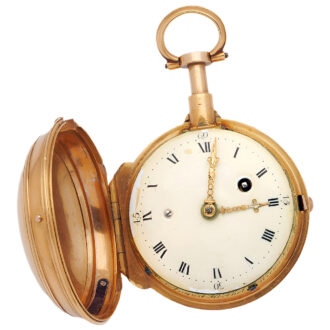
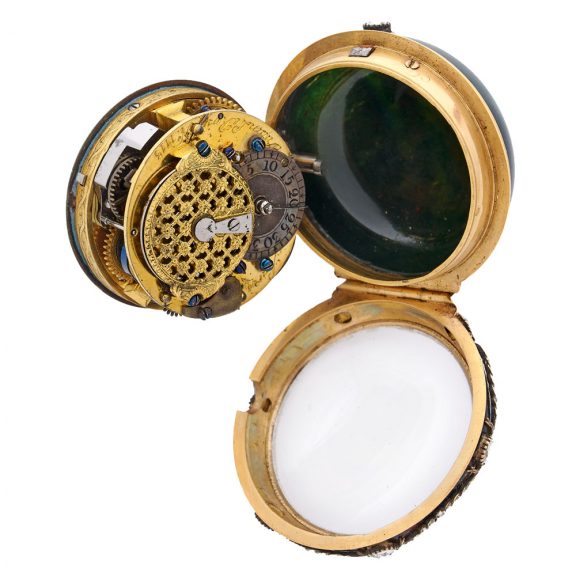
A French 18 carat gold pocket watch in gold and bloodstone, a so-called heliotrope, with quarter repeater, circa 1750. It has a full plate gilt movement with key winding, verge escapement, engraved and pierced balance cock, spiral balance, fusee and chain, adjustment disc, and baluster pillars between the two plates. The striking mechanism includes a hammer. Signed Julien Le Roy, Paris.
–
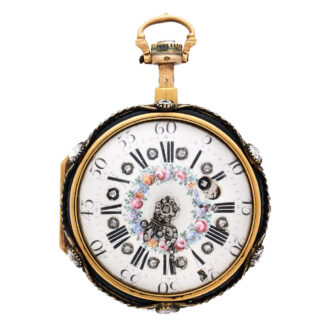
White enamel dial with Roman numerals for the hours and Arabic numerals for the five minutes, highlighted with applied diamonds. It features a polychrome painted flower garland in the centre, decorative silver diamond-set hands, a railroad minute track, and an opening for the winding square.
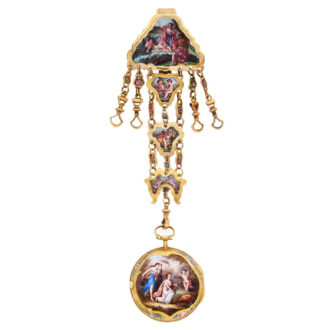
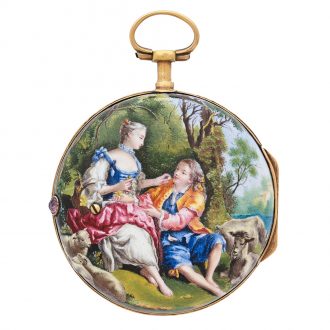
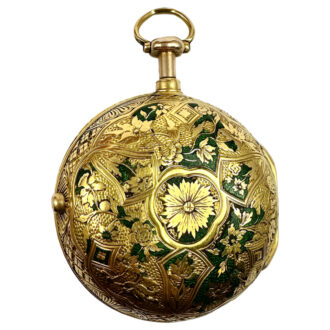
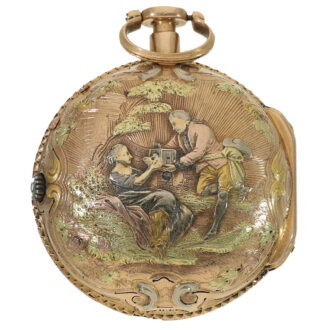
Round case on a circular hinge in bloodstone, so-called heliotrope, mounted in gold. The heliotrope bezel is highlighted with gold and diamond garlands. The pendant and pusher are set with diamonds.
–
Diameter 42 mm
–
Weight: 75 g
–
Signed: Julien Le Roy
–
Julien Le Roy (1686 – 1759)
Julien Le Roy (1686-1759) was one of the most prominent French clockmakers of the 18th century, known for his significant contributions to watchmaking and for being the clockmaker to King Louis XV.
Biography and career
Birth and education: Born on August 6, 1686, in Tours, Julien Le Roy came from a family of clockmakers. Trained by his father, Pierre Le Roy, he made his first clock at thirteen. In 1699, he moved to Paris to complete his apprenticeship with the clockmaker C. Le Bon.
Mastery and recognition: In 1713, he became a master clockmaker and in 1739 was appointed clockmaker in ordinary to King Louis XV. He ran his workshop on Rue de Harlay in Paris until his death in 1759.
Contributions to watchmaking
Technical innovations: Julien Le Roy is recognized for improving watch mechanisms, including introducing the lever escapement and enhancing repeater watches.
Horizontal clocks: He is credited with creating or popularizing horizontal building clocks, featuring an innovative gear arrangement, fewer parts, and simplified maintenance.
Legacy and posterity
Family of watchmakers: Among his four sons, Pierre Le Roy (1717-1785) continued the tradition by becoming a renowned watchmaker and contributing to highly precise timepieces.
Museum collections: Julien Le Roy’s works are held in many prestigious museums, such as the Louvre in Paris and the Victoria and Albert Museum in London.
Julien Le Roy remains an emblematic figure of French watchmaking, having left his mark on his era through his technical expertise and his role with the royal court.
–
Bloodstone is a mostly dark green stone featuring red or brown spots formed by impurities in iron oxide. These spots resemble blood splatters, giving the stone its English name. The stone is also called heliotrope, named from the Greek words helio, meaning ‘sun’, and tropos, meaning ‘toward the sun’. The colour is said to resemble heliotrope plants that face the sun. The solid green colour comes from amphibole or chlorite minerals found in green chalcedony. Chalcedony is a cryptocrystalline form of silica composed of fine intergrowths of moganite and quartz, the minerals that make up most agate stones. Because of its varied composition, the green in bloodstone is not always evenly distributed and may include blue or yellow streaks. It has been a popular gemstone for at least two thousand years.
Signed: Julien Le Roy, Paris
Share this page: