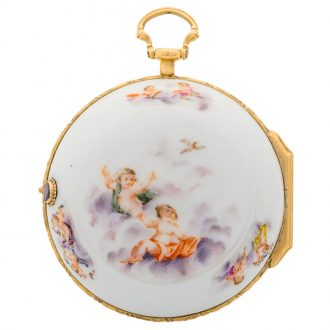
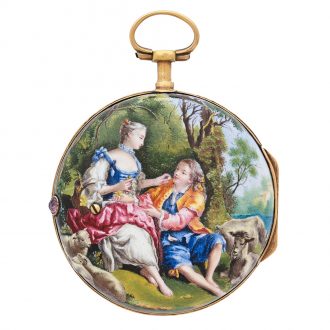
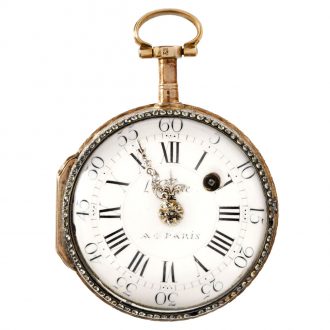
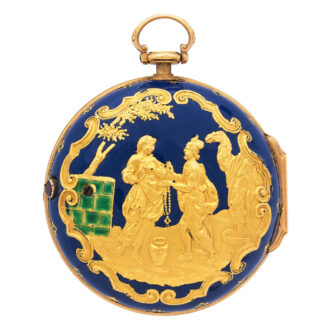
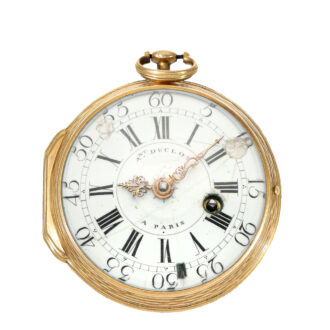
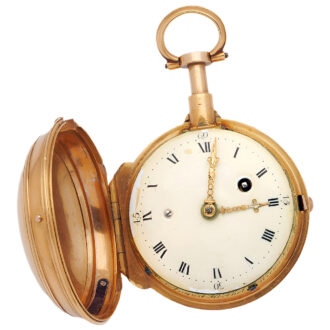
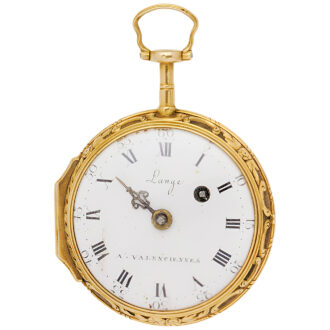
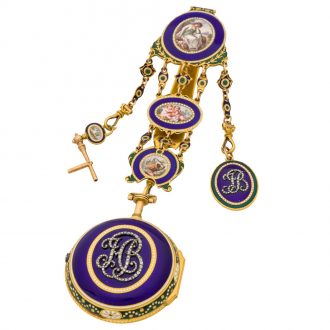
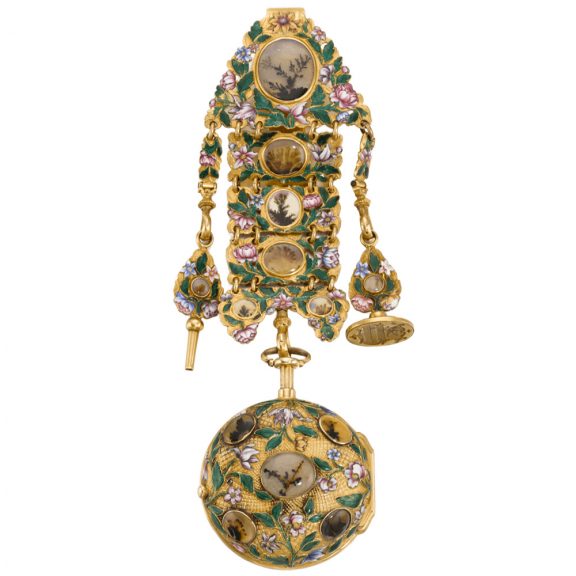
French quarter repeating à toc verge with matching chatelaine Circa 1749
- Kenmerk
- AS2136
- Diameter
- 46 mm
- Estimate
- € 9.000 - 20.000
- Price sold
- € 93.950
Gold, agate, and polychrome cloisonné enamel watch by François Jolly
–
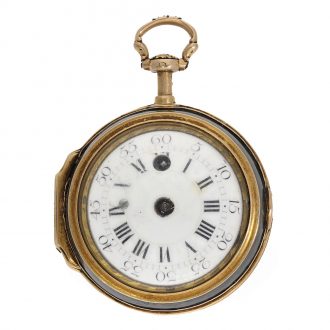
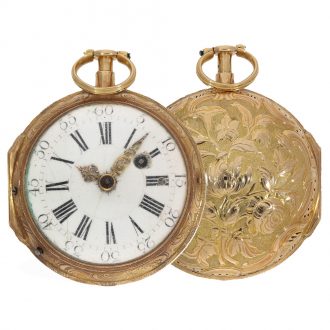
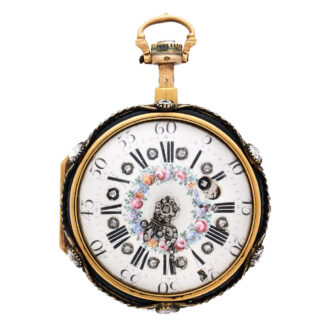
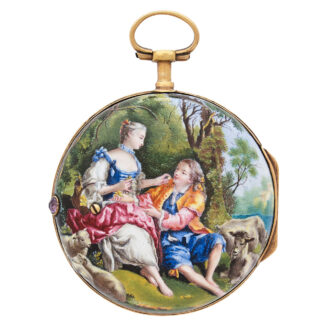
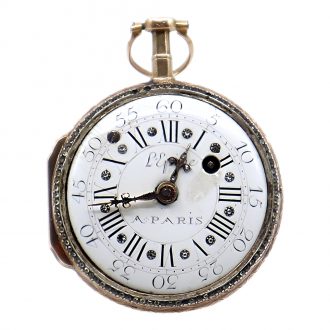
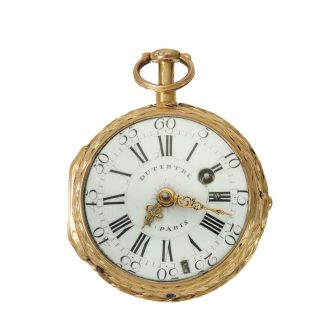
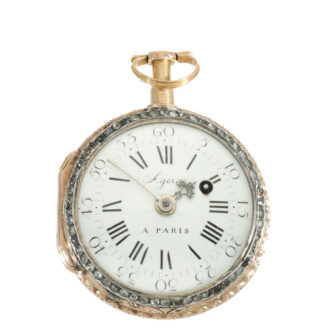
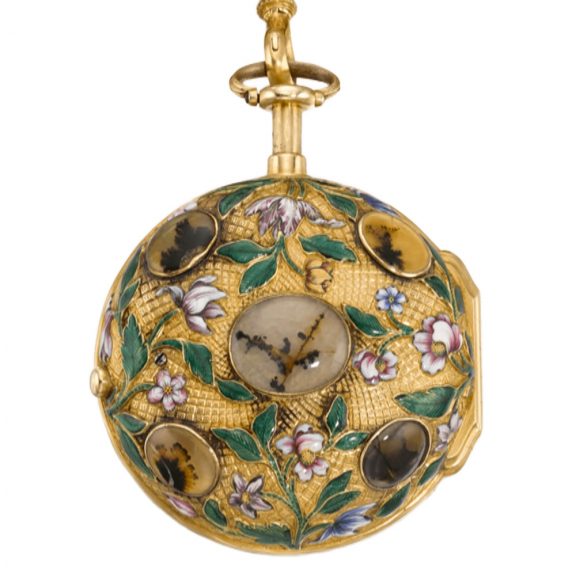
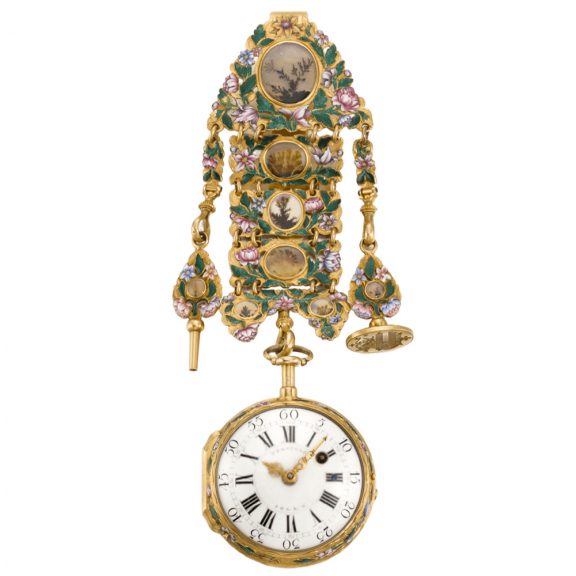
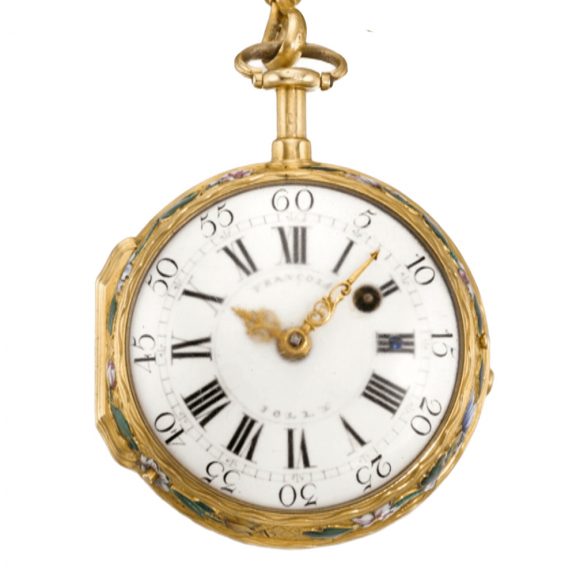
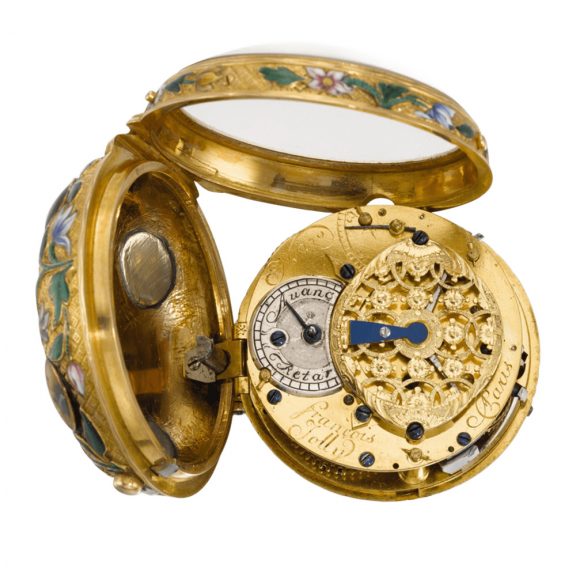
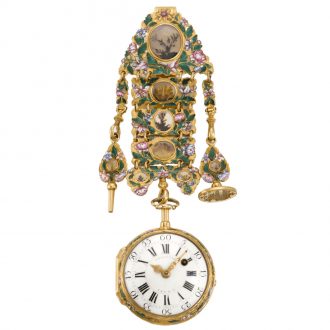
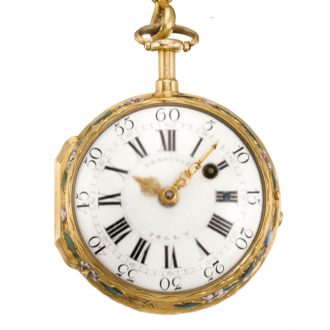
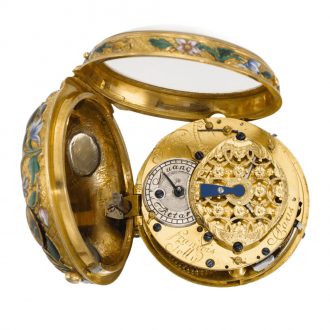
A French gold, agate, and polychrome cloisonné enamel quarter repeating à toc consular cased verge watch with a matching chatelaine, circa 1749/50. This watch features a gilded full plate movement with a verge escapement, a delicately pierced and engraved balance bridge, and a silver regulation plate. It includes a fusee and chain, plain brass pillars, and is signed and numbered by François Jolly, Paris, with the number 272. The white enamel dial is also signed by François Jolly and displays Roman numerals, an outer Arabic minute ring, and an aperture for winding.
–
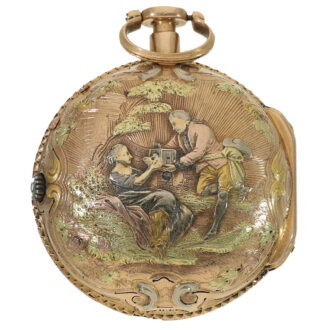
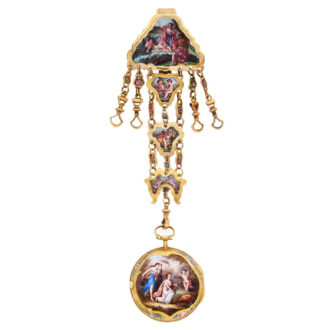
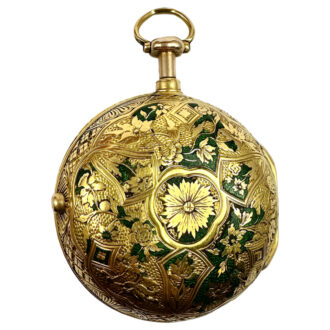
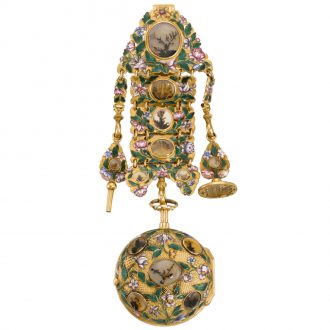
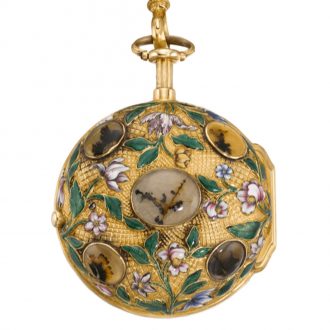
The gold case is adorned with an engraved radiating lattice design and decorated with polychrome cloisonné enamel flowers, resembling the style of a gold box by Jean Ducrollay in the Louvre. Additionally, it features applied moss agate panels and bears the case maker’s mark JQ with a star above it, indicating Joseph Quétin. Accompanying the watch is a gold chatelaine, intricately decorated with matching polychrome cloisonné enamel flowers and moss agate panels. The uppermost panel includes a pendant hook and two pendant chains, which terminate in a key and a seal.
–
Diameter: 46 mm
–
Overall length: 160 mm
–
Signed: François Jolly Paris
–
The dial has chips around the winding hole but is otherwise in good condition. The case has some cracks in the enamel decoration and scuffs on the glazed cover. The movement is running, although the strike mechanism struggles to work; it strikes the hours and quarters very slowly. The chatelaine has some areas of damage to the enamel decoration. The pendant is slightly bent and heavily scuffed. There are discharge and countermarks on the pendant of Julien Berthe, Paris, dated 1750-1756.
–
François-Antoine Jolly, the son of Claude Hector and Elisabeth Codolas, was apprenticed to his uncle, the Marchand-mercier Jean Jolly, at the age of 10 on May 8, 1718, for a term of six years. By 1737, he was described as an ouvrier libre; the same year, he married Marie-Anne Gribelin at the Church of Saint-Barthélémy. Jolly became a master craftsman in 1747 and established his business in Place Dauphine the following year.
–
Joseph Quétin became a master case maker on May 5, 1742, working in Paris at Rue de la Huchette in 1743 and Place du Marché Neuf in 1747. He retired to Châtillon-sur-Loire in 1772 and officially relinquished his title in 1775. Quétin supplied cases to notable Parisian watchmakers like Julien Le Roy, J.B. Baillon, F. Baillon, Chalon, Du Four, J.J. Gudin, and François-Antoine Jolly. Noteworthy examples of his work include watches by Jolly with cases featuring floral reliefs.
–
The raised floral enamel and moss agate decoration on the watch case and chatelaine are similar to two gold boxes by Parisian goldsmith Jean Ducrollay. The first box, housed in the Louvre, dates from 1750-1752, featuring a dotted diaper pattern, raised enamel flowers, and moss agate panels. The second box, in the Wrightsman Collection at the Metropolitan Museum, dates from 1749-1750 and has similar ornamentation but uses miniatures of the French royal family instead of agate panels, likely added later.
–
No objects with this raised enamel decoration are signed, but two 18th-century names are linked to it: Joaguet and Aubert. Joaguet was active from the 1730s, while Louis-François Aubert (1721-1755) is known for decorating a gold box with raised flowers on a matte mosaic background, commissioned for the King by Jean Ducrollay in 1751.
–
Jean-Dominique Augarde noted that in Paris, watch case manufacturing was primarily done by master clockmakers, not goldsmiths, despite the latter’s association with precious metals. Since the guild’s foundation in 1544, clockmakers could create their cases, though few did so, often commissioning specialists known as monteurs de boîte. These casemakers adhered to regulations similar to those of goldsmiths, such as taxation and registering a maker’s mark. In 1734, case makers’ marks were distinguished by initials topped with a six toothed cog wheel. Unlike Geneva, where case makers formed their guild, Paris had fewer professionals: 10 in 1739, 12 in 1753, and 19 in 1772, before numbers declined. Paris case makers focused on luxury watches, with cheaper cases imported from Geneva. They collaborated with goldsmiths to produce complete chatelaines for Parisian merchants, sharing designers, engravers, and enamellers.
–
In this example, watchmaker François Antoine Jolly collaborated with Joseph Quétin, whose mark appears on the case alongside an incomplete numeral (6[?]3). The matching chatelaine bears the Paris date letter and marks of Julien Berthe (1750-56) but lacks a maker’s mark. Jolly provided clocks and watches to Marchand-Mercier Lazare Duvaux, who recorded a sale on November 28, 1750, for a gold watch and chain made for the dowager countess d’Egmont for 1700 livres. Jean Ducrollay also supplied gold work around this time, suggesting the chatelaine may have originated from his workshops in partnership with Quétin, given the similarities in decoration to items at the Louvre and Metropolitan Museum. Likely, the enameller for the watch case, chatelaine, and boxes was Louis-François Aubert, and the original design may have come from Ducrollay’s workshops, as indicated by their album at the Victoria and Albert Museum.
Signed: François Jolly Paris
Share this page: