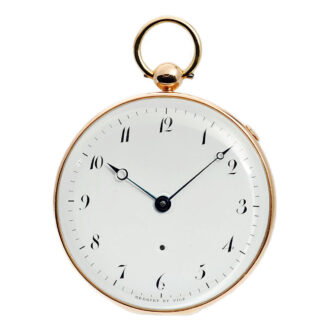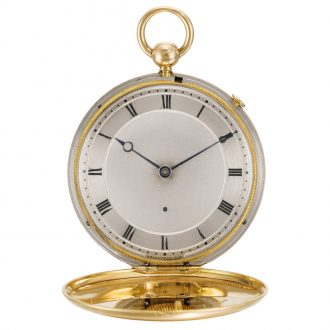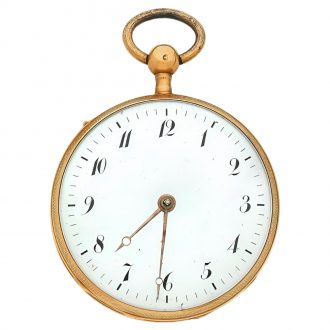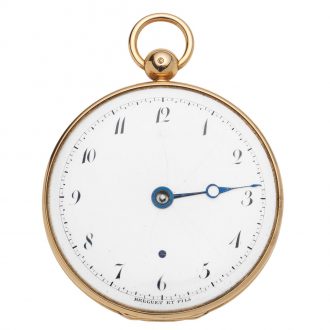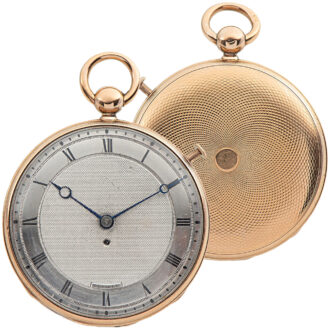
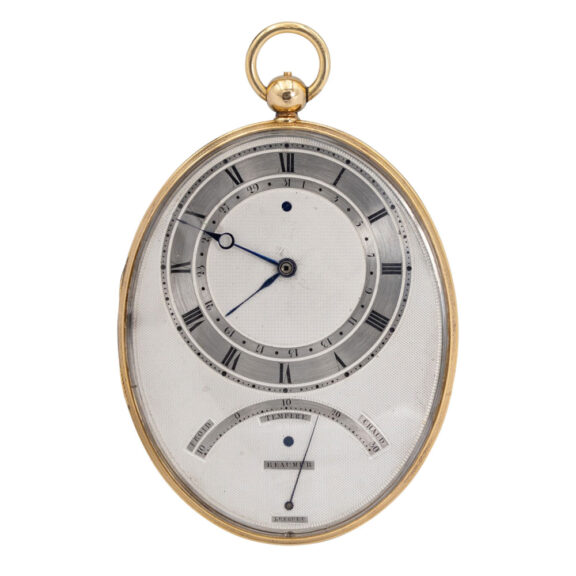
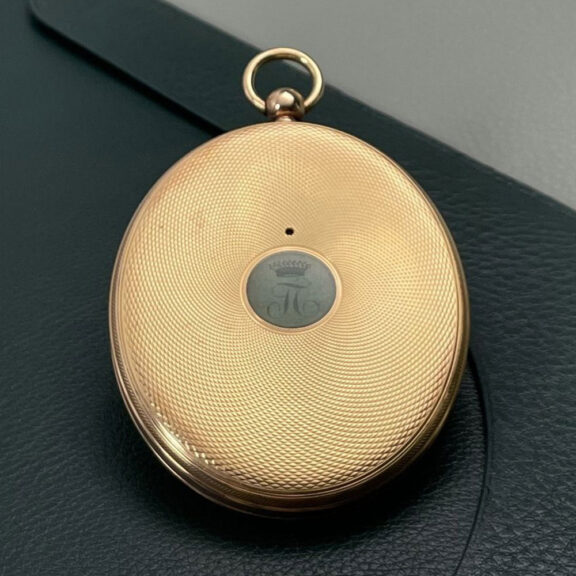
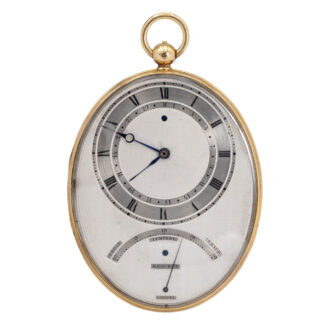
French unique 18K gold oval shaped cylinder watch Circa 1822
- Kenmerk
- DB1062
- Diameter
- -
- Estimate
- € 100.000 - 200.000
- Price sold
- € 137.500
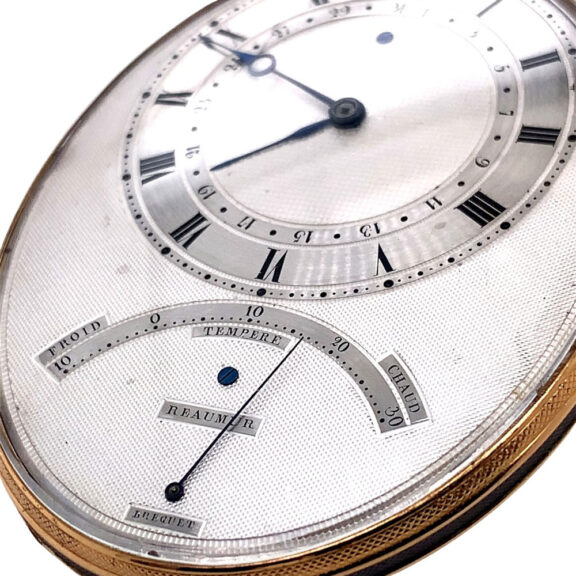
Gold watch with date and thermometer
–
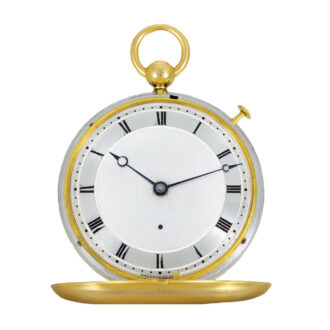
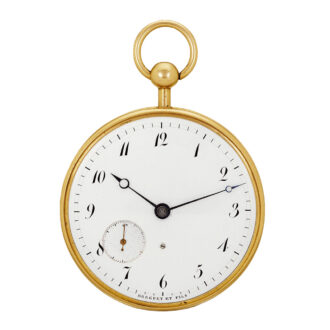
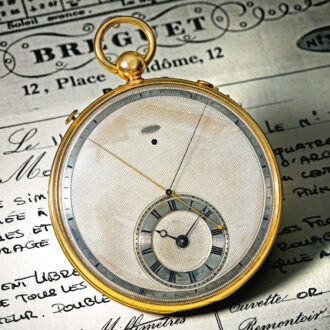
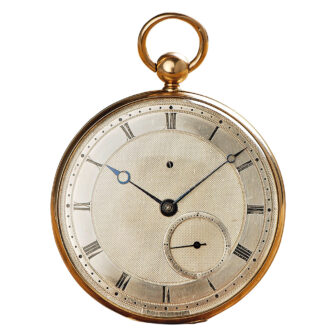
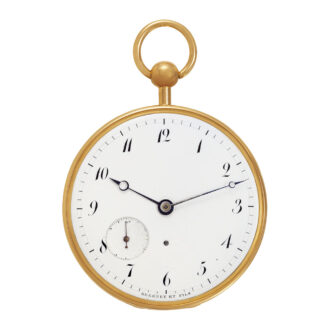
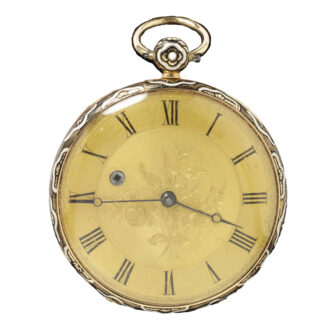
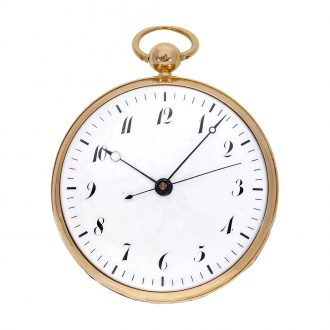
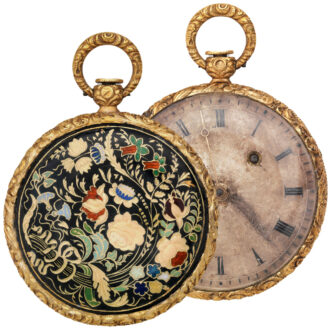
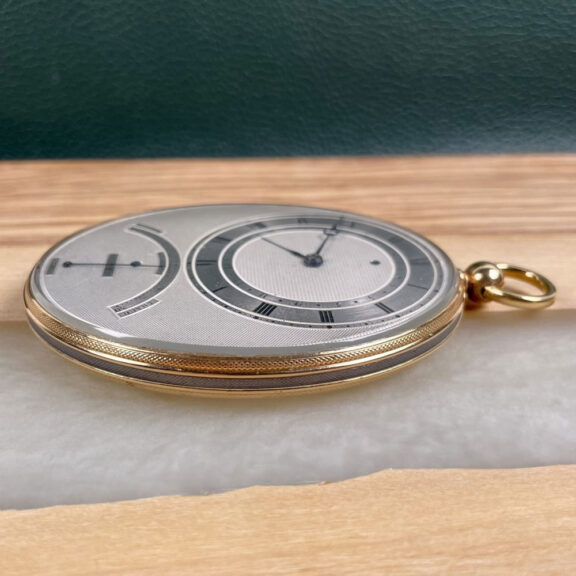
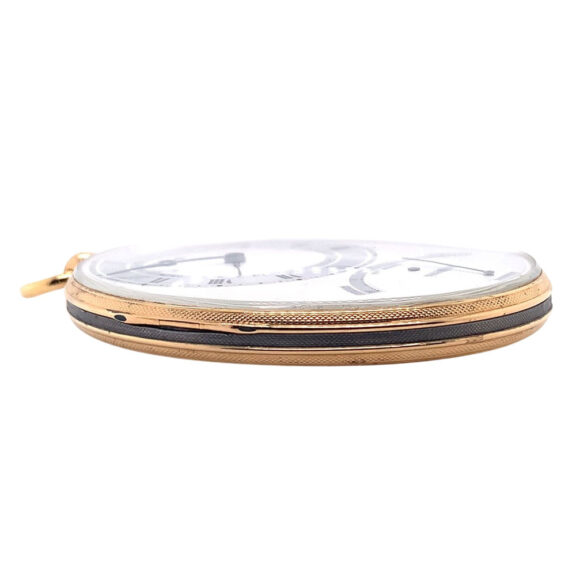
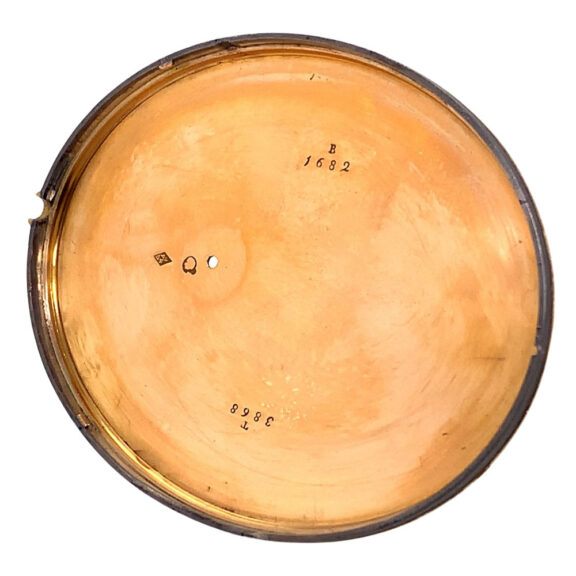
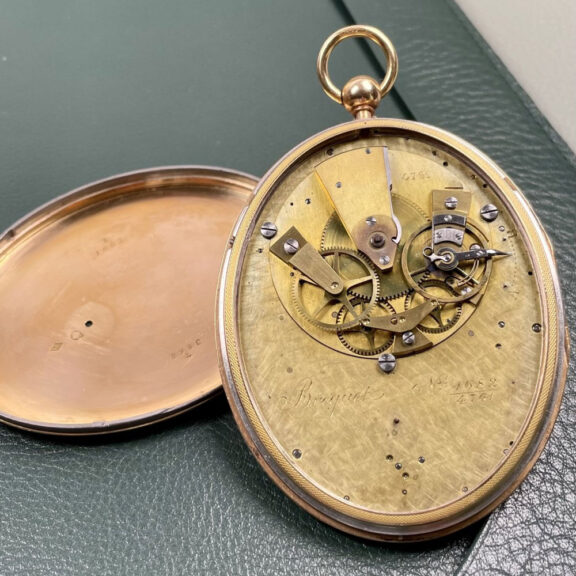
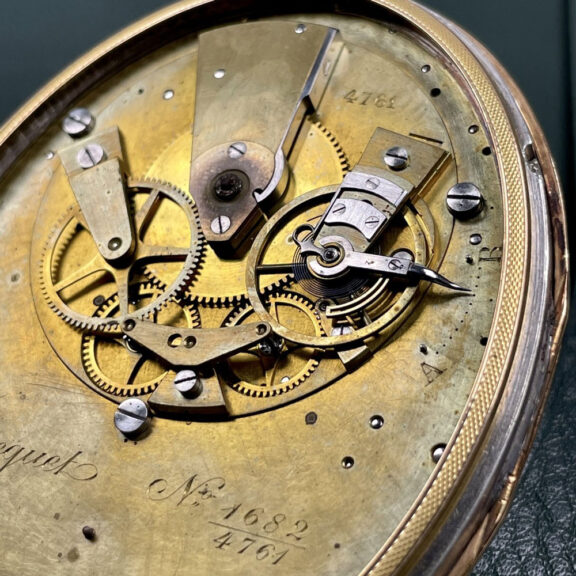
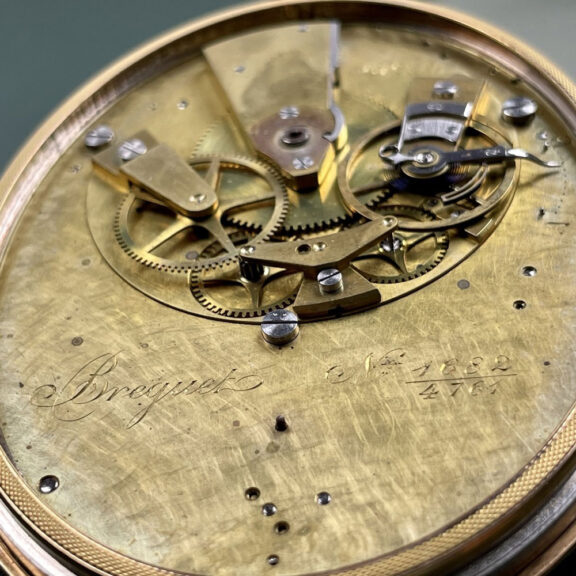
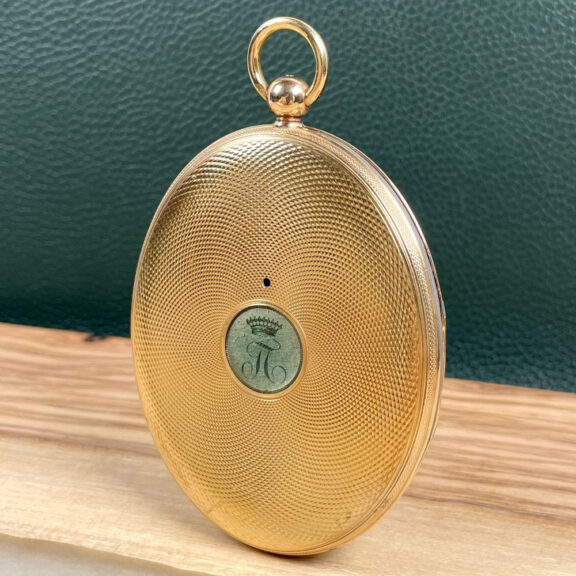
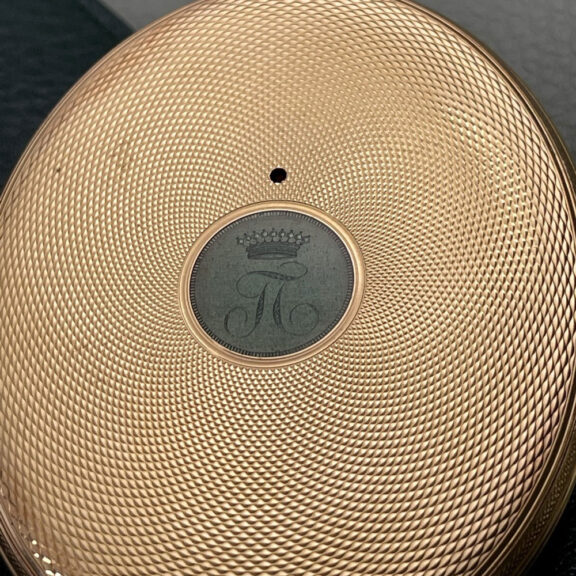
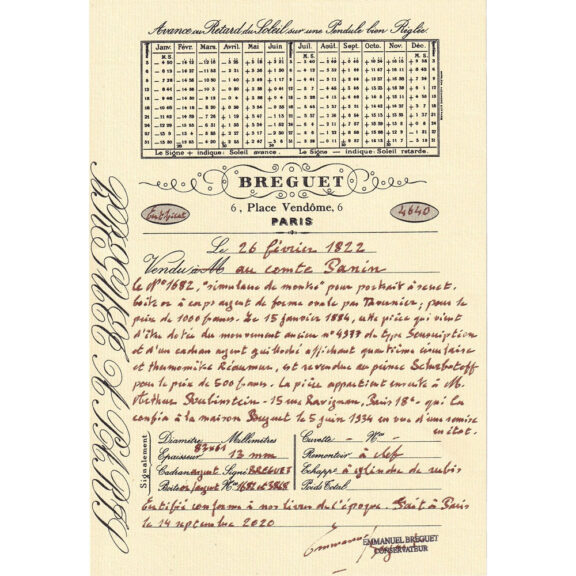
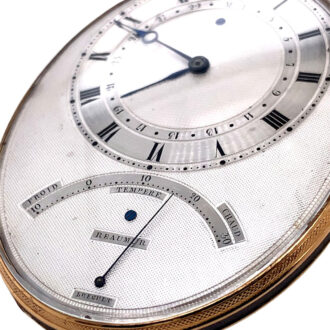
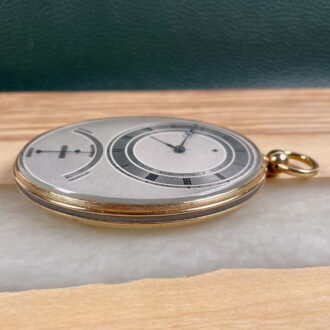
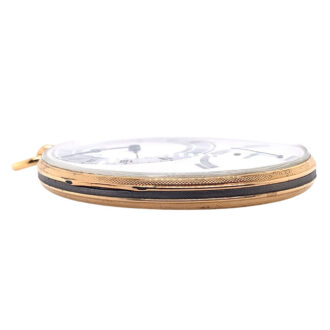
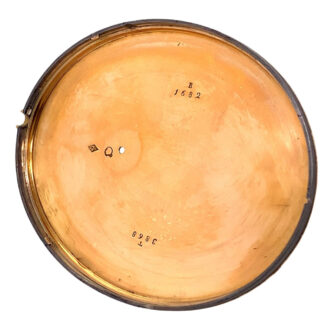
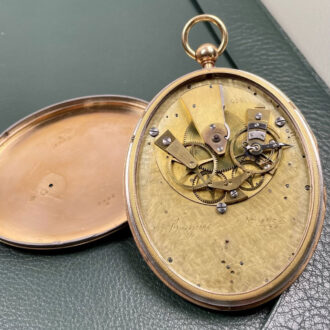
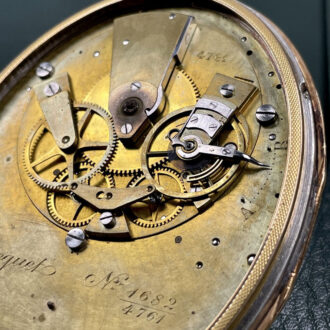
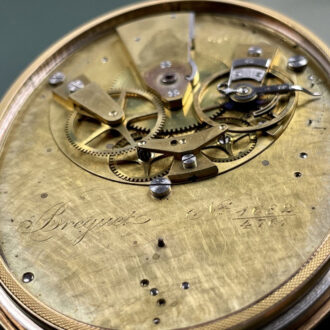
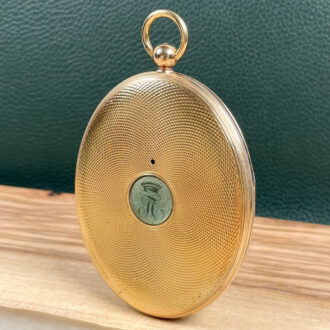
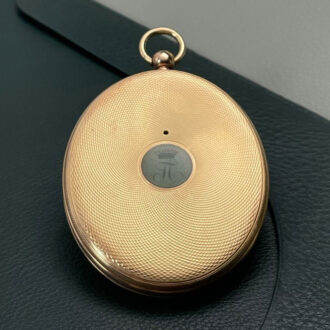
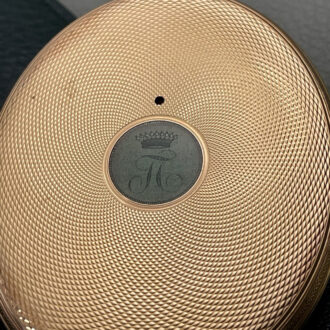
Important and unique French 18 carat gold open faced oval form pocket watch with date and thermometer made by Breguet in Paris, circa 1822. Sold to Count Nikita Petrovich Panin on February 26th, 1822. Rebuilt in 1884 on behalf of Count Scherbatoff and later sold to the famous pianist Arthur Rubinstein, who had it completely overhauled by Breguet in 1934. The brass key wind Souscription movement with a central barrel, shock protection parachute, ruby cylinder escapement in hanging arrangement, three arm brass balance and flat blued steel hairspring with bimetallic temperature compensation. The bimetallic thermometer mounted under the dial on the front plate, fitted with a double rack and pinion pointer movement. Oval, eccentric two-tone silvered guilloché Tavernier dial with decentralized time indication in the upper half featuring a brushed hour chapter ring with Roman hour numerals, outer minute divisions, concentric inner Arabic date display, a single blued steel Breguet hand for the hours and minutes, and a single Souscription, tapered spear hand for the date, a Réaumur thermometer scale in the lower half. An oversized oval engine turned Tavernier case with a silver band, pressure back with a central oval translucent green enamel medallion featuring an engraved Cyrillic P under a count’s crown. Dial and movement signed, case and movement numbered twice. Comes with the original certificate.
–
Dimensions: 61 x 84 mm
–
Weight: 159 g
–
Signed: Breguet
–
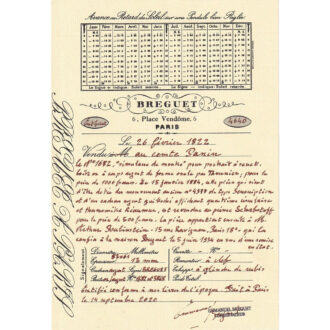
According to the included certificate number 4640, this watch is undoubtedly unique from Breguet’s working period. It has a complex and interesting history. On February 26th, 1822, Breguet sold the watch as a dummy watch, as a frame for a portrait, to Count Panin for 1000 francs. On January 15th, 1884, at the request of Prince Scherbatoff, Breguet fitted a guilloché silver dial and a small Souscription caliber with number 4977 into this medallion, which he still had in stock, for 500 francs and renumbered it 4761.
A thermometer was also installed. The resulting watch later came into the possession of Arthur Rubinstein, 15 Rue Ravignan in Paris, who entrusted it to Breguet for refurbishment on June 15th, 1934.
–
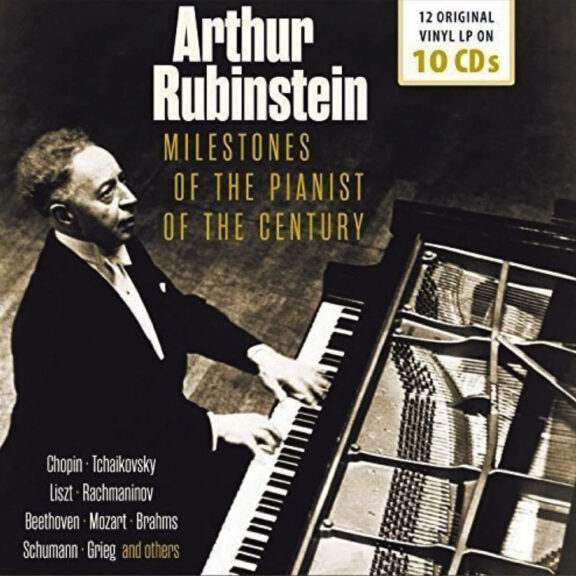
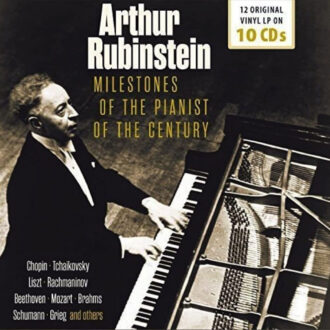
Arthur Rubinstein is considered one of the most important classical pianists of the 20th century. He was born on January 28th, 1887 in Lodz, then part of the Russian Empire, as the seventh child of a family that had no musical talent. Despite his father’s opposition, he began playing the piano at three years old.
–
At the age of ten, his mother took him to Berlin, which was then a center for famous musicians and European piano music. Joseph Joachim provided the young Rubinstein with rich sponsors and recommended him to the strict piano teacher Karl Heinrich Barth. During seven years of strenuous study, he learned much of what he needed to become a piano virtuoso. In 1904, at the age of seventeen, he moved to Paris, where he worked seriously on his career.
–
Rubinstein’s lifestyle and personality matched his enormous talent. He was acquainted with Marcel Proust, the Rothschilds, Maurice Ravel and Paul Dukas and friends with Hoffmann, Chaliapin, Saint-Saëns, Stravinsky, Pablo Casais and Picasso.
–
His fame was particularly due to his interpretations of Chopin’s works. In total he gave around 6,000 concerts during his life. He gave his last concert at the age of 88 in May 1976 at the Wigmore Hall in London. He had to end his career because he lost his eyesight. Rubinstein died in Geneva in 1982 at the age of 95.
–
Count Nikita Petrovich Panin (1770-1837), was a Russian diplomat, vice chancellor, state chancellor, acting from October 6th, 1799 to November 18th, 1800, and foreign minister of Russia. His uncle, Count Nikita Ivanovich Panin, was Russian Foreign Minister under Tsarina Catherine II from 1764 to 1780.
–
Panin planned the assassination of Paul I of Russia together with Count Peter Ludwig von der Pahlen and the Russian-Neapolitan admiral José de Ribas. Ribas died before the assassination, which was actually carried out on March 23, 1801 by a group of discharged officers led by General Bennigsen, a Hanoverian in Russian service, and General Yashvil, a Georgian. The assassination attempt brought Alexander I of Russia to the throne.
–
Abraham Louis Breguet devised the Souscription watch series to aid the recovery of his business after the French Revolution. The watches were production pieces for which the client would pay a quarter of the 600 Livres upon ordering the watch. This covered the cost of the materials and then, on delivery, the client was required to pay the balance.
–
The Réaumur scale also known as the ‘octogesimal division’ is a temperature scale in which the freezing and boiling points of water are respectively set to 0 and 80 degrees. The scale is named after René-Antoine Ferchault de Réaumur, who first introduced a similar scale in 1730.
–
A Tavernier dial refers to historical watch dials and complex calendar displays crafted or signed by the Tavernier family, a prestigious 18th and 19th century dynasty of master Parisian watchmakers who frequently collaborated with legendary horologists like Abraham-Louis Breguet.
–
Historically, there is no single generic mechanism called a ‘Tavernier dial’. Instead, the term points to the highly distinct, complex and very finely engineered multi dial layouts or enamelled faces made by different members of this family.
–
A Tavernier case refers to a watch case crafted by the famous Parisian Tavernier watchmaking family. They made cases for master watchmakers like Abraham-Louis Breguet, Lépine and Leroy.
Signed: Breguet
Share this page: