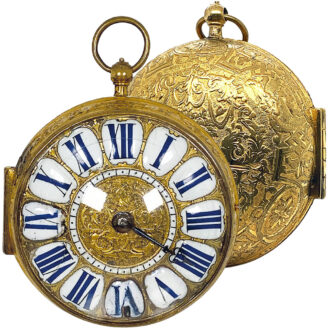
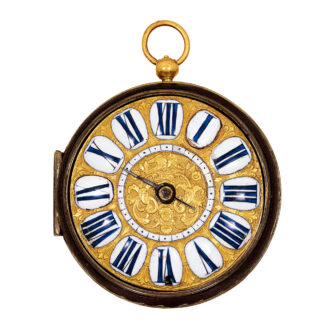
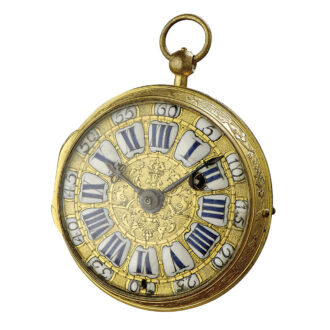
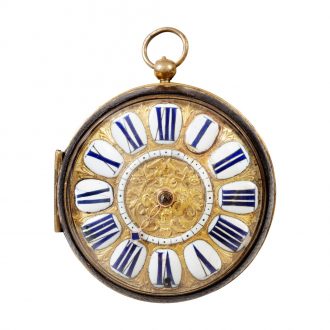
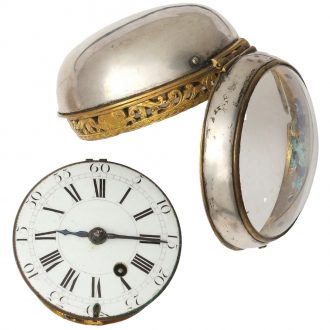
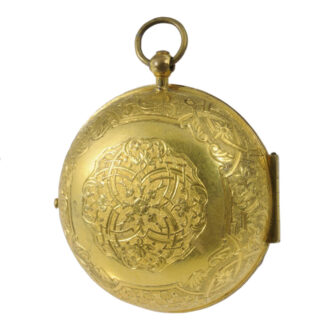
French single handed verge oignon pocket watch Circa 1700

- Kenmerk
- PD0341
- Diameter
- 57 mm
- Estimate
- € 30.000 - 50.000
- Price sold
- € 45.000
Gilt brass and enamel oignon watch
–
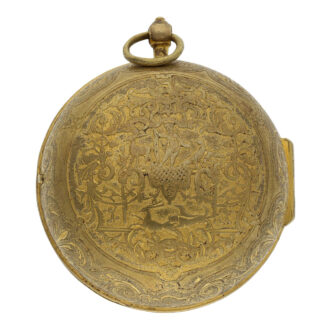
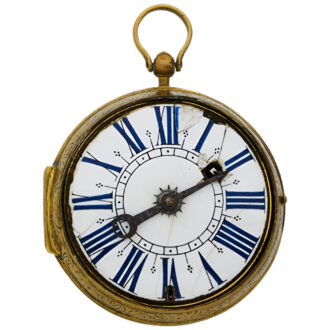
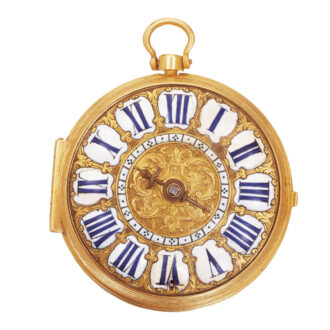
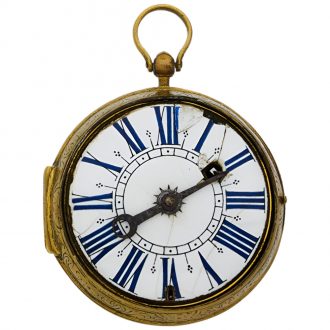
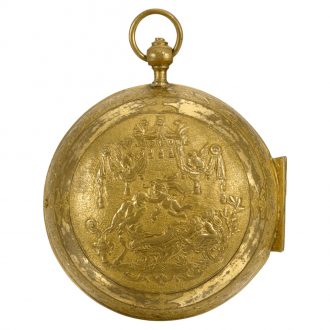
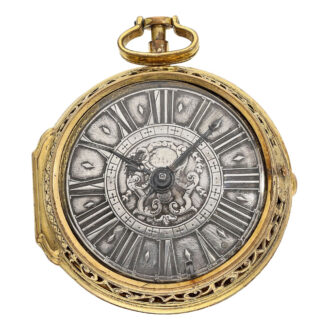
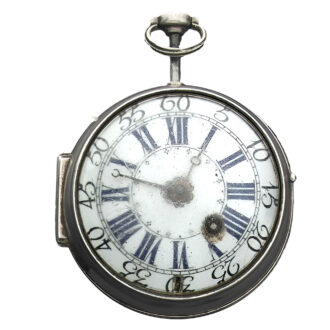
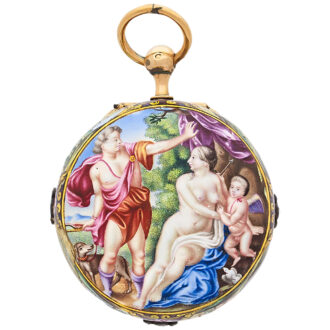
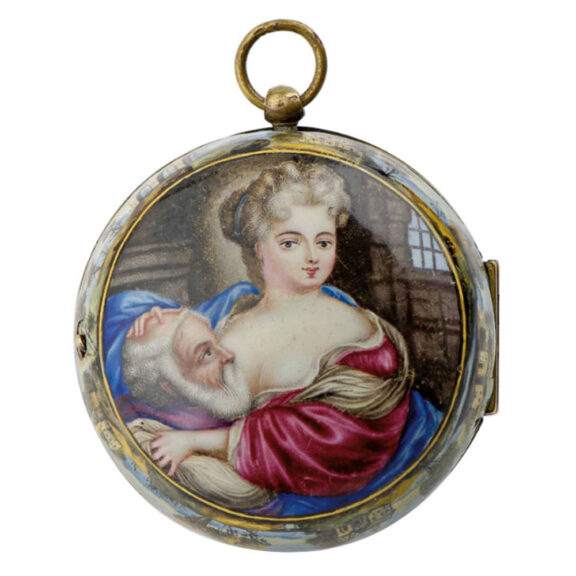
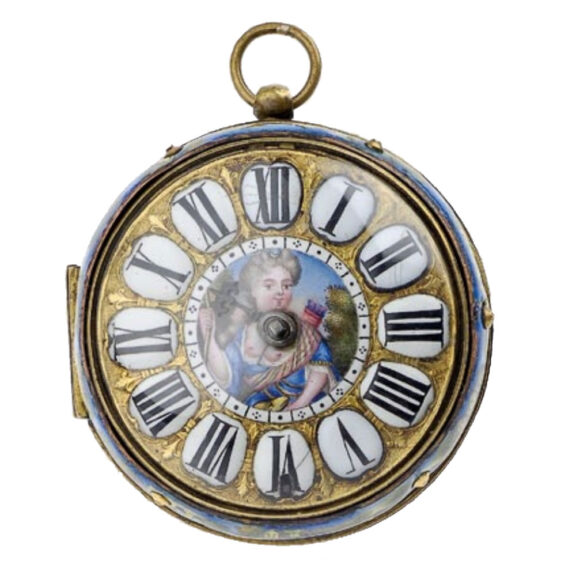
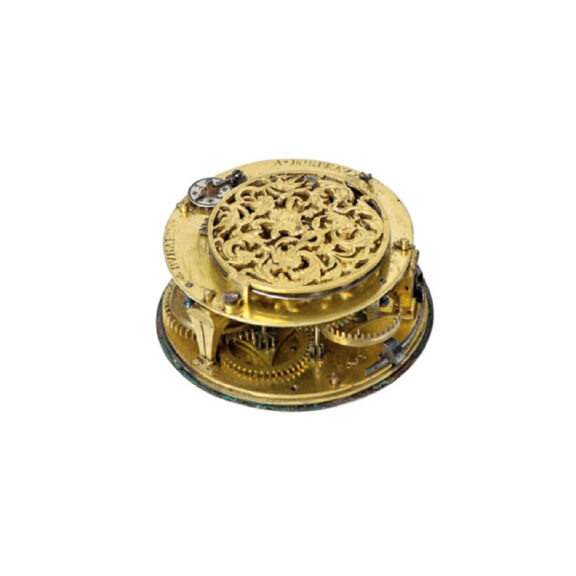
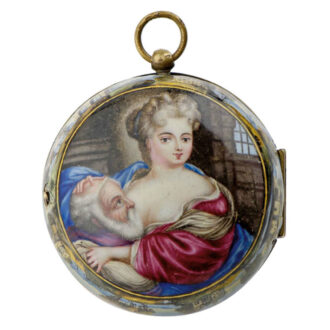
A rare and large French gilt brass oignon verge pocket watch, circa 1700. Regilded brass case, the back with a polychrome enamel scene after the painting Roman Charity or Cimon and Pero by Peter Paul Rubens, the enamel attributed to the famous enameller Jean Mussard V, the band with painted enamel pastoral scenes. Gilt engraved dial, white enamel cartouches with black Roman hours, a central polychrome enamel scene showing Diana, Goddess of the Hunt and a single steel hand. Gilt full plate movement, key winding, chain and fusee, Egyptian pillars, three arm steel balance, pierced balance cock with finely engraved birds, fish and mascarons. Movement signed.
–
Diameter: 57 mm
–
Weight: 174 g
–
Signed: Jean Duhard à Bordeaux
–
Roman Charity refers to the ancient story of a Roman woman who secretly breastfed her father who was sentenced to die of starvation in prison. It is an oil on canvas painting by Peter Paul Rubens executed around 1612, now in the Hermitage Museum in Saint Petersburg. Rubens also returned to the subject in the painting Cimon and Pero executed in 1630, now in the Rijksmuseum in Amsterdam.
–
Peter Paul Rubens was born in Siegen on June 28, 1577, and he died in Antwerp on May 30, 1640. He was a Flemish baroque painter, draughtsman, tapestry designer and diplomat, who worked in Antwerp. He was also called Pieter Paul, Pieter Pauwel or Petrus Paulus.
–
Jean Mussard V was born and died in Geneva, 1681-1754. He was one of the best enamel painters of the early 18th century, the son of Jean IV and a cousin of the Huauds. He began his career as a goldsmith and became a Master on December 7th, 1699. He later became a painter on enamel, in which discipline he was influenced by the style of Les Frères Huaud. Although he clearly was inspired by their work, his paintings were more according to the taste of the time, they showed religious designs as well as purely secular ones. He went into partnership with his son Jean-Antoine and trained several pupils, among them Gabriel Fontaine, André Oettner, and in 1712, Germain Colladon. The scene ‘The Death of Cleopatra’ can be found on several of his enamel watches, but two of his best known subjects are ‘Roman Charity’ and ‘Religious Scene’. His signature appears as ‘Mussard’, ‘Jean Mussard pinx’ and ‘Mussard pinx’.
Signed: Jean Duhard à Bordeaux
Share this page: