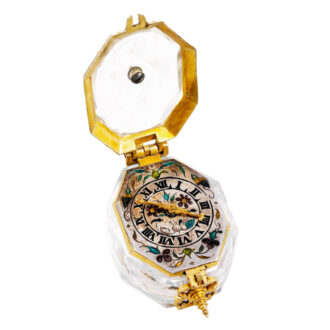
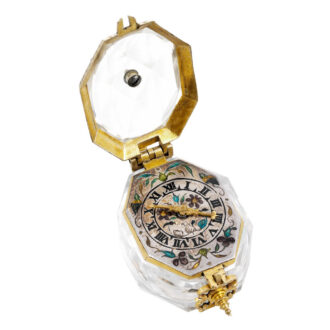
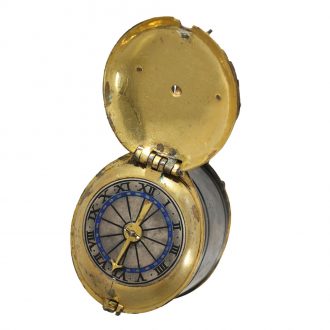
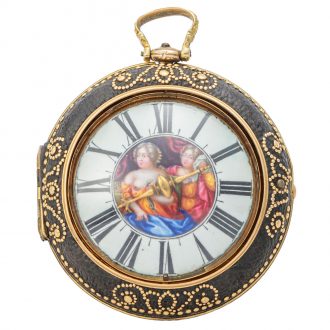
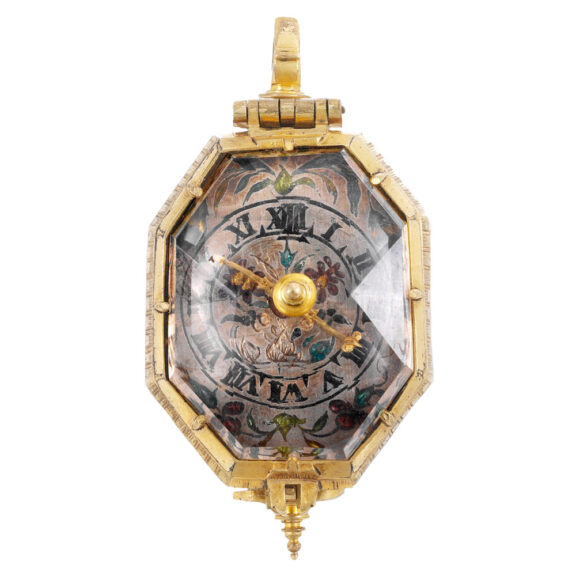
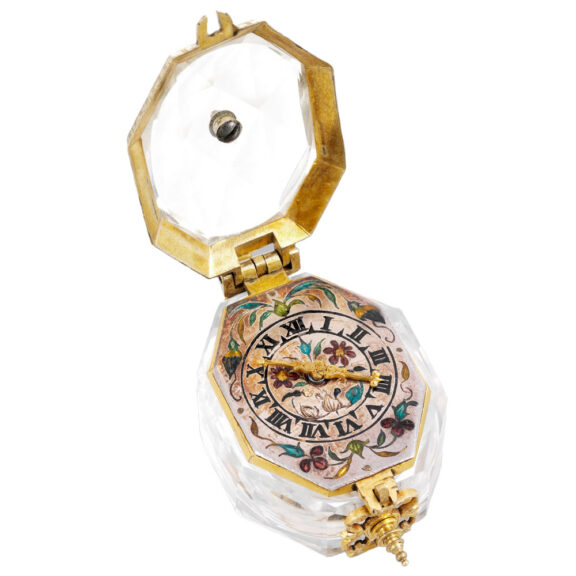
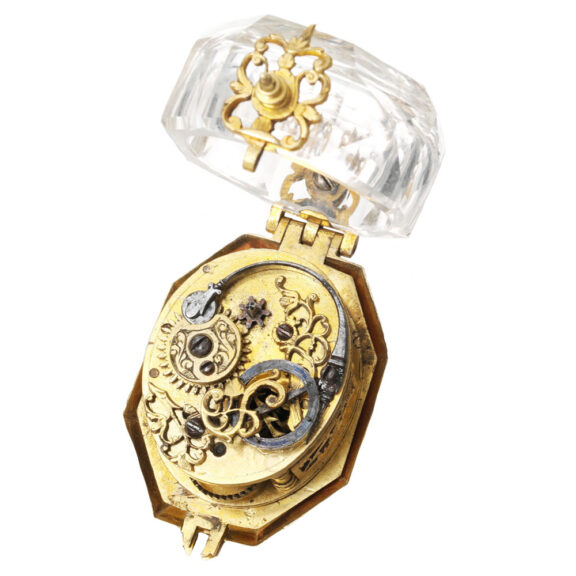
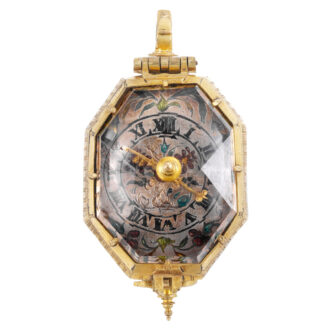
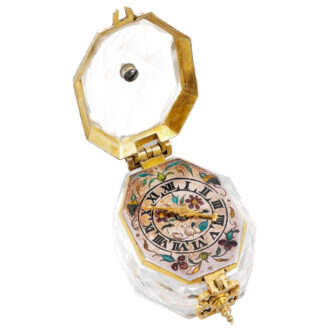
German gilt metal and rock crystal octagonal watch Circa 1600
- Kenmerk
- TA3566
- Diameter
- -
- Estimate
- € 25.000 - 50.000
- Price sold
- -
Gilt metal one handed verge pocket watch
–
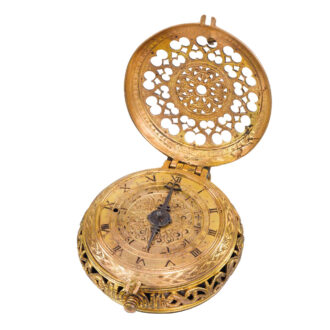
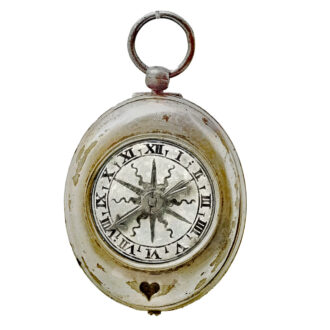
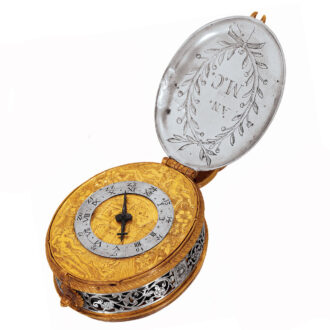
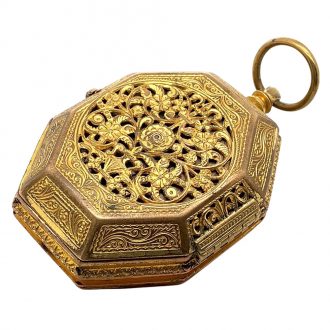
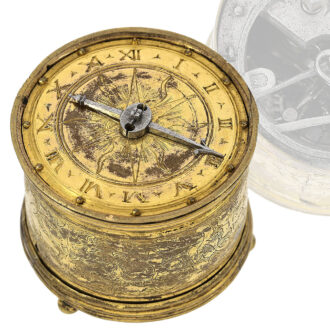
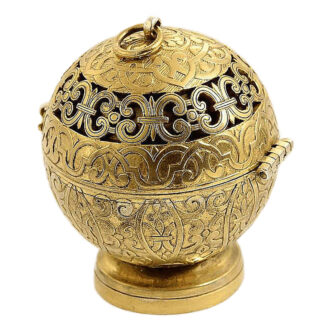
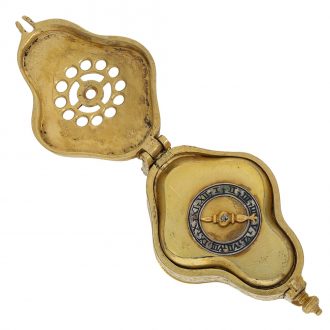
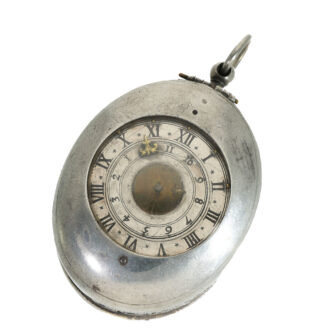
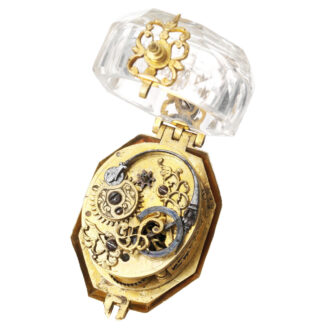
A very fine and rare German gilt metal, enamel and rock crystal octagonal verge pocket watch, circa 1600. An octagonal case, deep back, cut from a single piece of rock crystal, faceted on the sides and the back, hinged rock crystal front cover similarly faceted with small central finial fixed to an engraved gilt bezel, small tulip pendant and turned spire finial with pierced and engraved scroll feet. Octagonal, silver dial, chapter ring with champleve enamel radial Roman numerals with half hour divisions, the border and center decorated with polychrome champlevé enamel flowers and leaves and engraved gilt foliate hand. A gilt brass full plate movement, column pillars, fixed barrel, C shaped stack freed, short three wheel train pinions with six and five leaves, verge escapement, circular steel foliot, an adjustable pivoted lever for hog’s bristle regulation, small brass S shaped cock with wide pierced and engraved foot secured by a screw.
–
Dimensions: 72 x 50 mm
–
Signed: Conrad Kreizer Augsburg
–
The dial is slightly chipped and restored.
–
In the early 17th century small watches were very rare.
The Stack freed was designed to equalize the varying force of the mainspring. This was necessary because the rate of the foliot’s oscillation depends directly on the force with which the escape wheel acts upon it. The force transmitted to a watch’s escape wheel when the watch is fully wound is about twice that of when it is nearly run down. The need for an equalizing device was realized early on in the development of horology and the stackfreed was a crude but relatively effective method of achieving this. It was made for a relatively short period before being superseded by the fusee. In a 26 hour watch, the action of the stack freed spring causes constant high friction for the first 12 hours after winding, slowly diminishing friction for the next 6 hours, rapidly diminishing friction for the next 6 hours and no friction for the last 1 or 2 hours. The stackfreed is only found in watches made in Germany and continued to be used there into the 17th century even after the introduction of the fusee.
The Kreizer (also Kreiser & Kraiserer) Family The Kreizer family was a veritable dynasty of watchmakers, with at least four individuals apparently bearing the same Christian name. Some uncertainty exists as to whether Conrad III and IV were not in fact the same person, but certainly one of the Kreizers held the position of clockmaker to the Knights of the Grand Cross of Malta and indeed several watches use their characteristic cross as the form for the pendant. The Metropolitan Museum of Art has a cruciform watch by him.
Signed: Conrad Kreizer Augsburg
Share this page: