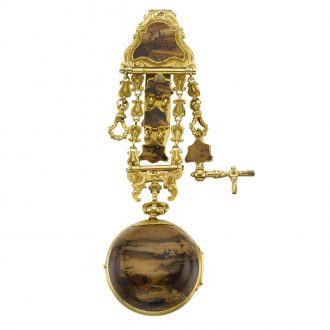
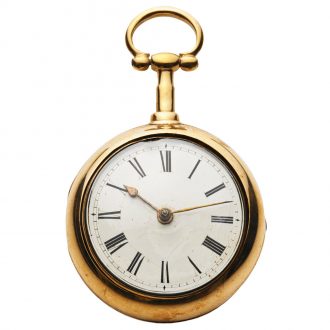
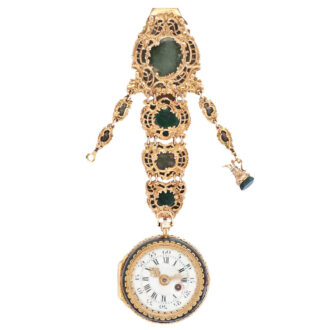
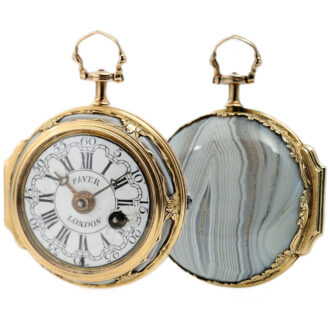
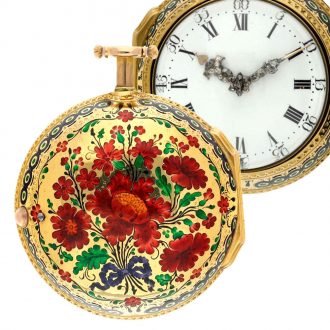
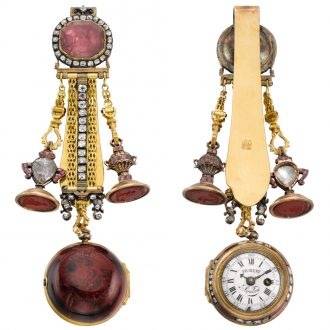
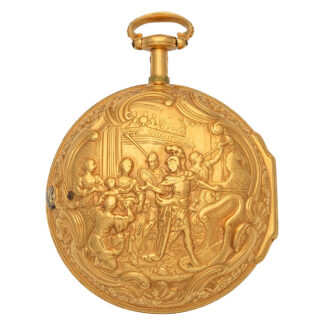
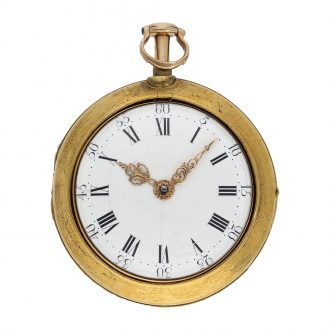
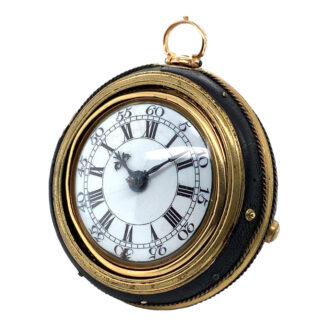
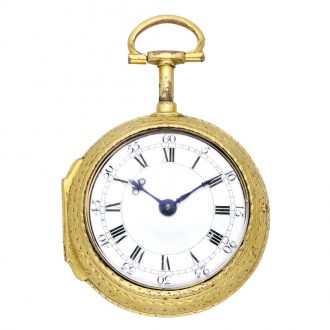
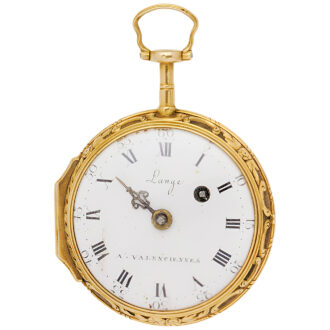
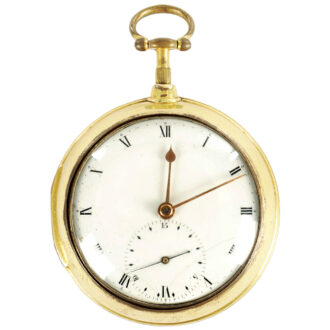
English gold half quarter repeater with à tact option Circa 1760
- Kenmerk
- TA1768
- Diameter
- 49 mm
- Estimate
- € 10.000 - 16.000
- Price sold
- € 12.250
Gold pair cased cylinder centre seconds watch with date
–
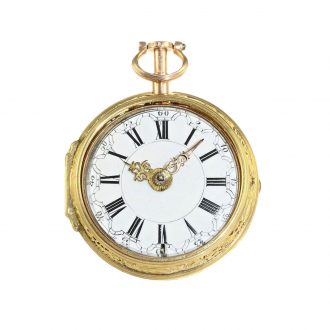
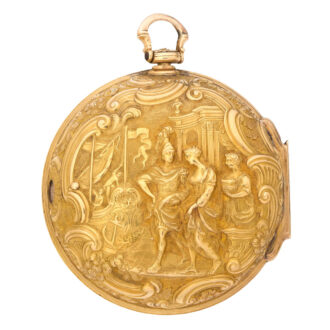
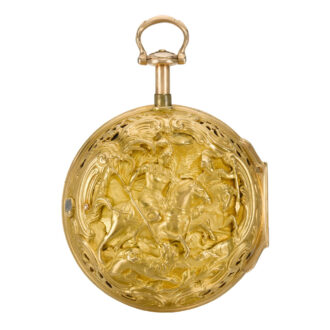
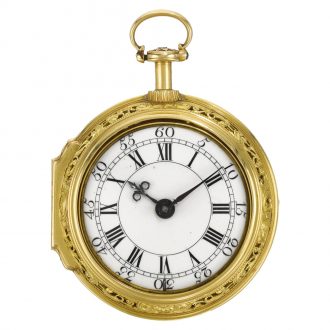
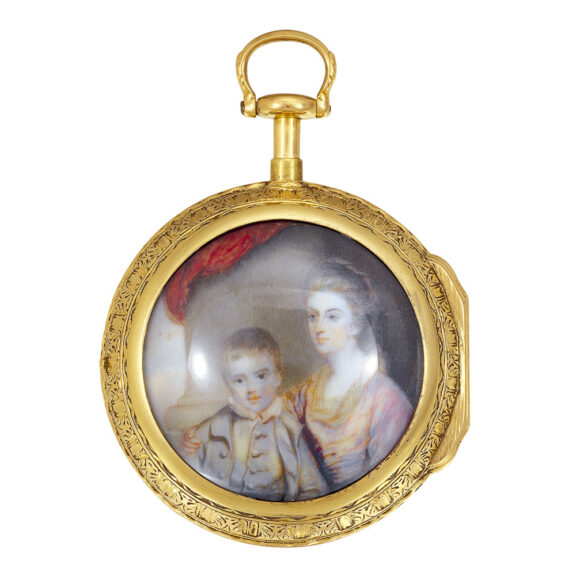
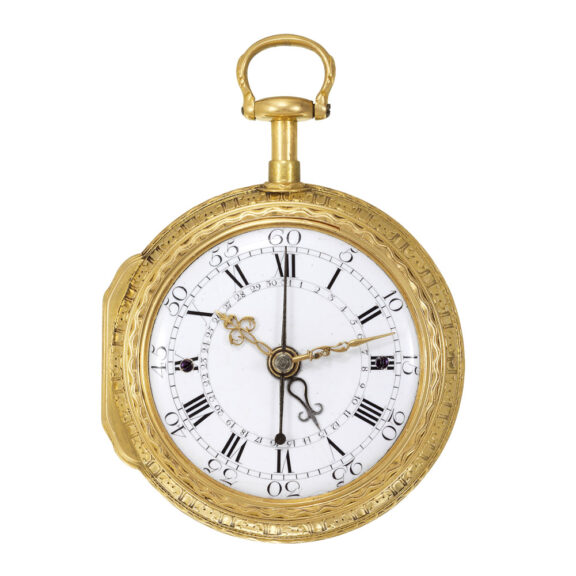
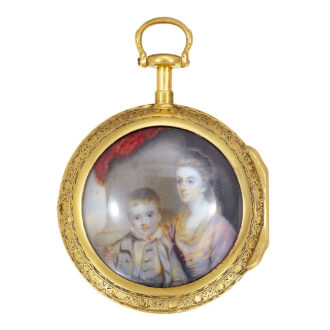
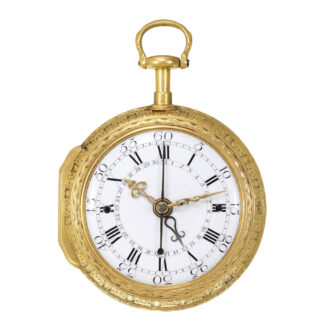
A very fine and extremely rare English 18K gold and enamel pair cased dumb half quarter repeating center seconds pocket watch with à tact option and date, circa 1760. The outer case is engraved with stiff leaf decoration, a finely painted on ivory miniature portrait of a lady and her son on the back, glazed with rock crystal. Polished inner case, punched with maker’s mark M.D., two screwed blocks for the repeat.
–
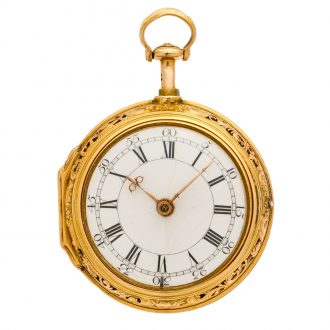
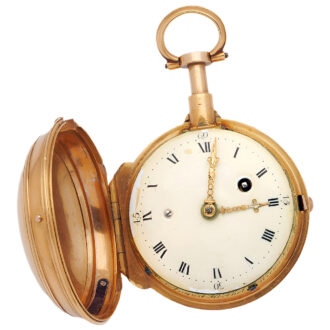
White enamel dial by Joseph Coteau, radial Roman hours, outer minute track with Arabic five minute numerals, inner ring for days of the week, secured by two screws, pierced gold hour and minute hands, blued steel centre seconds hand, polished steel date hand. A hinged gilt brass movement, full-plate with conical pillars, fusee with chain, cylinder escapement, plain steel three arm balance, flat balance spring, diamond endstone, gilt brass two footed cock pierced and engraved with scrolling foliage, finely engraved backplate furniture, silver regulation disc, all or nothing dumb half-quarter repeating, the hammers striking on the case activated by depressing the pendant, à tact lever between 7 and 8 o’clock, silence lever at 9 o’clock, gilt brass dust ring. The dial signed Coteau on the reverse, movement signed.
–
Diameter: 49 mm
–
Signed: Mudge & Dutton London
–
The former property of an Italian collector.
–
The present watch was perhaps made for export or improved by a French watchmaker, possibly for an English owner living in Paris. Several things suggest this, the case has amongst others no English hallmarks but Paris ones and Gros charge marks used between 1762 and 1768 on imported goods. The dial is further signed by Joseph Coteau (1740-1801), the most eminent French enameller of the 18th century. Dials signed by him are extremely rare. The movement, certainly English-made, has an unusual double-footed cock in a continental manner. The fine miniature painted on ivory on the back of the case is almost certainly after a full-sized painting, probably by Sir Joshua Reynolds and perhaps belonging to the watch’s original owner. This miniature may have served to remind the watch’s owner of his family while he was abroad.
–
Thomas Mudge (1715-1794) was one of the first watchmakers to produce constant-force watches was in partnership with William Dutton from 1755 to 1790. In 1765 he and Larcum Kendall were appointed to examine Harrison’s marine watch. In 1771 he retired to Plymouth, where he devoted himself entirely to research on marine chronometers.
–
Montre à toc. A ‘dumb’ repeater watch in which a hammer strikes the inside of the case to produce a muffled sound. Invented by Julian Le Roy in 1740.
–
Montre à tact. A type of watch made after 1795 by Abraham Louis Breguet to give time by touch. In the late eighteenth century it was considered impolite to consult one’s watch in company, a question of etiquette which the à tact watch helped to solve (the French tact, meaning touch, has given the English tact and tactful). Knobs representing the hours are positioned around the case with a large hand that could be turned until it met resistance. Its position in relation to the knobs gave the time. This kind of tactile watch is now mainly used by the blind and visually impaired.
Signed: Mudge & Dutton London
Share this page: