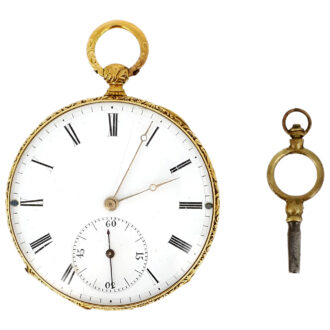
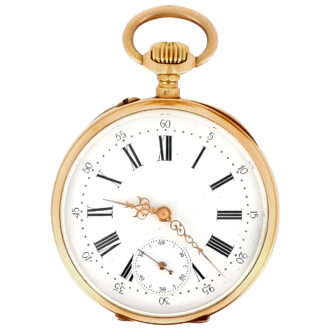
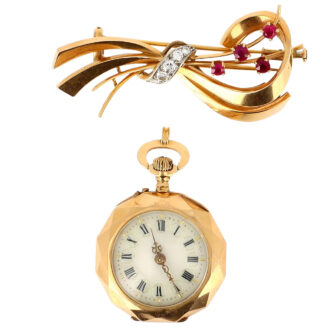
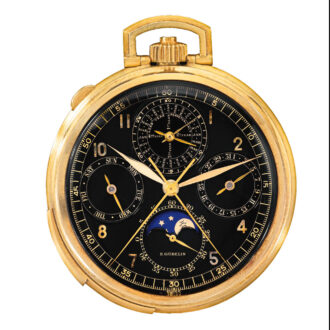
Important Swiss highly complicated pocket watch Circa 1865-1870
- Kenmerk
- AA0196
- Diameter
- 53 mm
- Estimate
- € 45.000 - 90.000
- Price sold
- € 56.500
Gold lever watch with nine complications by Louis Audemars
–
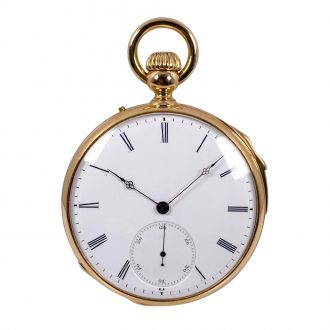
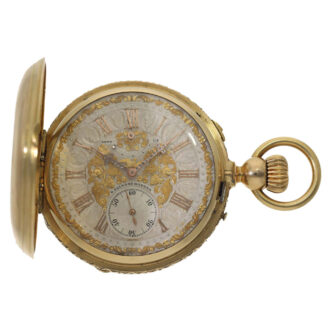
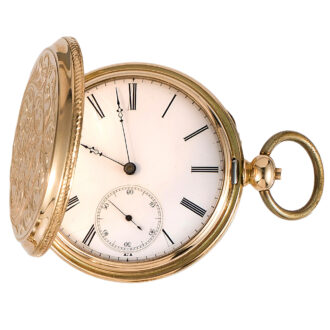
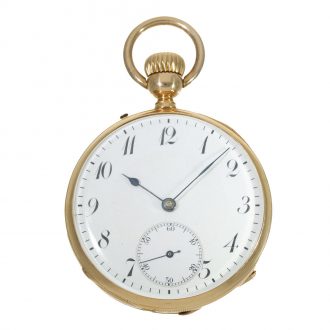
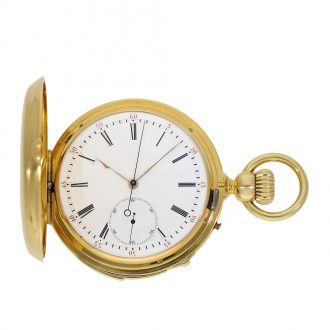
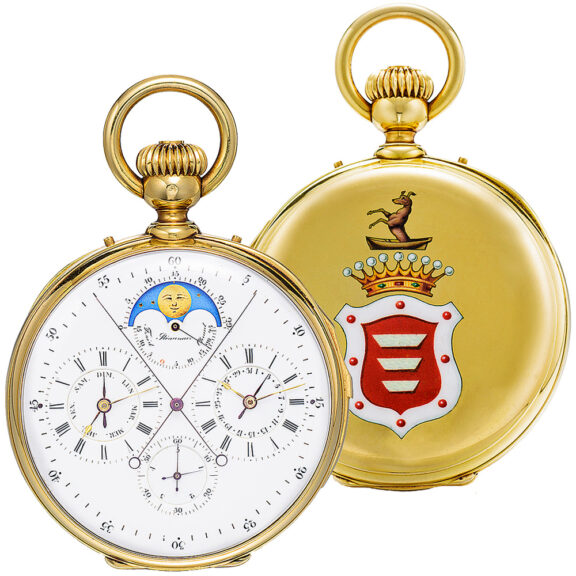
An important Swiss 18 carat gold open faced minute repeating keyless lever pocket watch made for Augustin Branicki, circa 1865-1870.
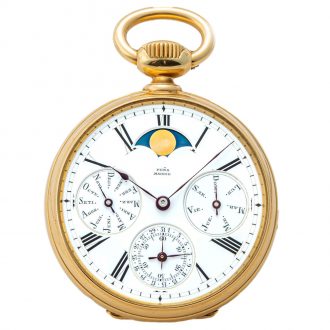
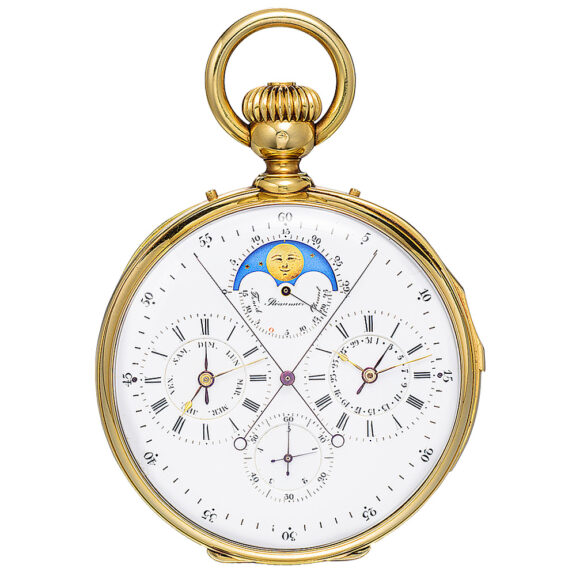
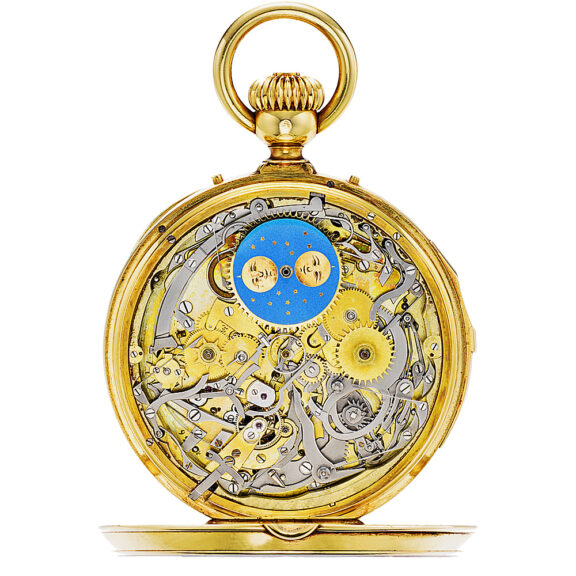
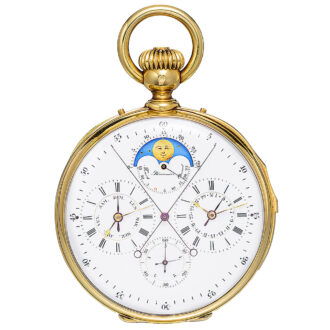
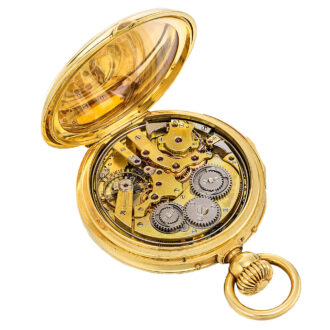
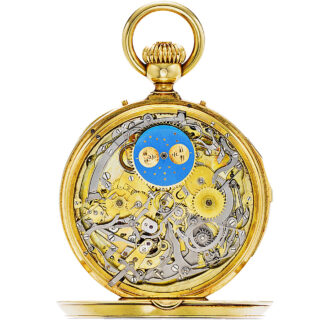
This timepiece has nine horological complications: repeating the minutes on two steel gongs activated by a slide at 3 o’clock, dead independent seconds (exterior graduation with a central hand, started by a push-piece on the winding crown), subsidiary seconds at 6 o’clock, split seconds (the second concentric central hand, activated by a push-piece on the winding crown), two barrels with differential gears and bi-directional winding inspired by Sylvain Mairet‘s movements (1850 – 1855), a subsidiary dial for the date at 3, days of the week at 9 (the indications in French), an aperture at 12 o’clock with the age and phases of the moon graduated from 0 to 29½, the hours and minutes of a second meridian known as double tour d’heures (the time setting by a push-pin on the left side of the pendant, a metallic thermometer according to the Reaumur scale (half circle graduation at 12 o’clock below the phases of the moon, not considered a horological complication).
–
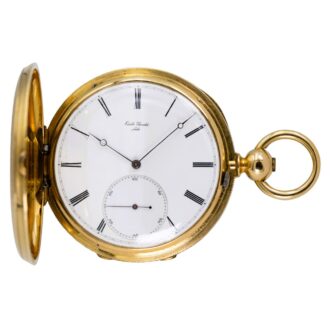
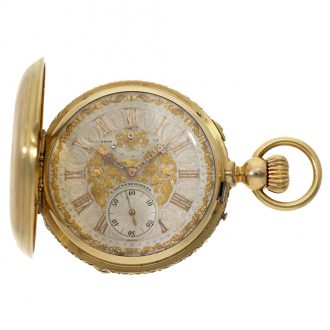
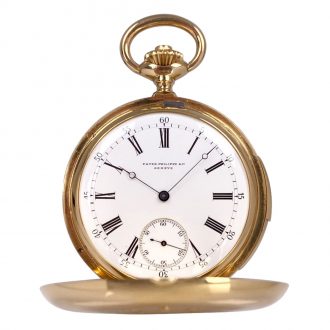
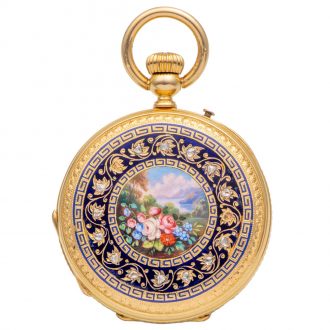
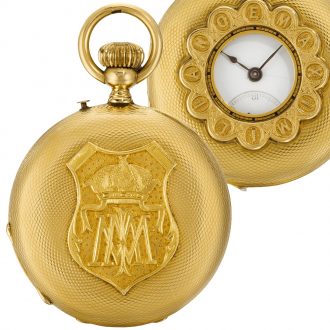
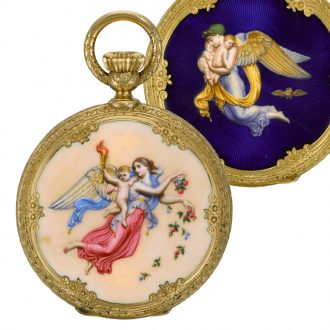
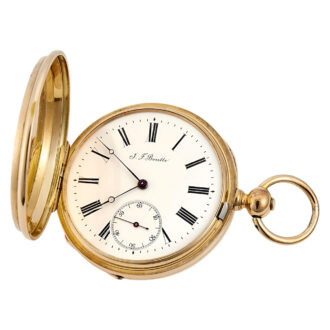
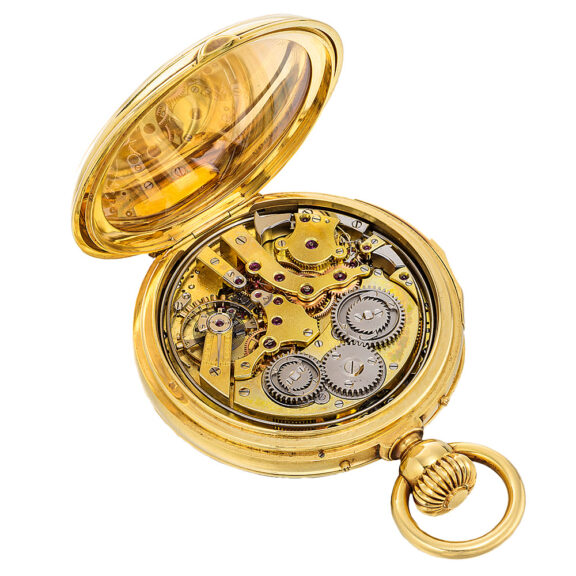
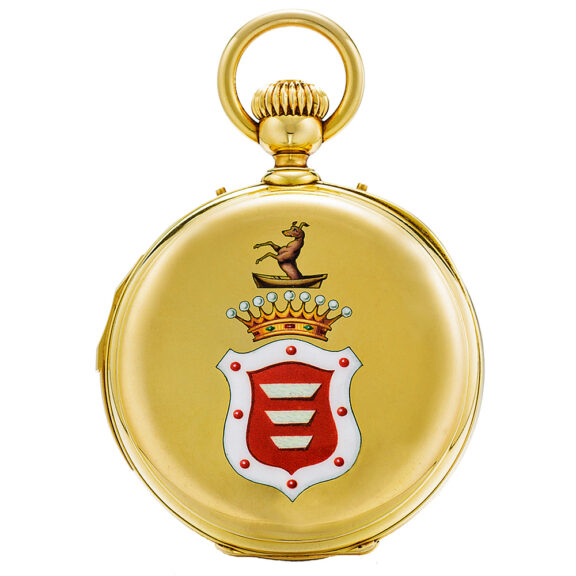
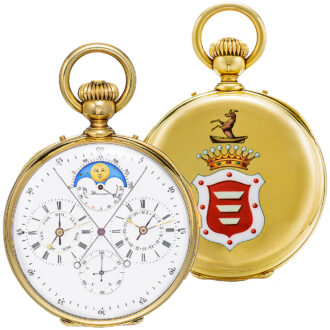
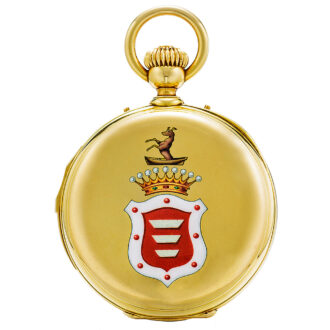
A gilded brass movement with two going barrels, a gold train of wheels, straight-line equilibrated lever escapement, compensated balance with gold and platinum poising screws and blued steel hairspring with a terminal curve. The dial is white enamel with Roman hours, an outer minutes/seconds track with Arabic five-minute/second numerals, split-seconds hands and subsidiary dials. The round-shaped case with a polychrome enamelled coat of arms of Count Augustin (or Augustyn) Branicki on the back. Dial, case and movement signed. Accompanied by copies of biographical articles.
–
Diameter: 52.5 mm
–
Signed: Le Roy & Fils
–
The quality of execution of this timepiece, its serial number, No. 9 294, and similar models allow it to be attributed to Louis Audemars, Le Brassus, Vallée de Joux, Switzerland. However, it should be noted that the production papers of the present watch are unfortunately no longer present in the Historical Archives of Louis Audemars, now kept by Mr Paul Audemars in England. The watch is similar to the Louis Audemars No. 10 517, illustrated and described in Hartmut Zantke’s, ‘Louis-Benjamin Audemars, His Life and Work’ (2003, pp. 262-263). The latter, No. 10 517, was sold by Antiquorum in Geneva, auction April 24, 2004, lot 159, for CHF 146 500.
Another Louis Audemars watch is fitted with the same type of horological complications, namely No. 11 820, but with the addition of a perpetual calendar. This watch was also retailed by L. Leroy & Cie in Paris and in 1920 presented by King Alphonse XII of Spain (1886-1941) to Count Vicente Santamaria de Paredes (1853-1924). The latter, No. 11 820, was sold by Antiquorum in Geneva, auction May 10, 2015, lot 159, for CHF 351 750.
A further watch of this type is known, retailed by Charles Oudin in Paris, No. 32 440, with the indication of the moon but without a thermometer. The latter was sold by Antiquorum in Geneva, auction October 21, 1995, lot 572. At the time it was made, this kind of watch is recorded in the archives of Louis Audemars in the register of ‘Montres supérieures’ (Superior watches). Examining this watch, one cannot help admiring the ingenuity and variety of the design and the attention paid to the details. The finish of the escapement with its equidistant pallets and the undercut of the escape wheel to make it lighter but still stable, the polish of the steel, the arrangement of the quadrature (the work under the dial) are on a par with the best horological work done. A single push-piece in the crown operates the dédoublante of the split dead independent seconds. The first push brings both chronograph hands together and starts the dead seconds with both hands, the second stops one of the hands and the third push stops the split seconds hand.
–
Sylvain Mairet (1805-1890).
–
François-Xavier Branicki de Korczak (Franciszek Ksawery Branicki in Polish) was born on October 26th, 1816 in Warsaw, Poland and died November 20th, 1879 in Assiut, Khedivate of Egypt. Count Xavier Branicki was a Polish nobleman, political exile and landowner who took French nationality. He became a political writer, financier, art collector and philanthropist. Branicki was the owner and restorer of the Château de Montrésor and estate (Touraine) in France. He was descended from a powerful magnate family with immense land holdings in the Duchy of Lithuania and Ukraine, partly as a result, it is said, of a family connection with Catherine the Great. He was a member of the close circle of Napoléon III. He was a co-founder of the Crédit Foncier de France, a bank that continues to this day. He married Pélagie (Pelagia) Cécile Eve Zamoyska but remains without legitimate descent. However, he has several biological children, including Augustin (Xavier Vadislas Constantin Augustyn), born on April 19th, 1854 in Paris and died in 1905, as the son of Sydonia Szumlaska Revitiski. He was acknowledged by his father but will not have good relations with him. Xavier was a diplomat and spouse in 1876. Xavier Branicki was, in his time, one of the richest men in France. Following an accidental death during a cruise in Egypt, his nephew Ksawery Wladyslaw inherited his fortune and the Montrésor Castle without legitimate posterity.
Signed: Le Roy & Fils
Share this page: